Author Archives: Joseph Shupac
thegeographicinvestor.com
How to stop me from changing the channel during regular season hockey games

Like many Canadians, hockey and basketball are the two sports I watch most. Though I enjoy both equally – and in the playoffs, probably even prefer hockey a bit – I generally watch a lot more regular season basketball than hockey. I suspect this is true for many hockey+basketball fans, especially in the United States, and perhaps also among younger generations of fans in Toronto.
With this in mind, here are a few regular season rule changes that would prevent me from changing the channel during hockey games. I’m not saying the NHL should make any of these changes. (Except for the first one, which the NHL should definitely make. No more shootouts!). But if it did, I’d watch more:
- Obviously, 2nd OT > Shootout
The league must know this already, which leads me to suspect that maybe the players are wary of having to work more/risk injury more during additional regular season overtimes. If that is the reason why we don’t have 2nd OTs yet, there’s a simple fix: in the 2nd OT, no players from 1st OT will be allowed to play. This means there is no extra workload or injury risk for top-line players. Instead, third or fourth liners who don’t usually get to play in OT will have a chance to shine. - Blowout the Goalie: If a team is down by 4 goals in the 3rd period, they must pull their goalie to attempt a comeback (and risk an even bigger blowout)
If I flip over to the Leaf game and one of the teams is up by 4, I usually change the channel. Especially if it’s in the 3rd period. But if the trailing team had to pull their goalie in this situation, I would keep watching. I’d watch to see if they could get closer to making a comeback, but even if that comeback attempt failed miserably I might still keep watching just to see how many goals – on both sides – would take place. - The Final Four: 4-on-4 hockey played in the final few minutes of the 3rd period (beginning after the first stoppage of play that occurs during the final four minutes of the game)
We don’t get to see enough 4-on-4 hockey these days, ever since OT switched to 3-on-3. But 4-on-4 hockey is great to watch, and if it took place during the final few minutes of the game it would lead to more scoring attempts in crunch time. It would probably get me to keep watching even when one of the teams is up by a few goals late in the game, because I’d want to see how the 4-on-4 shakes out before assuming the game is won or lost. And when the game is tied late in the third period, it would help to counteract the trend of teams playing conservatively in order to send the game to overtime and so receive at least a point in the standings for an OT loss - Video-Review Ref Clock: the refs get no more than 30 seconds of video review time to decide on a call. The clock starts ticking as soon as the play stops.
If a team is still unhappy with the call after that relatively quick video review, they can then use their coach’s challenge if they wish. And the risk of people changing the channel during a video review and then getting sucked into watching something else as a result would go way down. The video-review might even become interesting, since you’d get to watch the refs sweat it out.. - If a short-handed goal is scored, the penalty ends
I’ve enjoyed watching teams (especially the Leafs) become more aggressive in trying to score short-handed goals in recent years, even at the risk of giving up more power play scoring chances as a result. This rule change would further incentivize short-handed risk-taking, especially early on in the penalty kill.
NBA-style Hockey
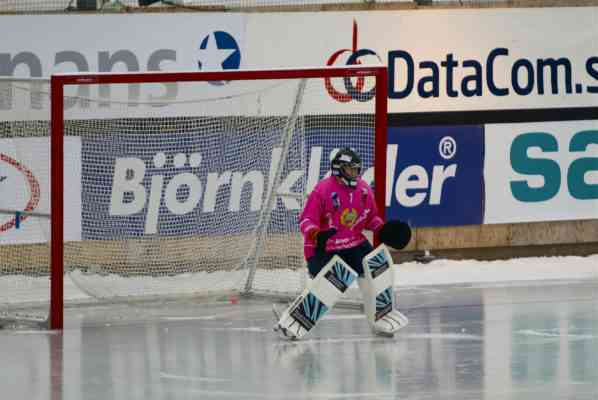
NBA teams score about 40 field goals per game on average, not counting free throws. NHL teams score about 3 goals per game on average. Per minute of play, the number of field goals in an NBA game is about 16.5 times higher than the number of goals in an NHL game. An NHL team would need to score about 50 goals in a game to equalize those figures.
The basketball-inspired alternative version of hockey I’m about to describe probably won’t have 50 goals per team per game, but it will have a lot more than 3. Its purpose however is not just to maximize scoring opportunities. Even more than that, it is meant to increase the number of highlight-reel saves.
In the NHL, despite the fact that the skill level and consistency of goalies is spectacular, there are not actually many individual saves that are highlight-reel worthy. (Broadcasters pretend otherwise though, hyping every save that looks even remotely impressive because they want to make the game seem as exciting as possible and want to give goalies their due). It’s hard to have lots of highlight-reel saves when the goalies are so big compared to the size of the nets.
The rules of basketball-style hockey are meant, in part, to amend this. Partly this is achieved by increasing the size of the net (see image below), and by playing 4 on 4. But it is also achieved by using a point-incentive system that is a tiny bit similar to basketball’s. In this system, you will get 1 point for scoring a goal when either you or a teammate of yours has at least one skate inside of your opponent’s goal-crease. (The goal creases, like the nets, will also be much bigger than in normal hockey). But you will get 2 points for a goal scored when neither you nor any of your teammates have a skate inside your opponent’s crease.
As a result, you are incentivized to at least sometimes attempt shots in which the goalie will have a relatively unobstructed or undeflected chance at making a save. Each save, however, will be more difficult because of the bigger size of the nets.


Whereas in basketball shot difficulty tends to increase the further away from the net you get, in hockey the crucial factor determining shot difficulty is the amount of traffic in front of the net. This point system reflects that. Just as basketball’s point system incentivizes taking more shots further away than you otherwise would, basketball-style hockey’s point system incentivizes taking more unobstructed shots than you otherwise would. 4 on 4 will also lead to more unobstructed shots. Together, and combined with the larger nets, this will lead to many more goals and many more great saves than in normal hockey.
The full rules of basketball-style hockey include the following:
- The net and the goal crease are both much bigger than in normal hockey
- You get 2 points for goal scored when neither you nor any of your teammates are standing in the goalie crease. You get 1 point for a goal scored when you or one of your teammates was in the crease
- The game is played 4-on-4
- Play doesn’t stop when a goal is scored or when a goalie makes a save. Rather the goalie gets five seconds to throw or pass the puck back into play after a goal or a save. Opposing players cannot enter the goalie crease during these 5 seconds. Failure to get the puck back in within 5 second results in a faceoff in the goalie’s own zone
- Power plays are 2 minutes long, and unlike normal hockey they do not end when a goal is scored
- Defensive players can get called for 3-in-the-key (3-in-the-crease) violations, so they cannot do this
- OT is 4-on-4, first team to 2 points wins
- 1 point for any goal scored on an empty net (when the goalie is pulled)
- Goalies can wear gloves on both hands without carrying a goalie stick (bandy-style) or they can use a goalie stick (hockey-style). They can switch back and forth between the two at will during the game, by putting stick down on top of the net at any time, or by switching gloves during stoppages of play
- Play will not be stopped for video-review to determine if the goal was worth 2 or 1. If it turns out the initial call was wrong regarding if a player had a skate in the crease when the goal occurred, the score will be amended during the next stoppage of play. If this happens at the very end of the game the play will be stopped for a review, but hopefully in basketball-style hockey the refs will get the video-review over with more quickly than they do in basketball itself.
- Basketball-style hockey can be played on ice or roller blades or as floor hockey, with a puck or a ball
Alternative 2nd Overtime Ideas for NHL Regular Season Games

Everyone who watches hockey knows that a second overtime period would be much better than the shootout. But the NHL hasn’t gone for this yet, perhaps because it worries that fans still like the shootout, or perhaps because the players don’t want additional overtime periods that would increase their workload and risk of injury.
If either of these are the reason why we still have shootouts instead of second overtimes, then here are a few alternative ideas that might overcome these objections:
- No players who played in 1st OT are allowed to play in the 2nd OT
The top-line players who play in OT would now not have to worry about working more or getting injured in a 2nd OT. Instead, the third and fourth line players, who otherwise rarely get a chance to play in OT, would get a chance to shine.
- Lower the minimum number of shooters in the shootout from 3 to 1
A one-shooter minimum shootout would be over more quickly, which is a good thing because the shootout is anti-climactic and relatively boring. It would also be more exciting, since it would put more pressure on the shooter and make each shot attempt more important. - Finally, and perhaps the most gimmicky, but nevertheless my favourite: have the goalie wear gloves on both hands, and not carry a goalie stick, in 2nd OT.
This is what bandy and field hockey goalies do. It too would tend to make the game end more quickly, and would probably lead to more highlight-reel saves
Game On: Road Traffic as Enemy #1 During Covid

One of the ironies of the truck protests in Ottawa is that they helped show that socially vibrant outdoor gatherings and activities can take place, even in very cold weather, so long as streets are at least partially shut off from car traffic. The protests also provided yet another illustration of the reality that large, loud vehicles and frustrated drivers tend to make city life worse than it needs to be, especially for people who are elderly, disabled, sick, or poor. In many cases, these are the same people who have been hurt most by Covid-19.
It is an interesting thought experiment to wonder what the pandemic would have been like if we had focused on making our streets as socially and commercially dynamic as possible, by (for example) turning our parking lots and parking lanes and city centres into patios and pedestrian-friendly areas and playgrounds and playing fields and skating rinks and bike lanes and transit lanes and outdoor vaccination clinics. Presumably, our small businesses would have performed better as a result, and our social, mental, and physical health would have too. There might have been fewer risks from Covid. There might even have been fewer protests against vaccine or mask mandates.
With this in mind, here is a list of 10 ways in which our overuse of oversized automobiles may have made the pandemic worse than it otherwise could have been:
- They take up most of our public outdoor space
- They take up most of our sunny outdoor space in winter, autumn, and spring
Sunny ways! The cars get them, but relatively few sidewalks, patios, and bike lanes do. If you are, say, an elderly person trying to walk outside in the winter, you will often find that there is no sidewalk at all on the dry, sunny, north side of residential streets, and that you instead must walk on the icy, snowy, shady south side. (Assuming there is even a sidewalk at all, which in many, many cases there is not). Sometimes even crossing the street to get to the sunnier side will be difficult, because of the combination of ice, snowbanks, and cars. And even when you get there, the sunny sidewalk is often too narrow, even on main streets, with not always enough room to avoid the texting-while-walking younger generations.
Restaurant, cafe, and in some cases even gym owners who would have liked to offer a sunny outdoor option during the pandemic, perhaps even being willing to invest in a large, space-heated, semi-enclosed patio, similarly found that in many cases the only patio space available to them was stuck in the shade for most of the day. During the winter, they were often not given any street space at all. Meanwhile, adjacent parking lanes are frequently lined with cars lying like cats in the sun, even in restaurant-filled city centres.
At the very least, a time-share system in which pedestrians are given more sunny space during the daytime during the colder seasons, and parked cars are given space at night or in shade, could be an improvement over the car-dominant status quo, particularly during a pandemic when indoor activities are limited. - They help cause Covid co-morbidities, and other health problems
Cities built around cars and traffic jams tend have less healthy populations than cities built around walking, transit, and cycling. In car-oriented cities people are more likely to lead relatively sedentary lifestyles, experience stress if they are regular rush hour commuters or if they live on busy streets, and inhale air pollution. Also, because traffic jams can make going anywhere slow and expensive, the health of poorer populations in particular can also become more likely to suffer from local food deserts, in which healthy food is scarce. The correlation, for example, between obesity, car dependence in urban and suburban areas, and vulnerability to Covid appears to have been high. - Life-years lost to road traffic deaths have gone up a lot during Covid, and are a major global crisis in their own right
Covid deaths worldwide are estimated at around 6 million since the pandemic began. This might be an undercount: by looking instead at excess mortality estimates, which might be more relevant and accurate, the death toll of the pandemic could be somewhere between 12-24 million. During the same period, nearly 3 million people are estimated to have died in road accidents. However because road accidents often claim the lives of youths, whereas Covid tends to spare young people and target elderly or infirm people, the number of “life-years” lost to road accidents is probably not all that far behind those lost to Covid. They might, perhaps, even be greater than those lost to Covid. Worse still, Covid appears to have led the number of road accident deaths worldwide to rise.
In the United States, approximately 39,000-40,000 people per year died in car accidents in 2020 and 2021, the highest numbers in any year since 2007. (Road deaths in the US had however already been rising gradually since about 2014, which suggests that reckless driving during Covid lockdowns was not the only reason for the recent increase in road deaths). Road accidents are the leading cause of death for young Americans (and Canadians) above the age of about 5. Covid excess deaths in the US per year during the pandemic are estimated at 438,000. But here too it is possible, because such a large majority of Covid deaths were of older people, that the number of life-years that Covid and car crashes robbed Americans of during the pandemic were not so far apart.
In countries like the United States and Russia (the two countries with the most excess deaths from Covid in absolute terms) and in Canada as well, Covid cases and car crashes both also tend to peak in winter, sending people to overworked hospitals at the same time. In Canada, excess mortality from Covid has been about 7000-7500 per year during the pandemic, while road accidents kill approximately 2000-3000 Canadians per year. In other words, because we in Canada have done better than most in limiting Covid deaths, but not in preventing road deaths, it is likely that we have lost more life-years to car accidents than to Covid during the pandemic.
Poorer countries not surprisingly tend to suffer the worst loss of life, and of life-years, from road accidents, despite having many fewer cars per capita than rich countries. This is the result of bad roads, bad driving practices, bad weather, younger populations, and more motorbikes and pedestrians. In some countries, most notably Brazil (3rd in excess Covid deaths behind the US and Russia, and 3rd in road accident deaths behind India and China), both Covid and cars have taken a terrible toll. In others, such as in Africa and (for different reasons) Northeast Asia, the loss of life from Covid has tended to be far less than from road accidents. - Traffic jams add to supply-chain delays and inflation
Truckers and commuters waste time and fuel in traffic. Because most goods travel by truck and most workers travel by car, this helps contribute to supply-chain delays and inflation. More directly, inflation in car prices, and in rental-car prices, was particularly high during the pandemic, in part because commuters and travellers switched from transit and airplanes to cars and car rentals. - Social isolation of elderly populations
Traffic makes it more difficult or expensive for seniors to walk, drive, take the bus, or take a taxi (or Uber, etc.). Taking an Uber, for example, becomes more expensive and time-consuming for elderly people not only because the car itself becomes stuck in traffic, but also because young people are in many cases pushing up the price of Uber by using the app so much themselves. Yet when a young person uses Uber, it is often because they are lazy, or rich, or drunk, or going on a trip (in many cases all of those things at the same time). Whereas when an elderly person uses Uber, it is more often for something important, like going for a medical appointment or visiting family, and it is more often because walking, cycling, or riding transit is difficult for them. - Access to health care
Doctors and nurses and eldercare workers and people going to get their vaccine booster shots also get caught in traffic jams. Many nurses and eldercare workers also have to take the bus to get to work. And since buses have tended to remain fairly crowded during the pandemic (unlike trains, which have seen most their riders work from home), this means that traffic jams leave them stuck for a longer amount of time on an often unpleasant vehicle where they might catch or spread Covid, on their way to or from a difficult job where they might catch or spread Covid.
Health care is also one of the major energy-intensive, greenhouse gas-emitting, polluting industries, though because it is so important it is not usually discussed as being such. So (as is more frequently discussed) is the auto industry. This means that, indirectly, the use of cars can push up the cost of health care to a certain extent, by way of energy prices. It also means that cars and health care can both contribute to climate change and various forms of pollution. - Access to childcare
Child care is labour-intensive, and therefore traffic-haunted. Children, parents, teachers, and Covid substitute teachers all commute during rush hour, often travelling far distances to do so. This was especially difficult to do when, in some cases during the pandemic, schools were open but carpools and school buses were being avoided. Extra-curricular activities, such as organized sports, also involve a lot of hours on the road, often in traffic jams. - Local air and noise pollution
Greenhouse gas emissions fell in 2020 because of pandemic lockdowns, but local air pollution in many cases did not, as people continued driving locally and as there was a rise in dirty delivery trucks and in indoor or backyard wood-fires. Noise pollution too remained high during the pandemic, from cars and trucks and from a rise in the number of homes being constructed or renovated. Noise pollution may also have been somewhat more impactful for people who were working from home or trying to socialize outdoors, particularly for people who live on busy streets. - Class inequality, within countries and between countries
Wealthier people often create traffic by driving or frequently using Uber or Amazon, yet have also tended to have the luxury of avoiding traffic by working from home or from cottages. Poorer people meanwhile often cannot avoid getting stuck in traffic, either on buses or as pedestrians, bike couriers, Uber drivers or deliverymen, or as regular commuters using their own cars. They also pay a higher price for gasoline because of the enormous amounts of fuel that wealthier people use. Because oil prices tend to be relatively similar across the globe (far more so than natural gas or electricity, for example), this is often true on an international level as well: more fuel use in rich countries can mean more expensive fuel for poorer countries. It also means more carbon emissions for poorer, climate-threatened countries to worry about.
This of course does not mean that rich people and rich countries are bad, but it does mean that during the pandemic, which was already worsening class inequalities (in Covid deaths, in working from home options, in the quality of homes to be locked down in, in the availability of vaccines and health care, etc.) it would have been better to avoid the needless immense waste that rich countries and people create through, among other things, their daily use of big automobiles. That includes as well the oversized electric cars and car companies that the richest countries and richest people have been increasingly buying or investing in during the pandemic.
You might be thinking that all of those ten examples are really just saying the same thing over and over – that too much road traffic is unnecessary, and bad, and especially bad when other things are bad too, like Covid, or infirmity, or poverty. Yes, I think that’s probably about right.
The Warmly Behatted Bike-in-a-Box, for Winter Outdoors
The bike-in-a-box is a way to stay warm, fit, and social in cold outdoor weather, in a way that doesn’t waste energy. It’s a little bit like a one-person portable sauna (see ridiculous pictures below), except that it’s not actually a sauna, and it can be used by more than one person at a time.
The idea is this: you put one or more stationary recumbent bikes inside an insulated box, with a hole on top of the box for your head (your warmly behatted head) to peep out of. Ideally the bikes also have heated seats, so that you’ll be warm when you first sit down, before you’ve had a chance to heat up from pedalling. The insulated box will trap most of the heat given off from the seats (and from your body), and will also act as a wind-breaker on windy days.


If the box is placed in a sunny area during the daytime, that will obviously provide a source of heat as well. You could also place the box near a fire, or heat the box from within, for example by using a space heater. Once you’ve warmed up from pedalling, you can then reduce these additional sources of heat in order to save on your use of electricity or fuel (or in the case of backyard wood-fires, to reduce your smoke inhalation and contribution to urban air pollution).
Another source of heat for the bike-in-a-box can come by way of hot drinks and hot food. The box will come with a hatch for hot food and drinks to be stored in, so that your food and drinks can stay warm inside of the insulated box while, at the same time, they will also be providing extra heat to the box. (I haven’t quite figured out how to get the food from the box to your mouth yet, but we’ll cross that bridge when we come to it…)
In theory, the bikes could also be attached to a pedal-powered heat pump to provide additional heat to the box.
The bike-in-a-box can therefore be a social and physical activity,
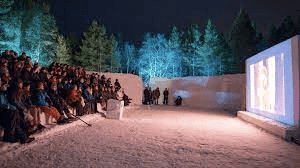
allowing you and your friends to eat and drink outside in cold weather, perhaps in front of a small fire under the stars in the countryside, or perhaps while watching sports or a movie on a big outdoor screen in your backyard in the city. (You won’t be bothering your neighbours nearly as much as you would on a warm night, when windows are open and they might be outside too). You might also bike-race your friends virtually, or even play pedal-based video games with your friends, on that same big outdoor screen.

If you use a recumbent or semi-recumbent bicycle or tricycle during the warmer part of the year, you could also put it on a bike trainer stand in the winter in order to temporarily turn it into a stationary bike in a box for the season. If you do this, you would then also have the option of taking your bike or trike out of the box, in order to use it indoors as well during the winter:

In the summer, the box could double as a backyard storage shed, for your summer sports or garden equipment (etc.) that you might store in your garage during the winter.

Sure, it may look absurd to sit outside with your head sticking out of a box. But it’s also a way of getting fresh air and exercise and having fun in the winter, particularly for seniors who might, for example, be worried about going to the gym because of a winter pandemic surge, or be worried about jogging outside on icy roads. And it’s a great excuse for watching tv guilt-free.

Archway Bikeways (with low-ceiling outer lanes)

For every 10 men over 65 years old in Canada, there are nearly 12 women over 65 years old. For every 10 men over 85 years old, there are roughly 20 women over 85 years old. This is true of most countries, more or less. Combined with the fact that older people tend to get shorter as they age, this means (among other things) that senior citizens, and especially older senior citizens, are on average much shorter than younger adults are. The average height of an adult in Canada is 5″7 (5″10 for men and 5″4 for women); the average height of a Canadian over 85 years old is probably 5″2 or 5″3.
Seniors, and children, also tend to be much more vulnerable to traffic than adults in general are. This includes not just auto traffic, but also a vulnerability to bikes in busy bike lanes, e-bikes, e-biking food couriers, e-scooter-wielding teenagers and tourists, etc. etc.
Seniors also tend to be less reckless on the road than younger people, particularly younger men. Men for example are much more likely to bike while drunk, and bike recklessly in general. Men are also heavier than women, so the impact they have when they do crash into a fellow cyclist or pedestrian tends to be greater than would be for a woman, child, or senior citizen.

Seniors and disabled cyclists also tend to use recumbent or semi-recumbent tricycles more often than adults in general do. (Though because of SUVs and trucks and road traffic in general, these recumbents are sadly not used very much on city streets). These recumbent bikes are obviously much shorter in height than conventional adult bikes are too.
I think you can perhaps see where I’m going with this. If we are going to turn our cities into much more bike-friendly places than they have been thus far, and especially if we are going to build higher-speed bike and e-bike expressways, then we also need ways of allowing the most vulnerable populations to bike without facing too many dangers and discomforts, like they currently do in our car-dominated cities.
The simplest way to do this is to create multi-lane bike paths, in which the outer lanes will tend to have lower speeds than the inner lanes. An additional feature that might be useful, however, is archway-bridge underpasses, in which the outer lanes of the underpass have lower ceilings than the inner lanes:

If the outer lane had a ceiling that was, say, only 7 feet tall, that might be short enough to nudge taller riders into using the more spacious inner lanes of the bike path, and so free up the outer lane for use by children, seniors, and recumbent bike or wheelchair users.
If the outer lane ceiling was only 5 feet tall, that would certainly do the trick, although it might also raise the risk of a taller rider accidentally using that lane and bumping their head…

Bikeways with archway underpasses and children-friendly low-ceiling outer lanes might be particularly useful in the developing world, where there are still lots of children, lots of bicycles and motorbikes, and, sadly, lots of road accidents, road traffic, and air and noise pollution. But it might also be increasingly useful in the rich world, where populations are aging, bike and e-bike ridership is rising, and car dependence (and in North America, obesity) is extremely high.

Wall Ball, Target, and Rainforest (The New Brick and Mortar American Sports)

North America’s mega-parking lots make cities hotter and, in many cases, more prone to flooding than they would otherwise be. By incentivizing car usage, they may also make cities more prone to traffic jams, air and noise pollution, and road accidents. And they are becoming emptier now than ever before, even during holiday shopping seasons, thanks to online shopping alternatives.
It is likely that companies like Walmart will redevelop parts of their parking lots in the years ahead, turning them into land for housing, more commercial real estate, or even parks and playgrounds and playing fields.


With that in mind, here are three new simple sports that could be played on redeveloped parking lot playing fields. For now, they exist only in dreams. If Walmart and Target build them, customers will come…


Wall Ball is an American variant of soccer. It can be played on a football field, or a basketball court, or a floor-hockey rink, etc. Goals are scored by kicking or heading a soccer ball or through a raised hole in a wall. 1 point is awarded for a header goal, 2 points for a normal goal, and 3 points for a goal scored from behind a three-point line.
The sport is obviously a bit of a blend between soccer and basketball. It is more like soccer because you cannot use your hands at all, but it is also like basketball in that there are no goalies, the hole in the wall is raised about ten feet in the air and generates rebounds on missed shots, and goals are worth either 1, 2, or 3 points. (There is also a ‘no three-seconds in the key’ rule, but, as in basketball, it will be violated frequently but called rarely). Unlike basketball, there is no backcourt violation rule.
There will tend to be much more scoring in a Wall Ball game than in a conventional football game, because low scoring games are un-American. The strategies teams employ may resemble basketball’s too. You might, for example, try to place a dominant big man in front of the net to score header goals. You might fill the floor with 3 point shooters to create spacing. Or you might create some midrange magic by finding a sort-of Lionel Messi-Chris Paul hybrid type of player. Flick-ups and bicycle kicks will both be very useful in Wall Ball.
The size of the wall, the size and height of the hole in the wall, and the number of players per team can differ from venue to venue. If playing on a basketball court, you can of course just use the existing 3 point line. The wall is allowed to be as big as the entire baseline, or it can be far smaller than that. There can also be some floor space in between the baseline and the wall, to lessen the risk of players getting hit into the wall.
For anyone who wants to play or practice the sport at home, or on the wall of their neighbourhood school, a circle can simply be drawn on a wall, or a hula hoop can be placed on a wall, or a quidditch-style raised hoop can be used, etc. You can also play it with a dodgeball-style ball, which will be easier to hit high in the air and won’t hurt as much when the ball hits you in the head.
Finally, for extra corporate shameless marketing, Walmart can use Wall Ball in its ongoing expansion into China, since China is a country that loves soccer, basketball, and walls.
2.

Target is another variant of soccer. It can be played in parking lots, as well as in baseball or cricket stadiums. In Target, a fairly large bell sits atop a roughly 12-foot-high pole in the middle of a circular field, and players score goals by hitting a soccer ball into the bell, without using their hands.
Lines in concentric circles are drawn on the field. A goal scored from the innermost circle is worth 1 point. From the next circle out is worth 2 points. Then 3 points, then 4 points. A 5-point outer circle may also be added in, for larger fields.
If an opposing players’ shot deflects off of you and hits the bell, it is their goal, not yours. If however you purposefully hit an opposing players’ shot out of the air and directly into the bell, it is your goal.
You do not have to ‘clear the ball back out’ (to use a term from pickup basketball) upon intercepting the ball from the opposing team. You can immediately take the ball and attempt to score a goal yourself.
After a goal is scored, the opposing team gains possession of the ball. They start with the ball in the 4-point circle.
Overtime is sudden death, college-football-style. For example, if your team has the ball first and scores a 2 point goal, the other team then gets the ball and must score either a 2 point goal (to go on to a second OT round) or a more than 2 point goal (to win)
The other specifics – penalties, free kicks, the number of players per team, substitutions, the dimensions of each point zone and the field as a whole, the height and size and shape of the bell, etc. – can differ from venue to venue.

3.
Rainforest

Rainforest is an opportunity for companies like Walmart to undo at least a little bit of the damage to cities and natural environments they have caused, while at the same time to defend themselves a bit from the threat that they and cities and natural environments each now face from Amazon. It is a sport in which the playing field can double either as a partially-forested park, or as a tree-shaded parking lot.

As is the case with golf courses, the design of Rainforest fields can differ almost entirely from course to course, and can incorporate natural features such as wooded areas, and even water. Unlike golf, Rainforest fields can be environmentally positive rather than hugely negative. They can also provide the players – at least in part – with shade and shelter, so that it can be played in almost any weather in cities with hot summers or heavy rains.
The sport itself is another variant of soccer, though its fields could also be used to play variants of sports like ultimate frisbee, hockey, lacrosse, capture the flag, or bicycle racing. It is played with traditional soccer nets and goalies and rules, and with teams switching sides at halftime. For any fans watching the game, cameras can be placed on the trees so that the game can be followed even when the action moves in to the more densely wooded areas of the field.
Just as Wall Ball could expand into the soccer and basketball loving Chinese market, and Target into the cricket and soccer loving Anglo and Indian markets, Rainforest could be well-suited for tropical, soccer-loving countries like Brazil.
Bellringer (an alternative version of soccer, for cricket grounds and baseball stadiums)

There are 11 sports stadiums in the world with a capacity of over 100,000, according to Wikipedia. Eight of these are American college football stadiums. Two, including the largest stadium of all, are cricket grounds. Narendra Modi Stadium in Gujarat, India can seat up to 132,000 fans as of 2020. The Melbourne Cricket Ground in Australia can seat about 100,000 fans. (The other 100,000-plus-capacity stadium, the second largest in the world, is in Pyongyang, North Korea, built during Kim Il Sung’s reign in 1989).
![The Biggest Stadiums in the World Based on Capacity [Quick Facts]](https://i0.wp.com/www.travelandsports.com.au/wp-content/uploads/2017/02/5175326-3x2-940x627.jpg)
In the US, the largest cricket ground is in Fort Lauderdale, Florida, with a capacity of 20,000. But with the South Asian and Caribbean communities growing, there are ambitious plans for more American cricket grounds to be built. The US Major League Cricket league is expected to debut in 2023, initially with six teams. In addition to building new venues, there are also plans to turn a 6,000-fan-capacity baseball stadium in Dallas (previously used by the defunct Texas AirHogs baseball team) into a cricket venue. In California, there are plans to build a 15,000-fan-capacity cricket stadium in Santa Clara.

Here, then, is another sport that you could play in a cricket stadium:

Rules of Bellringer:
– A bell sits atop a 12-foot-high pole in the middle of a circular field
– Players on both teams score goals by hitting the bell with a soccer ball
– No player can touch the ball with their hands
– The field is made up of concentric circles. A goal scored from the innermost circle is worth 1 point. From the next circle out is worth 2 points. Then 3 points, etc. etc.
– If an opposing players’ shot deflects off of you and hits the bell, it is their goal, not yours. If however you purposefully hit an opposing players’ shot out of the air and directly into the bell, it is your goal.
– You do not have to ‘clear the ball back out’ (to use a term from pickup basketball) upon intercepting the ball from the opposing team. You can immediately take the ball and attempt to score a goal yourself
– After a goal is scored, the opposing team gains possession of the ball. They start with the ball in the 4-point circle
– Overtime is sudden death, college-football-style. For example, if your team has the ball first and scores a 2 point goal, the other team then gets the ball and must score either a 2 point goal (to go on to a second OT round) or a >2 point goal (to win)
– The other specifics – penalties, free kicks, the number of players per team, substitutions, the dimensions of each point zone and the field as a whole, the height and size and shape of the bell, etc. – can be decided upon by each Bellringer league
You can also play ultimate frisbee bellringer, or (with the proper rollerblading surface) rollerblade ultimate frisbee bellringer. You can also suspend the bell from the ceiling on a really, really long rope, instead of putting it on top of a pole.
High Kick

The Rules of High Kick:
- Teams receive 2 points for scoring the ball (a soccer ball) through an upright goal, and 3 points for scoring the ball from behind the 3-point line
- No players are allowed to touch the ball with their hands, except for goalies
- The upright goal is defended by a trampoline-goalie, who uses a goalie-only trampoline located in his or her team’s end zone. The goalie is allowed to leave the end zone (High Kick’s version of ‘pulling your goalie’), but no players other than the goalie are allowed into the end zone, with the exception of offence-only ‘High Kickers’
- The offence-only High Kickers must remain in their team’s offensive-zone end zone at all times, and are only allowed to touch the ball when they are airborne. If the ball touches the ground in the end zone, it is an out-of-bounds
- In the 1st Quarter of the game, there are no High Kickers playing. In the 2nd Quarter, there is one High Kicker per team, who is allowed to move back and forth between the three High Kicker trampolines. In the 3rd Quarter, there are two High Kickers, who are allowed to move back and forth between trampolines. And in the 4th Quarter, all three High Kickers play.
- Teams receive 1 point when a High Kicker scores a goal. (High Kickers, in addition to being able to score 1 point airborne goals, are also very useful in obstructing the goalie’s vision in order to make it easier for teammates to score 2 and 3 point goals).
- Teams also receive 1 point for hitting any part of the goal post, including the pole that holds up the goal. (For example, if you fake a shot to get the goalie to jump in the air, you can then score a 1-point goal by sniping the goal post below the airborne goalie).
- Overtime is first-goal-wins, but no High Kickers are allowed to play in it, and the goal cannot be a 1-pointer
- Penalties result in hockey-style power plays
- Free kicks and corner kicks are soccer-style
- Each quarter is 15 minutes long. 5 minute breaks between quarters, 20 minute halftime break, for a total of ∼1.5 hours.
- Trampoline-goalies are allowed to ‘run’ up the pole that holds up the upright goal as they jump, but are not allowed to hang from or sit on the goal post in order to stay up in the air longer than gravity allows
- For reasons of safety, High Kickers are not allowed to stand next to the goalie-only trampoline, and the goalie is not allowed to stand next to the High Kicker trampolines. The end zone as a whole is separated from the rest of the playing field by a short (perhaps 1-foot-high), soft barrier
- Also for reasons of safety, the goal post may be well-padded
- Players, including trampoliners, can make player substitutions ‘on the fly’, hockey-style, as well as during stoppages of play. Players are also allowed to swap positions: a player is allowed to be a goalie, a High Kicker, and a normal player all in a single game
- Coaches have one timeout and one coach’s challenge per game. Commercials and advertisements are not allowed
- The dimensions of the field, and the height and diameter of the goal posts, and the number of players allowed on the field at a given time, are allowed to differ from one venue to the next. Let a thousand flowers bloom. Within reason. (No actual flowers are allowed on the playing field..)
- If playing on a smaller field – futsal-style High Kick – the game is allowed to be played without any High Kickers, or with only a single High Kicker. In futsal-style High Kick, header goals are worth 1 point
- In Major League High Kick, all of the league’s team rosters simultaneously reset every seven years: all new rosters are drafted, in one big league-wide fantasy-style draft. This takes place either in Las Vegas or Vatican City
- Finally, most importantly, when a fan catches a ball, they get to keep it
 Future Economics
