Japan from 1995 to 2035

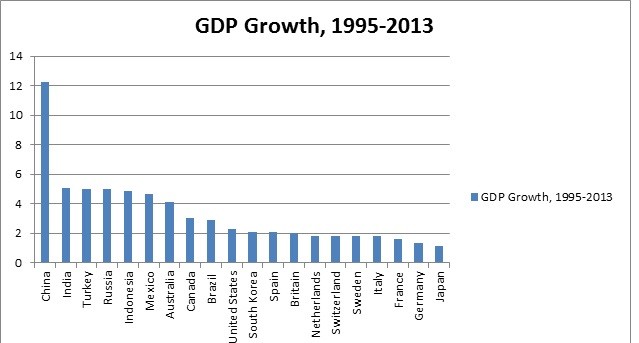
The graph below shows the world’s 20 largest economies, and how many times larger they are today than they were in 1995. As you can see, Japan grew the slowest of the countries on the list. Though it is still the world’s third largest economy, close to double the size of fourth-place Germany and more than half as large as second-place China, its economy is barely larger than it was in 1995. During that same span, China’s economy is believed to have grown more than twelve-fold.
gdp


How did this happen?

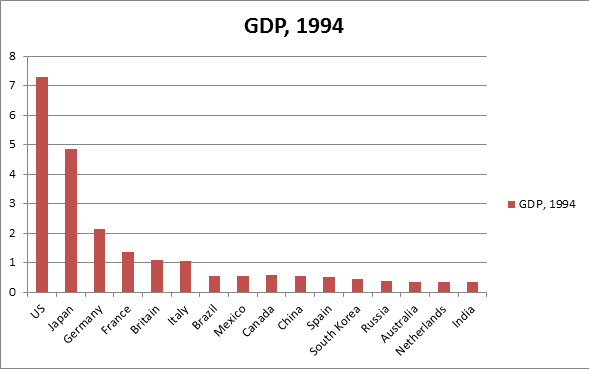
Japan was all over America’s radar in the early 1990’s. As you can see from the graph below, Japan’s gdp is thought to have been 66% as large as the US’s in 1994. By comparison, even China’s gdp today is only thought to be 52% of the US’s. At the same time, there were no other obvious candidates to attract American attention back in the 1990s; Germany was inwardly focused on reabsorbing East Germany, while China’s economy was only the 10th largest in the world and Russia was in its post-Cold War disarray.
gdp 4


Many Americans at the time worried that Japanese businesses were out-competing their own, and as a result called on their government to reduce some of the benefits that the United States had provided Japan during the Cold War. This attention was probably not the best thing for Japan; indeed, it may not be a complete coincidence that the Japanese stock and real estate markets collapsed during 1990, the year after the Berlin Wall came down.

The most famous “Japanophobic” film: Rising Sun (1993), starring Wesley Snipes and Sean Connery


Japan’s gdp per capita in 1995 was 1.4 times higher than the United States, the next richest major economy. It was 4 times that of neighbouring South Korea. Having such a nominally wealthy population may have made it difficult for Japan to compete with other developed countries, much less with developing ones.

gdp 4

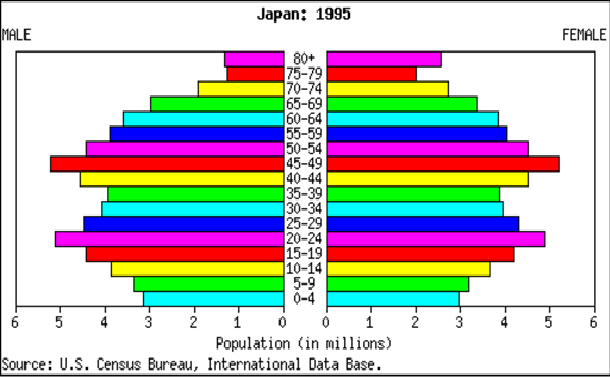
Most of Japan’s baby boom generation reached the age of 50 in the late 1990’s, and began saving more for their eventual retirement.  This meant that there was less private consumption to stimulate Japanese gdp.  By comparison, the boomers in the US and Europe in 1995 were only in their mid-30’s, and in China they were in their mid-20’s. Japan’s second largest generation, meanwhile, was entering their mid-to-late 20’s during the 1990’s, meaning that Japan’s labour force was not growing at the same speed as it had through the 1980’s when this generation was graduating from high school and college.
gdp 4

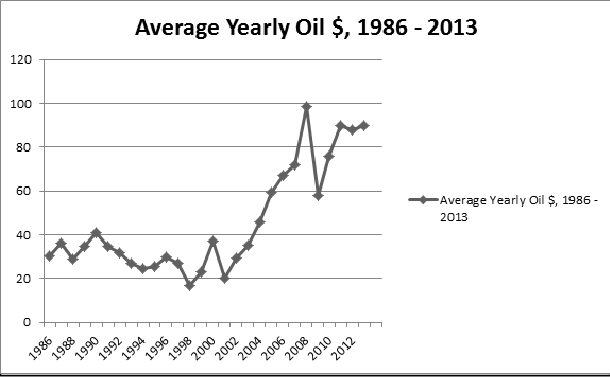
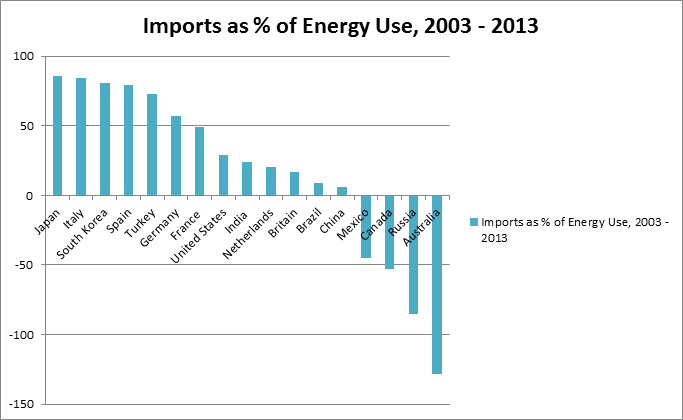
Between 1997 and 2007 the price of energy shot way up, reaching all-time monthly highs even when adjusted for inflation. Despite dipping somewhat during the recession in 2008, prices have stayed very high by historical standards during the past five years. Japan, though it uses its energy more efficiently than most countries, is also one of the most dependent upon imports for its energy consumption. As a result, the high prices of the past decade have helped limit its economy’s ability to grow.
gdp 4

gdp 4

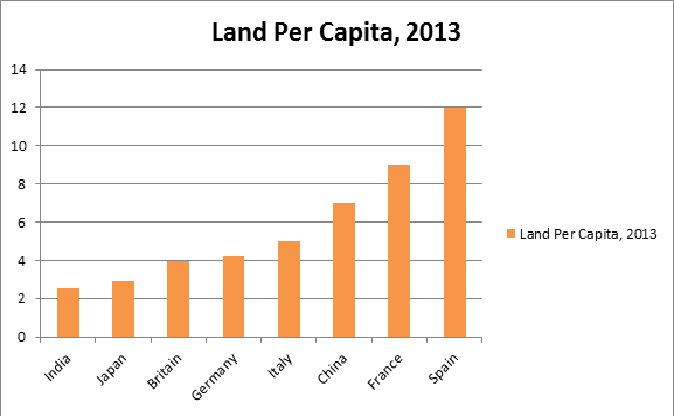
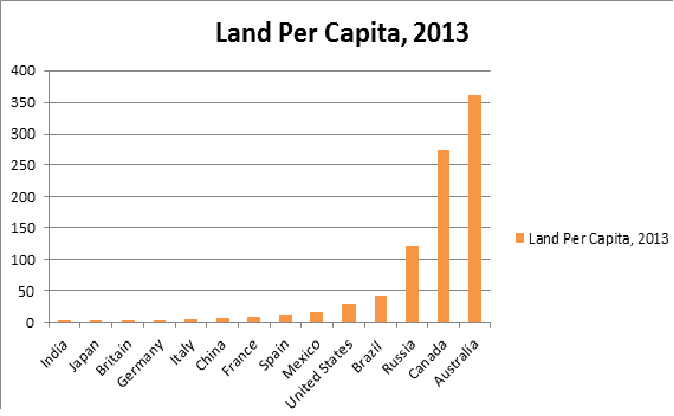
Japan is not only dependent on importing energy, but also most other natural resources. It is the world’s largest importer of tin, and the second largest importer of iron ore, copper, aluminum, nickel, silver, and coffee. Using land as a (admittedly limited) proxy for natural resource wealth, the graph below shows how Japan compares poorly with other major economies on a per capita basis.
gdp 4

And zooming in on this graph:

gdp 4

Japan’s small amount of land and resources relative to the size of its population probably played a role in its poor economic performance in the past two decades, as this period saw global mineral and food prices rise rapidly.

Finally, Japan is one of the most equal countries in the world in terms of income distribution, and has one of the lowest unemployment rates. Arguably, Japan’s gdp grew less than it could have because the country was more focused on pursuing social welfare goals like employment and income equality.


What’s next for Japan?

Obviously, Japan is no longer attracting too much American attention: that honour now goes to China. Japan’s development costs may also no longer so much higher than those of other developed countries.  Japan now has a per capita gdp that is around 87% as high as Germany’s and France’s, 74% as high as that of the United States’ and Canada’s, and just 59% as high as Australia’s.

However, Japan’s population is still the oldest in the world, and it is older than ever. Japan’s baby boomers are now 65 – 70 years old on average; given that the average effective age of retirement in Japan is 69, they may soon retire en masse. Meanwhile, the second largest generation in Japan today is 40 – 45 years old on average, meaning that their levels of consumption may decline as they enter their 50’s and 60’s over the next fifteen years. It is perhaps worth mentioning here that not only did Japan’s financial crash in the early 1990’s occurred when its baby boomers were approaching age 50, but that the US and Europe’s crises of 2007-2008 occurred as American and European baby boomers were approaching age 50.

Fortunately, Japan does have the highest NIIP in the world. (NIIP = Net International Investment Position; which is basically the amount of money a country’s government, businesses, and people are owed after you take into account the amount of money they owe to other countries). In fact, as recently as 2010, Japan’s NIIP was roughly that of China and Germany, the world’s next two largest creditors, combined. Japan also has the highest life expectancy of any country in the world, at 84.6 years – compared, for example, to 80 for the US. And Japan is also frequently listed as having the highest standard of life among major economies, if such ratings are to be believed.

That being said, Japan’s population is aging so rapidly that it is not clear whether either of these things will be sufficient to allow it to remain economically competitive in the years ahead.  In addition, the huge amount of money that Japan is owed by other countries can only be used if those countries are able to pay it back; something that does not always happen so easily, as Germany has learnt in recent years. To be fair, much of the money owed to Japan is invested in the United States, which is unlikely to turn into Greece anytime soon. Still, you can never be too sure.

Japan also continues to be highly dependent on imports for its energy consumption, particularly since the tsunami-induced nuclear meltdown it experienced in 2011. 95 percent of Japanese energy comes from imported fuels, compared to only 15 percent for the US and 10 percent for China. Japanese electricity prices are more than double those of the United States, and higher than all major European countries apart from Germany. This could make it relatively difficult for Japan to use machines to help supplement its aging workforce.

One obvious way to deal with an aging population is through immigration. This is not, however, something that Japan is accustomed to doing.  Japan has one of the smallest foreign-born populations in the developed world. Moreover, unlike English, Spanish, Portuguese, and French, there are no large and poor populations in the world who speak Japanese that Japan can recruit. The Japanese diaspora is only about 2.5 million strong, 1.2 million of which live in the US and probably aren’t looking to move to Japan, and 1.5 million of which live in Brazil, which is about as a far away from Japan as you can get. Some countries, like Sweden, Denmark, and the Netherlands, deal with a similar problem by using English to speak to some of their immigrants. However, Japan is also the worst at speaking English among nearly all developed countries in the world. Plus, Japan’s population density is also still extremely high, so the country may have an especially difficult time growing its population further through immigration.

Of course, none of this means that Japan will definitely not open its doors to mass immigration – it has a high standard of living to attract prospective immigrants, and it has historically proven that it can undergo dramatic cultural and economic changes in a very short period of time. That being said, Japan will probably find it many times harder to solve its demographic problems through immigration than, for example, Canada will when it eventually faces the same kind of rapid aging that Japan is on the verge of.

If immigration and automation cannot get the job done in the short time frame Japan faces before its population reaches old age, this might only leave outsourcing as a solution to its demographic problems. There are 1.3 billion Chinese people living within a relatively short distance of Japan that it could potentially outsource to. However, Japan is unlikely to rely on China for too much of its outsourcing needs, for five reasons.

First, Japan is unlikely to decide to become too dependent on China given that it knows China might become powerful enough to dominate it at some point in the future.Second, China still resents Japan for its brutal occupation of much of its territory during the 1930’s and 1940’s. Third, Japan is already extremely dependent on China; 26% of Japanese imports came from China in 2013, compared to only 11% from Japan’s next largest trade partner, the United States. No country wants to be too dependent on any other single country, so Japan will not want its dependence on China to increase much more than it already is.

Fourth, Japan does not want to be too dependent on China because the Chinese economy is potentially unstable, having become accustomed to rapid growth that may now be unsustainable. Finally, Japan will not outsource too much to China because Chinese labour is no longer so cheap to employ. China’s average income is now $6000, and in coastal provinces that Japan can access most easily it averages around $10,000. By comparison, average incomes in nearby Vietnam are only $1700, Cambodia $950, Indonesia $3600, the Philippines $2600, North Korea $1200, India $1500, and Bangladesh and Burma $900.

Thus, Japan will probably look to Southeast Asia or even India for most of its future outsourcing needs. This could help it to overcome its demographic challenges, while also serving as a boon for the poor countries receiving Japanese investment. However, it will also mean that Japan will have to be increasingly active in regional affairs, driving hard bargains when it comes to crafting economic agreements with the countries and businesses it outsources to. In addition, Japan will continue to rely heavily on Southeast Asia, the Middle East, and/or Pacific Russia for its energy and mineral needs for at least the foreseeable future. As a result, Japan could once again become an extremely active player throughout much of Asia, looking to gain access to both cheap labour and natural resources.

How might this affect its relations with other regional powers, particularly China and the United States but also South Korea, Australia, Thailand, Indonesia, India, Taiwan, and Russia? Will Japan be able to maintain healthy relationships with all of these states, or will it be tempted to move closer to some and further away from others? And can Japan’s economy come through its demographic changes intact, perhaps even serving as a model for other Western countries whose own Boomers will reach their seventies during the 2020s and 2030s? We will find out soon enough.
China’s North-South Split

It would be impossible to understand the United States without knowing a bit about the differences between northeastern states like Massachusetts and southeastern states like Mississippi. To an even greater extent, a similar thing can be said of China. There are many things that make northeastern and southeastern China very different from one another. Now that China has become the second largest economy in the world, it is probably important that we learn some basic facts about these differences.

Let’s start with the geographic differences first, before moving on to economics and politics:

Topography      

Topographic-map-of-China-2005

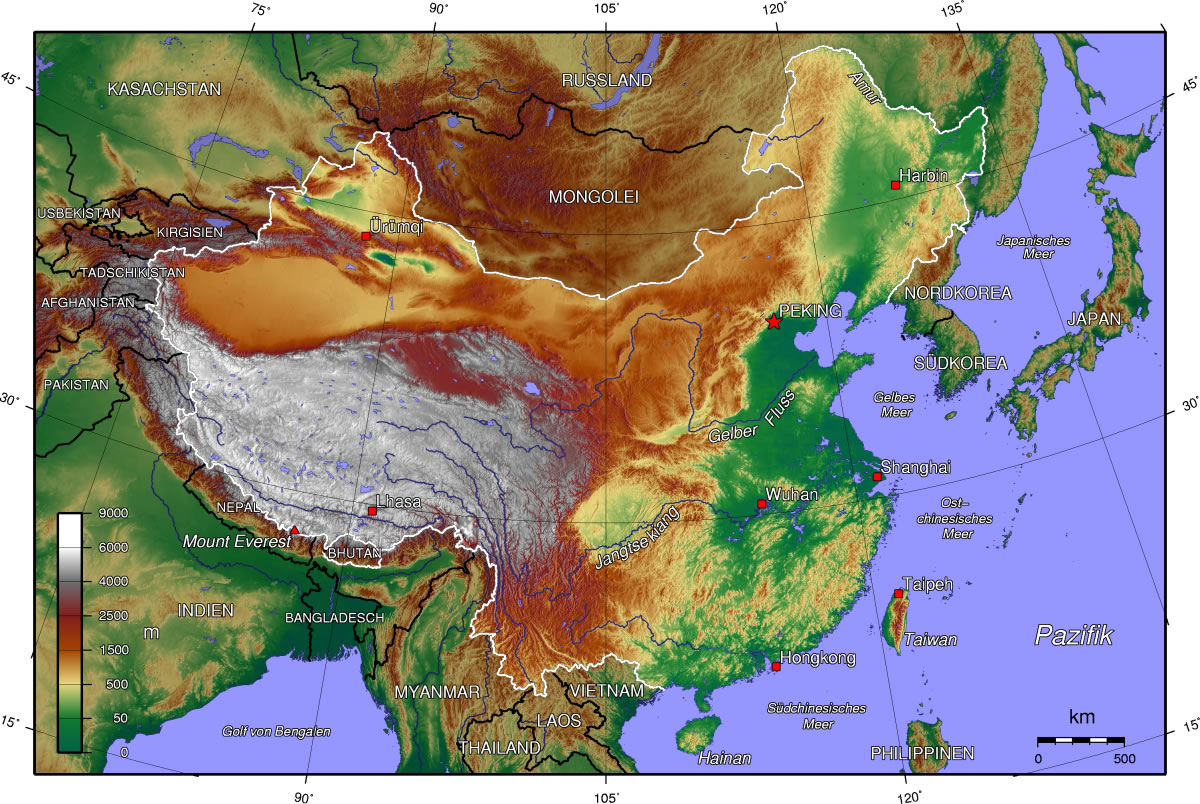
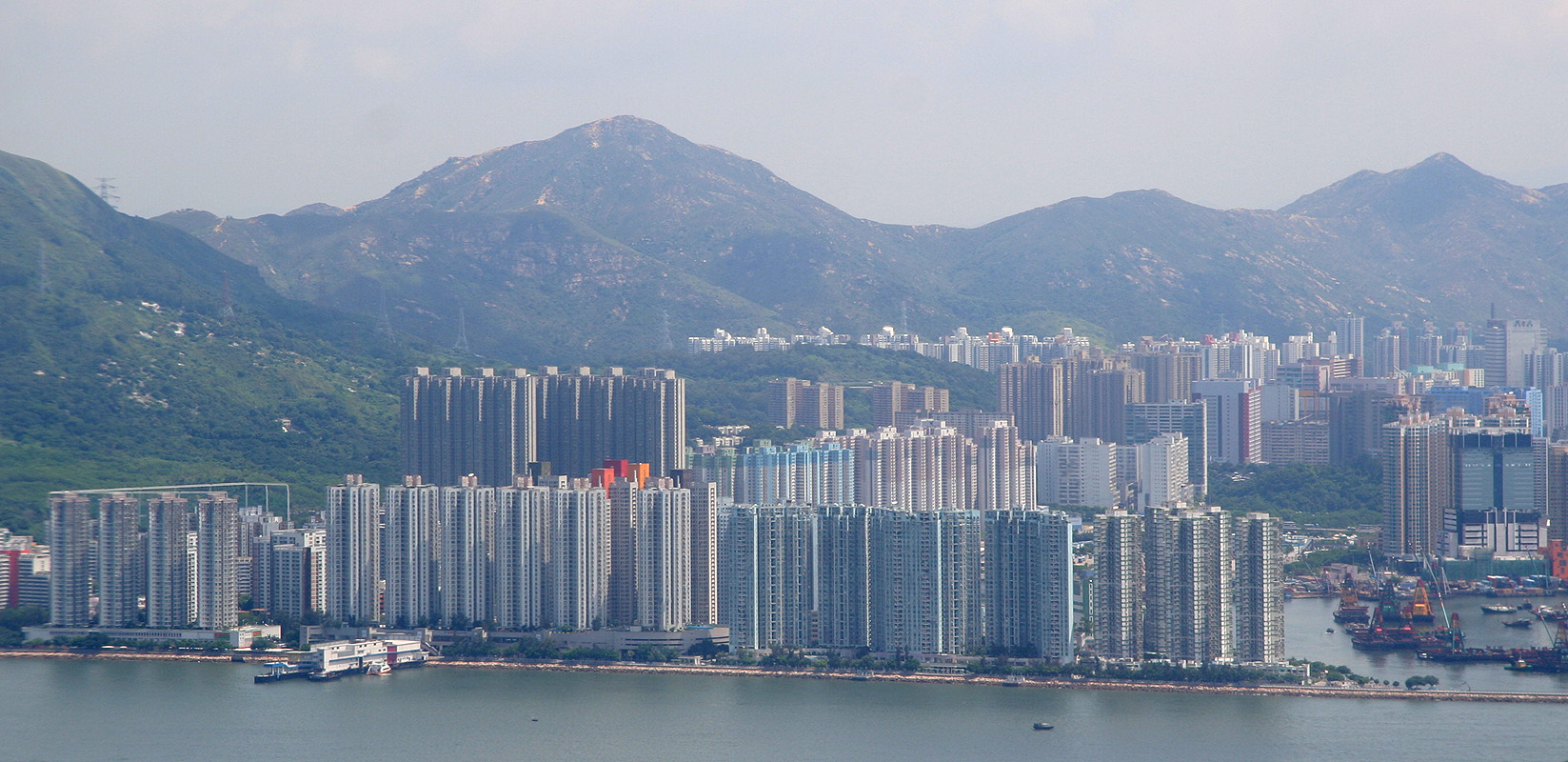
As you can see from the map above, northeastern China contains two large plains, one located immediately to the west of the Pacific Ocean and one  immediately north of the Pacific Ocean. In contrast, southern China is comprised almost entirely of hills and mountains, which in most places extend as close as 1-50 km to the Pacific. This picture below of the southeastern city of Hong Kong, for instance, shows that much of its population lives in high-rise apartments that are sandwiched between mountains and the sea.

5241-hongkong

Rainfall

aa

Southeastern China receives roughly three times as much rainfall as  the coastal areas of northeastern China, and between three and twenty times as much rainfall as areas within a few hundred km inland of the coast of northeastern China.

Forests       

aaaa

Southeastern China is covered in many places by forests, whereas northeastern China, with the exception of the areas near the border with North Korea  and Russia (which are home to only around 15 million people), is not.

Agriculture     

aaaaaa

In spite of China’s rapid industrialization, the country still relies on agriculture for around 10% of its economic output and 37% of its employment. As you can see from the map above, southeastern China primarily produces rice and tea, while northeastern China produces wheat, corn, millet, sorghum, cotton, and soybeans.

Pollution 

aaaaaaa

aaaaaaaaa

Northeastern China, in part because it is where most of the country’s coal is produced, is generally much more polluted than southeastern China.

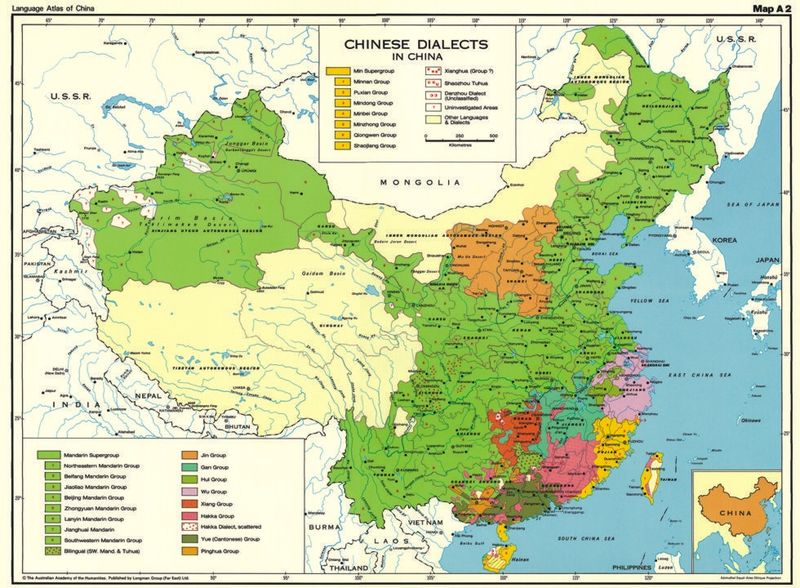
Language  

aaaaaaaaa

Languages and dialects are always complicated to pin down, making graphs that depict them over-simplistic in most cases. That being said, it is probably not a stretch to say that China’s regional linguistic divisions are in many cases quite substantial. Speakers of a southern Chinese dialect would not necessarily be able to converse with speakers of a northern one, for example. The map above shows that southeastern China has much more linguistic diversity than northeastern China, and less of a linguistic connection with China as a whole. The map also shows that the southeastern province of Fujian shares a linguistic connection with neighbouring Taiwan.

Ethnic Minorities     

aaaaaaaaaaaaaa

(Note: just because a place is coloured in on this map, does not mean that it is majority non-Chinese, but only that it is home to a relatively large concentration of non-Chinese. In fact,  as of 2000,  only the far western provinces of Xinjiang and Tibet were thought to be majority non-Chinese).

The map above does not show this, but the ethnic minorities in southeastern China have a combined population that is approximately four times larger than those of northeastern China. There is also much more ethnic diversity in southeastern China, as the map does show.

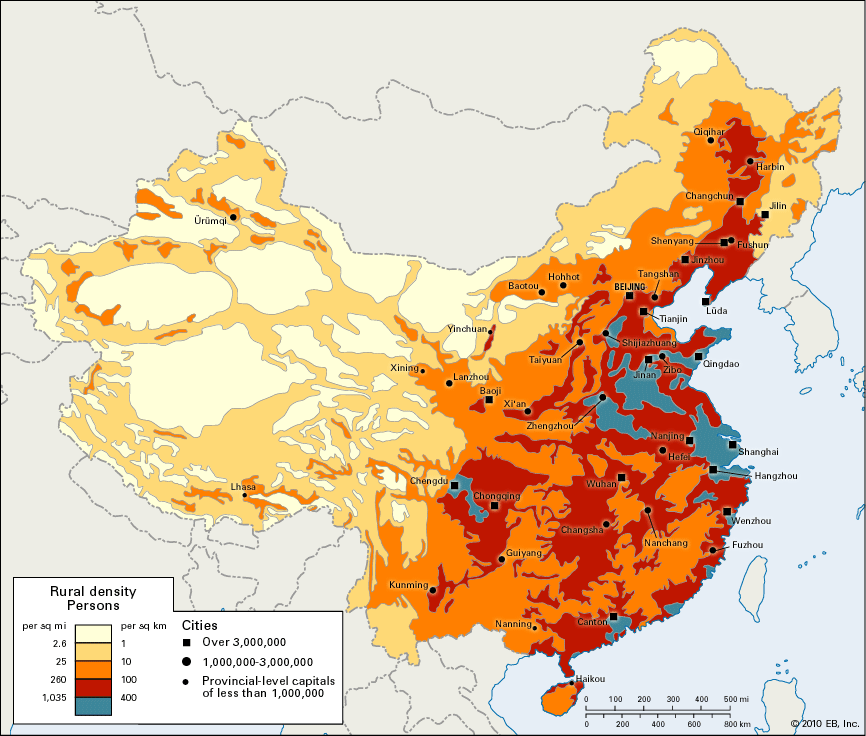
Population Density      

aaaaaaaaaaaaaa

(Keep in mind that this is China: even the orange areas of this map have population densities greater than that of the United States).

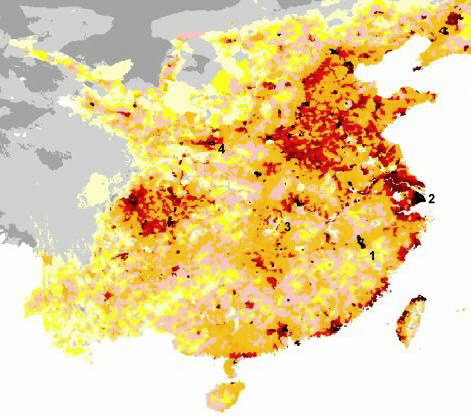
This map reveals several differences between northeastern and southeastern China. First, it shows that northeastern China’s population density is generally much higher than southeastern China’s. Second, it shows that northeastern China’s population is clustered together, whereas southeastern China’s is spread out relatively thinly in enclaves along its Pacific coast. Third, it shows that northeastern China’s highest density areas are located a few hundred km inland, while southeastern China’s high density areas are beside the sea.

Here’s a slightly more detailed map of China’s population density, which really shows this northeast-southeast difference:

China_density-pop

Politics      

Hong Kong, one of the largest cities in southern China and one of China’s two major financial centres, was a British territory until the late 1990’s. Taiwan, an island 180 km off the coast of southeastern China, has effectively been independent since the mid-twentieth century.

Today, of the 43 members of the three leading political offices in China (the Politburo of the Communist Party of China, the Secretariat of the Communist Party, and the Central Military Commission), only two were born in southern China. Of the Politburo Standing Committee (the seven-man group which is generally considered to be the top leadership of China), only one person – who is the lowest-ranked of the seven – was born in southern China. And not one person in any of those groups was born in the southern province of Guangdong, which neighbours Hong Kong and is China’s largest province both by population size and  economic output. Finally, nobody born in Southeastern China or Southwestern China has ever become the ruling General Secretary of the  Communist Party of China or the Premier of the People’s Republic of China.

History   

This interactive map of Chinese history – http://www.timemaps.com/history/china-1500bc – describes some of the historical fault lines between northern and southern China; for example, during the 6th and 13th centuries AD and prior to the 3rd century BC.

Also not shown in this map are the different experiences northern and southern China went through when confronted with foreign powers in the 19th century. To give a simplified summary of what happened during that era, parts of southern and central China were roughly divided into Japanese, British, and French spheres of influence (with Germany, the US, and other European states also influential in certain areas), whereas northern China was by comparison left as a relatively independent state.

During the Xinhai Revolution which overthrew the last emperor of China just prior to WW1, meanwhile, it was the southern provinces where most of the earliest and most influential rebellions took place. In fact, the critical diplomatic moment of that revolution was at an international conference called the North-South Conference. Later, the Northern Expedition from 1926 – 1928 was one of the largest military campaigns in China in the first half of the twentieth century, and it reflected north-south divisions within China as well.

In the decades after that, a number of southern Chinese provinces would also play arguably the most important role in the original rising of the Communists in China against the ruling Nationalists, during the Chinese Civil War from 1927 – 1950. Finally, when the tables turned against the Nationalists in the civil war, they fled to the southeastern Chinese island of Taiwan, where they continue to govern today. Taiwan has become one of the 25 largest economies in the world, and it has particularly close commercial and social ties to mainland China’s southeastern provinces.

Economics

If you visit this interactive webpage that the Economist magazine has made – http://www.economist.com/content/chinese_equivalents – you can see a number of interesting things. First, that Hong Kong, in southeastern China, has a per capita gdp that is far higher than that of any other significant Chinese city; more than double those of Beijing or Shanghai, six times the national average, and more than 11 times that of China’s poorest province. Second, that apart from coastal areas like Guangdong, Fujian, and the city of Hong Kong, southeastern China is actually the poorest area in China, home to four of the five poorest provinces. And yet, the coastal provinces of southeastern China are for the most part just as rich as the coastal provinces of northeastern China. In fact, Taiwan, which lies off the coast of southeastern China and speaks a southeastern Chinese dialect, has a per capita income that is between 3 – 10 times greater than those of China’s provinces.

Finally, you can see that the coastal areas of southeastern and central-eastern China are much, much more dependent upon exports than other parts of China are.

Religion 

Parts of Southeastern China in recent years seem to have joined Hong Kong in becoming one of the main centres of China’s potentially enormous transition toward Christianity. Today, according to the Economist, arguably more than 100 million people in China are Christian, up from perhaps as few as 15 million as recently as the 1990’s. If these numbers are accurate, then the growth of Christianity within China during the past two decades represents one of the largest religious adoptions in all of human history. Hong Kong has long had a significant Christian population, meanwhile, and remains around 10-15 percent Christian today. A number of the Hong Kong protest organizers were practicing Christians, in fact. And, notably, the Chinese government may have begun to crack down on parts of this growing Christian religion within China during the past year or so.

Energy 

The vast majority of Chinese energy production is located in the north, in provinces like Shanxi and Inner Mongolia, which produce nearly all of China’s coal (and coal accounts for about 70% of Chinese energy use), and in provinces like Xinjiang and Heilongjiang, and Liaoning, which produce nearly all of China’s oil (and China is the world’s 5th largest oil producer).

Northern China also accounts for most of China’s natural gas production (7th largest in the world), natural gas imports (which come overland from Central Asia; China is the world’s 10th largest gas importer), and recoverable shale gas reserves (thought to be the world’s largest). Northern China also directly borders and has a relatively close relationship with North Korea, which has the world’s 17th highest production of coal and 2nd highest production of anthracite coal (which is the most desirable type of coal, though it only accounts for an estimated 1 percent of global coal reserves).

Southeastern and central-eastern China, in contrast, accounts for most of China’s oil imports from other countries (and China is the world’s 2nd largest oil importer), most of China’s liquified natural gas imports (5th largest in the world), most of China’s nuclear power production (5th largest in the world), most of China’s hydroelectric power (by far the largest in the world), and, in the southwestern province of Tibet, the most potential hydroelectric power in the world.

Military    

http://ytilaerniereh.files.wordpress.com/2010/08/china_ground_force_units_2008.jpg

According to the map above, which was made by the US Department of Defense, of the 19 major ground force units of China’s People’s Liberation Army, 6 of the 9 not to have primary missions that are defensive are the 6 that are located the furthest in southeast.  5 of the 6 that have amphibious primary missions are located in the southeast. 4 of the 5 to have mobile units are located in northern China. A 2012 Pentagon report also claims that “consistent with a near-term focus on Taiwan Strait contingencies, China bases many of its most advanced systems in the military regions opposite Taiwan”, in southeastern China.

Recent Articles:

2019 Year in Review: GDP Growth 

Modi’s in Luck Now

Too Much Heaven: A Brief Look Back at 1979  

A Demographic Overview of the World 

Guest Post: The Universal Spider

Everyone for Tennis?

Transit Oases

The Birthplaces of China’s Leadership

Argentina in 2019

Countries to Watch: El Salvador

Internal Chinese Geopolitics, part 1

The Geopolitics of Saudi Arabia

Morocco the Outlier 

Like Night and Day

North Korea and the Olympics Curse

Don’t Discount Reunification

North Korea in the Next Five Years

Trump and the Turks

Eurozone Geopolitics (and the Future of “Czechia”)

Spanish Economics: Past, Present, and Future

Ontario: The Borderland Economy

In Politics, the Triple Crown is Even More Elusive

Geopolitics in Canada

Examining China’s M&A Boom

The Canadian Election

Geopolitics within China

Political Dynasties and their Discontents

Secession Procession

Should Hockey Fans Be Keynesians? 

Guest Post: Babbit, by Sinclair Lewis

Peace and Prosperity in Israel’s Future?

A Look Back At Barack Obama’s Foreign Policy

Presidential Beginnings and Regionalism in America

Trolleytrucks + Autonomous Cargo Handling = Clean, Cheap Transportation

Fasten Your Snowbelts: Technology and the Great Lakes

Guest Post: Political Turnover in the United States 

Labour Strikes in China

Passing Gas: 10 Winners and Losers of the Panama Canal Expansion

Seniors Discount? Oil Prices and Old Rulers

US Politics: The Real Swing State

The Other Greek Economy

The Provincials

Northeast Asian Trade

Forest and Farm 

Geopolitics in Iraq

Islands of the Pacific

The Return of the Atlantic

Europe’s Mountain Lands

Germany at a Crossroads 

Satellite Geopolitics in Eastern Europe

Canada Goes to Vote! 

US Politics: Unique New York

Turkish-Russian Geopolitics

Why Iraq is Still So Important

The Day After Tomorrow, in Morocco

Europe and Arabia: A Geopolitical Perspective

China’s Hidden Regionacracy

Legal US Immigration

Russia, Turkey, and Greece: Clash of “Civilizations” 

Motor Vehicle Production

Capital Idea

5 Challenges for Canada’s Economy in 2015

New Website: Investors Aloud

America’s Domestic Environmental Geopolitics

10 Consequences of US-Iranian Reengagement

Why Israel Won’t Let the West Bank Go 

The Geopolitics of Ukraine 

Iran’s Weakening Position

 Greek and Mediterranean Islands

Estonia in 2015: Energy, the Euro, and Elections

Germany’s Trade Empire

The 10 Largest Relative Trade Networks 

The PIPEs are Calling?

New Jersey: The Densest State

China’s North-South Split

The Not-So-Tiny Baltics

Now That’s A Basin!

Regional Canadian Politics 

Why Iraq?

America and Argentina

The Uncertain Future of Bulgaria

Turkish-Israeli Geopolitics

Japan from 1995 to 2035

What if Syria Fragments

10 Myths About the Global Economy

You Didn’t Build That

Germany’s Trade Empire

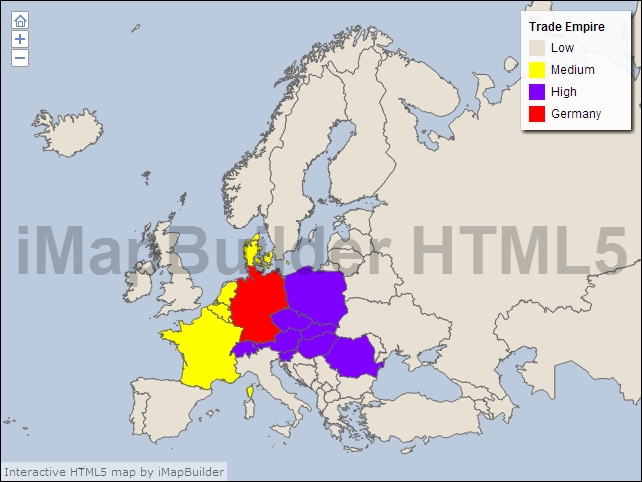
The age of formal European empires may be over, but that does not mean that nations no longer possess meaningful spheres of influence. Germany in particular retains an impressive trading empire in the heart of the European continent. This “empire” exists in spite of the fact that Germany’s economy accounts for less than 20% of Europe’s overall economic output. To varying degrees, it encompasses Austria, Switzerland, Poland, Romania, the Czech Republic, Slovakia, Hungary, and Slovenia, forming a geographically contiguous region with a population of 185 million and an economic output of about $5.5 trillion.

France, the Netherlands, Belgium, and Denmark could be said to fall within this sphere as well, albeit to a lesser extent, adding to it another 100 million people with an economic output of $4 trillion. To put these numbers into context, the United States has a population of 315 million, and China has an economic output (at least officially) of $9 trillion.

germany

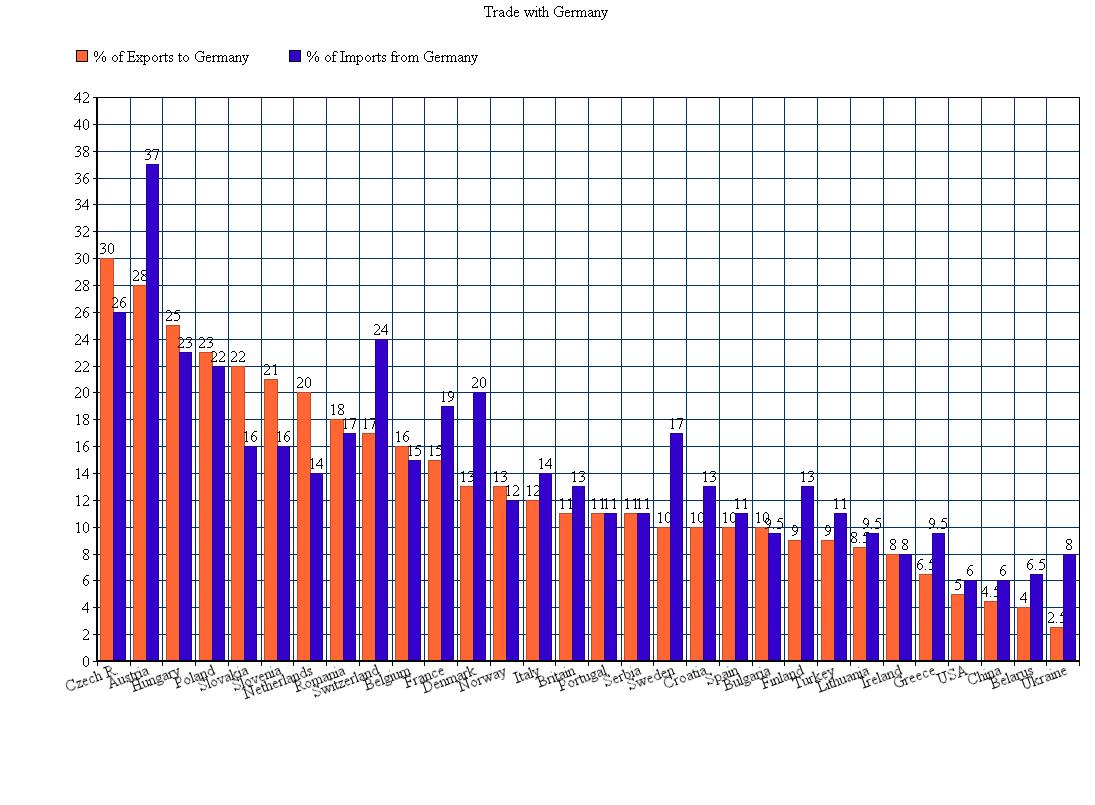
The statistics behind this trading sphere are rather impressive, considering that most of the countries within it only began trading seriously with Germany during the last two decades, following the end of the Cold War. The Central and Eastern European countries within the sphere rely on Germany for an average of 28 percent of their trade. These numbers may not be as high as, for instance, the 75-80 percent of Canadian and Mexican exports that go to the United States, but they are substantial nonetheless. By comparison, Germany accounts for only 12 percent of Britain’s trade.

Trade With GermanyNone of the countries within Germany’s trade sphere have any other economy they depend nearly so much on. Their second largest trade partners account for an average of just 9 percent of their overall trade. Most of the countries in Central and Eastern Europe also trade a considerable amount with one another, such that when you look at their trade with countries that are not a part of the German trading sphere, it generally accounts for only around 40 – 50 percent of their total. This is a lot of economic exposure for these countries to have to a single bloc of nations.

In France, Belgium, the Netherlands, and Denmark, the countries located in between Germany and the Atlantic Ocean, the numbers are somewhat less decisive. France sends 17 percent of its exports to Germany and receives 20 percent of its imports from Germany. Germany accounts for about 17 percent of the Netherlands’, Belgium’s, and Denmark’s trade, with the Netherlands particularly dependent on exporting to Germany and Denmark particularly dependent on importing from Germany. In addition, these countries trade a lot with one another, so that their exposure to Germany`s commercial sphere as a whole is  equal to roughly 35 – 45 percent of their trade.

Of course, not all states depend equally on trade for their economic activity (see graph below). Exports, for example, account for 75-95 percent of the GDPs of the Netherlands, Belgium, the Czech Republic, Hungary, Slovakia, and Slovenia,  but just 25-35 of the GDPs of France, Romania, and all of the major European economies outside of Germany’s trade sphere (namely Britain, Italy, Spain, Russia, and Turkey). This makes countries like the Czech Republic and Slovakia particularly dependent on trade with Germany, and countries like Romania and France much less so.

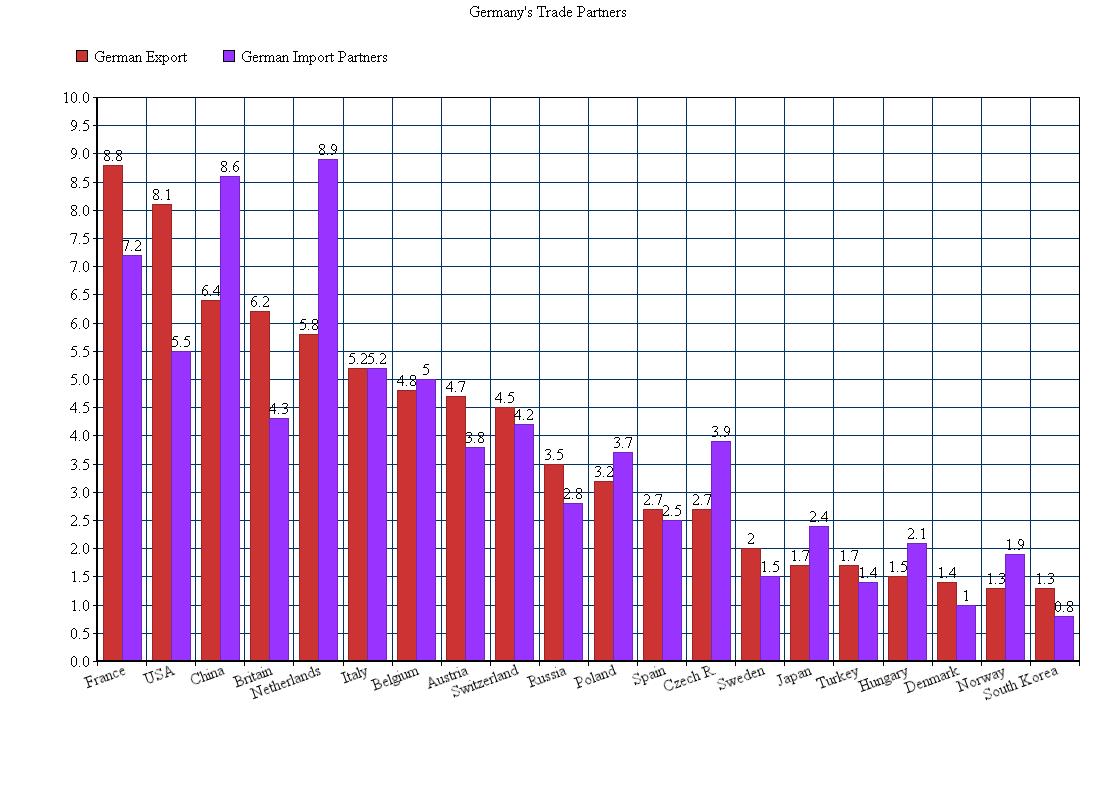
Exports as % of GDPUnlike any of the countries within its trade sphere, Germany is well-diversified in its import and export patterns. It not only spreads out its trade throughout its “empire”, but also engages significantly with many different countries outside of it, such as Italy, Britain, Spain, Russia, China, and the United States. Germany’s only real trade dependence – without getting into specific industries, such as natural gas production, where it receives over 65 percent of its imports from Russia – is receiving 14 percent of its imports from the Netherlands. However, this same trade accounts for 23 percent of the Netherlands’ exports, and the Netherlands is one of the most export-dependent countries in the world, so in general the Dutch cannot easily threaten to raise the prices of the products they sell to Germany.

Germany's trade partnersAlthough they need to be taken with a very large grain of salt, these trade statistics reveal a pattern that is much too large to ignore. One thing that stands out – glaringly, given the current political debates in Europe – is that this trading group barely corresponds with the European monetary zone. Poland, Switzerland, the Czech Republic, Hungary, Denmark, and Romania are all in Germany’s trade sphere, yet use their own national currencies instead of the Euro. On the other hand, a number of economies located outside of the trading sphere, such as Spain, Italy, Finland, Greece, Ireland, Portugal, and Estonia, do use the Euro as their currency.

Countries that use the Euro:

https://i0.wp.com/www.ey.com/Media/vwLUExtFile/ACTv2_Eurozone_2012/%24FILE/all-country-map.jpg

(the graph above is a few years old: Latvia and Lithuania should now be highlighted too)

Trade with Germany:

germany

This disconnect is for the most part a legacy of the Cold War, as the precursors of the Eurozone were built at a time when Russia still dominated Eastern Europe. Now that Eastern Europe is sovereign and commercially integrated with Germany and Austria, however, the shape of the Eurozone seems to make little sense. It actually conforms more to the trade spheres of France, Italy, Spain, the Netherlands, and Belgium than it does to Germany’s.

France, for example, relies on Spain and Italy for more than twice the share of its trade that Germany does, and on Poland, Hungary, and the Czech Republic for three times less than Germany does. Even Britain, which still uses the pound, conducts almost 10% more of its share of trade with Eurozone countries than Germany does. (Britain trades a lot with Ireland, Belgium, the Netherlands, and France, each of which uses the Euro).

One of the results of this disconnect is that even though Germany has the largest trade surplus in the world apart from Saudi Arabia, it actually buys slightly more from the countries within its trade sphere than it sells back to them. This is partly because the Netherlands and Switzerland have incredibly large trade surpluses relative to the size of their gdp’s, but it is also because Germany’s largest trade surpluses tend to be with countries which, unlike Eastern Europe, have relatively high wages and/or strong currencies, such as the United States, Denmark, and Eurozone countries like Italy and Spain.

Another thing these statistics show is that while German influence is pronounced in all of the countries within its trade sphere, it is decisive in none of them. Apart from Austria, a German-speaking state, no country relies on Germany for more than 40 percent of their overall trade, and most less than 30 percent. In contrast, if all of these countries were to band together, Germany would be dependent on them for approximately 45 percent of its trade, and more than 20 percent of its trade even if you exclude France, the Netherlands, Belgium, and Denmark.

In other words, Germany is dependent upon these countries as a group, just not (with the possible exceptions of France and the Netherlands) on any of them individually. As such, for these states to exert any meaningful leverage over Germany, they would have to cooperate closely with one another. Within Eastern Europe, the only country that could potentially provide enough leadership to promote such cooperation is Poland.

Poland is by far the biggest of the Eastern European countries in the grouping of states that are heavily dependent on German trade.  Poland’s gdp, at around 515 billion a year, is not much smaller than the combined gdp’s of Romania, Hungary, the Czech Republic, Slovakia, and Slovenia. Its population of 39 million is similarly close to these countries’ combined population of 49 million. Poland also relies on exports in general for around half the share of its gdp that the Czech Republic, Hungary, and Slovakia do, making it much less dependent on Germany. And Poland is also slightly more diversified in its trading partners than the Czech Republic or Hungary are. For example, only 27% of Poland’s trade is with Germany and Austria, whereas Hungary and the Czech Republic conduct 30-35% of their trade with Germany and Austria.

It will, however, be difficult for Poland to exercise leadership in Eastern Europe, not only because of its trade dependence on Germany, but also because of its distraction with Russia to its east. Even though Poland’s economy grew an estimated 2.5 times faster than Germany’s and twice as fast as Russia’s last year, its gdp is still almost seven times smaller than Germany’s and four times smaller than Russia’s. Poland’s population is less than half the size of Germany’s and almost five times smaller than Russia’s. Russia is also Poland’s sixth largest export destination, and supplies Poland with natural gas.

As has often been the case in the past, therefore, the question of Poland’s relationship vis-à-vis the Germans and Russians is of critical importance to the political trajectory of Europe as a whole. How much will Poland’s economy grow in the years ahead? How much leadership will it be able to provide in Eastern Europe? How much support will Poland receive from countries that may want to turn it into a regional counterweight to Germany and Russia – countries, for example, like the United States, Britain, France, or even Sweden? Among other things, the answers to these questions could help determine whether or not Germany can keep hold of its relatively newfound commercial empire.

Why Iraq?

Ten years after the invasion of Iraq, most people are still confused as to why the United States chose to initiate a war against Saddam Hussein. While it is generally understood that the WMD and democracy-building arguments for war peddled by the Bush administration were overly propagandistic, the most popular explanation to replace these arguments, namely that the United States wanted to control Iraq’s oil, does not stand up to the test of logic either. If the United States had wanted access to Iraqi oil, it would have been enormously cheaper simply to buy it. This is of course not to say that oil did not play a big role in the decision to invade. It just did not do so in the simplistic, “I drink your milkshake” sort of way that is often implied or alleged by Bush’s critics.

The real motivation behind the American invasion of Iraq seems to have been the Bush administration’s belief that it would help the United States to bolster the American strategic position in the Middle East and constrain Islamic-oriented militancy.  Saddam Hussein might not have wanted to support Osama bin Laden or planned to acquire nuclear weapons, but Iraq was critical to Bush’s plans anyway because of its position in the heart of the Middle East and its Saddam-era animosity towards Iran and Kuwait.

The United States blamed two countries the most for 9-11: Afghanistan and Saudi Arabia. Afghanistan was blamed because it was where Al Qaeda was based, while Saudi Arabia was blamed because Bin Laden and other high-ranking Al Qaeda members were Saudi, fifteen out of the nineteen airplane hijackers were Saudi, much of the funding of the Taliban, Al Qaeda, and other extremist Islamic organizations was derived directly or indirectly from Saudi oil revenues, and Saudi Arabia itself had an officially radical – or, if you prefer, ultraconservative – ideology (among other things, it is illegal for Saudi women to drive). Saudi Arabia was also allied with the nearby majority Sunni population of Pakistan, a country which was also close to the Taliban, had become the first Muslim state to acquire and keep nuclear weapons in 1998, and had fought a war against India in 1999.

The United States wanted to compel Saudi Arabia to crack down on its religious radicalism, but the Saudis were loath to do so because such radicalism was ingrained deeply in their society and state, and was also used as a tool for the Saudis to project influence abroad. Invading Saudi Arabia was not an option: it is the seventh largest country in the world, is covered almost entirely by desert and mountains, was an integral component of the US-led global economic system because of its oil production (whereas Iraqi production was low because of decades of sanctions and wars), and it would have been extraordinarily difficult to “put back together again” with any new government – more difficult even than Iraq was, perhaps.

Indeed, given the conservatism of the Arabian peninsula, not only in Saudi Arabia but also in neighbouring, overpopulated Yemen, the region would potentially have become even less friendly to the United States under a government other than the Saudi royal family. And of course, it would have been a disaster to put American troops anywhere near the Saudi-controlled sacred cities of Mecca and Medina. Thus, the Bush administration followed through with a different plan: invading Iraq.

Invading Iraq might have been about overthrowing a dangerous totalitarian regime, like Bush claimed, and it might have been about putting Iraqi oil reserves under the influence of the United States, like Bush’s critics claimed. Either way, it was also supposed to put pressure on regional Middle Eastern powers like Saudi Arabia by placing hundreds of thousands of American soldiers on their vulnerable borders, as we will discuss in a moment. Moreover, it was supposed to force the Saudis to become more dependent on the US for regional security, as Saddam Hussein’s Sunni-led regime had been Saudi Arabia’s foremost ally in the region against the Shiite and Persian government of Iran.

Saudi Arabia’s population is deeply divided by both geography and religious sect. Sunnis make up the majority of the Saudi population, with fourteen million Sunnis living in provinces bordering the Red Sea and six million Sunnis living in or around the central, capital city of Riyadh. Saudi Arabia’s Persian Gulf region, however, is predominantly Shiite Muslim. This area, separated from the coast of the Red Sea by a thousand kilometres of desert and mountains, possesses roughly ninety percent of Saudi Arabia’s oil.

Saudi Arabia worries that Iran will lead this part of the country to rebel against Saudi rule. Saudi Arabia has not exactly been kind to its Shiites: it has plundered most of their oil wealth and occasionally banned celebration of their holidays. Saudi Arabia’s 2009 invasion of neighbouring Bahrain, aimed at protecting Bahrain’s Sunni monarchy from its protesting Shiite majority, is a recent illustration of this phenomenon. America’s unseating of Saddam Hussein, who had led a massive war against Shiite Iran during the 1980’s and then brutally repressed Iraq’s very large Shiite population during the 1990’s, was in this way a tremendous blow to Saudi security.

Invading Iraq was also intended to transform the United States into the dominant power of the Middle East over the short- to medium-term. In addition to Saudi Arabia, it put tens of thousands of American troops on the borders of Iran, Syria, Kuwait, Turkey,  and Jordan, and created a direct link-up with the US’s Kurdish allies in the region, some of whom had been protected by the US no-fly zone over Iraq between the First Gulf War and 2003. It also displayed American force and resolve (at least, initially), which is why the invasion strategy was referred to as “shock and awe” in the first place. From Bush’s perspective, this was much more useful than pouring troops into Afghanistan, a vast, landlocked country with some of the most rugged terrain in the world, no significant Arab population, and a decade of experience fighting a guerrilla war against the Soviet Union that at the time had ended only twelve years earlier.

While Bush’s strategy involved strengthening Iran in order to weaken the Sunni Arab world by comparison (and, possibly, to weaken the geopolitical positions of Sunni Pakistan and/or Sunni Turkey as well), it was likely believed that Iranian influence could later be contained fairly easily by other regional powers like Turkey, Israel, and Saudi Arabia. This has now occurred to a certain extent with the undermining of the Assad government in Syria, which has been one of Iran’s most important regional allies.

Indeed, Iranian influence was seen as inherently limited, as Shiite Arabs are only a plurality of Iraq and Lebanon’s populations rather than a majority, Syria’s Iranian-allied ruling Alawite population is greatly outnumbered by Syrian Sunnis and other non-Shiite groups, Iranians are not Arabs, and Iran is itself deeply internally divided between ethnic Persians (who are only about half of the Iranian population, according to some estimates), Azeris (bordering energy-rich Azerbaijan, which became independent when the Soviet Union broke up), Turkmen (bordering energy-rich Turkmenistan, which also became independent after the Soviet Union), Kurds (bordering Turkish Kurdistan, Syrian Kurdistan, and energy-rich Iraqi Kurdistan, which became empowered by Saddam’s removal from power and, more recently, by Assad’s weakening), Shiite Arabs (bordering southern Iraq, who also became empowered by Saddam’s removal), Baluchis (bordering Pakistan’s restive Baluchistan region, which became a bit more empowered when the US-Afghan War led to Pakistan’s relative destabilization), and other groups.

iran-principal-ethnolinguistic-families-courrier-international-2009

While destroying the Iraqi regime obviously strengthened Iran over the medium-term, in the short term it was also supposed to make Iran vulnerable to American influence. Invading Iraq put the American military on the border of Iran’s Khuzestan province, which is unique among Iranian provinces in that much of its population is Arab rather than Persian, its border is flat and exposed rather than mountainous, it is separated from the rest of Iranian territory by hundreds of km of mountains, it is home to most of Iran’s oil deposits (which are thought to be the second largest “conventional” reserves in the world, after Saudi Arabia’s), and it is close to most of Iran’s offshore natural gas reserves (which are also thought to be the second largest in the world, after Russia’s). Khuzestan is in many ways the achilles heel of Iran, and the American military presence along its border in Iraq was therefore supposed to help grant the United States leverage over the Iranian government.

Unknown
Source: Freeworldmaps.net

This was an important aspect of US strategy, as Iran has a religious government and had not been an ally of the US since before 1979, and because Iran’s cooperation was needed in order for the war in neighbouring Afghanistan – which is largely a Persian-speaking country – to go smoothly. In fact, because Khuzestan’s Arab population is Shiite, the American goal of replacing of Saddam Hussein’s anti-Shiite regime with a secular Iraqi government may have also been intended to destabilize Iran in the long term by making Khuzestan Arabs more likely to want to secede from Iran and integrate themselves with Iraq instead. To be sure, when Saddam invaded Khuzestan during the Iran-Iraq War, it is thought that he had expected to be received as a liberator by the Arab inhabitants of the province, but was instead shunned by them as a Sunni tyrant.

It is true, of course, that Saddam Hussein’s regime was a Baathist one, and was therefore technically secular rather than Sunni Islamic. And some of Saddam Hussein’s main victims, such as the Iraqi Kurds or the Kuwaitis, were Sunni. That being said, Iraq’s huge and terrible war against the explicitly Shiite government of Revolutionary Iran in the 1980s, the collapse of Iraq’s secular benefactor the Soviet Union in 1991, the repression of Shiite Iraqis in the early 1990s following the Fist Gulf War with the US, the placing of “God is Great” on the Iraqi flag in 1991, and other events – including, arguably, the giving of some support to known Al Qaeda members – seemed to show that the Iraqi Baathists were becoming more politically religious.

Many Baathists certainly did go on to use religion as a political tool following the US invasion; ex-Baathist officials have frequently been accused of playing a leading role in post-Saddam Sunni groups like Al Qaeda in Iraq, or, more recently, in ISIS. And in general, there has been a post-Cold War trend of once secular Sunni Middle Eastern states, for example that of Turkey, the Palestinian militant resistance, the opposition in Algeria during its civil war throughout the 1990s, post-Gaddaffi Libya, or, briefly, post-Mubarak Egypt, moving in an Islamist direction. Though we will never know how the Iraqi Baathists may have evolved over time had they not been removed from power by the US in 2003, seeing Saddam’s government as a Sunni one is nevertheless not an incorrect viewpoint – even if the full truth of it may be a bit more complex.

Of course, none of this changes the fact that the Iraq War was arguably a strategic mistake for the United States, and possibly a moral failure as well. Still, it may be comforting to know that, contrary to popular belief, the reasons behind the invasion were not entirely incoherent or sinister (or at least, not sinister in the ways that people have assumed they were). And perhaps we should not judge Bush too harshly for concealing his true purposes. After all, Obama cloaked his support for Syria’s rebels in precisely the same anti-tyranny, anti-WMD rhetoric that Bush once employed towards Iraq, consistently avoiding the fact that the rebels’ success benefited the United States by curtailing Iranian influence in places like Syria, Iraq, Lebanon, Jordan, and Palestine. And now Obama finds himself again in the same dilemma as Bush, wanting to move closer to the Shiites and/or Persians in the region in order to counterbalance the dominant Sunnis and/or Arabs, yet also concerned that this will result in increased Sunni militancy, a destabilized Arabia, and an ascendant Turkey or Iran.

Bulgaria’s Uncertain Future

Most North Americans know nothing about the country of Bulgaria, except maybe that it was the birthplace of Quidditch superstar Victor Krum.

This is not surprising. After all, there are a lot of countries in the world, and Bulgaria is a relatively insignificant one. It has a population of only seven and a half million, and an economy that is smaller than all but five of America’s fifty states. Americans tend to learn about other countries only when newsworthy events take place in them, and Bulgaria has not generated many of these in recent history. Lying quietly behind the Iron Curtain between 1945 and 1989, then spectating as its Balkan neighbours descended into violence during the 1990s, Bulgaria has largely managed to avoid any wars or ethnic unrest since the Second World War. In that conflict, however, Bulgaria played an active role, taking part in both a Nazi-led occupation of Greece and Yugoslavia in 1941 and an Allied invasion of Hungary and Austria in 1945.

Bulgaria’s current level of anonymity may disappear in the not-too-distant future. In fact, it can be expected that in the approaching decades Bulgaria will attract a level of attention from the rest of the world that it has not experienced in many decades. This notoriety will not come about as a result of Bulgaria`s own accomplishments (sorry Bulgaria). Rather, it will emerge as the product of Bulgaria`s relationship with its increasingly powerful Turkish neighbours.

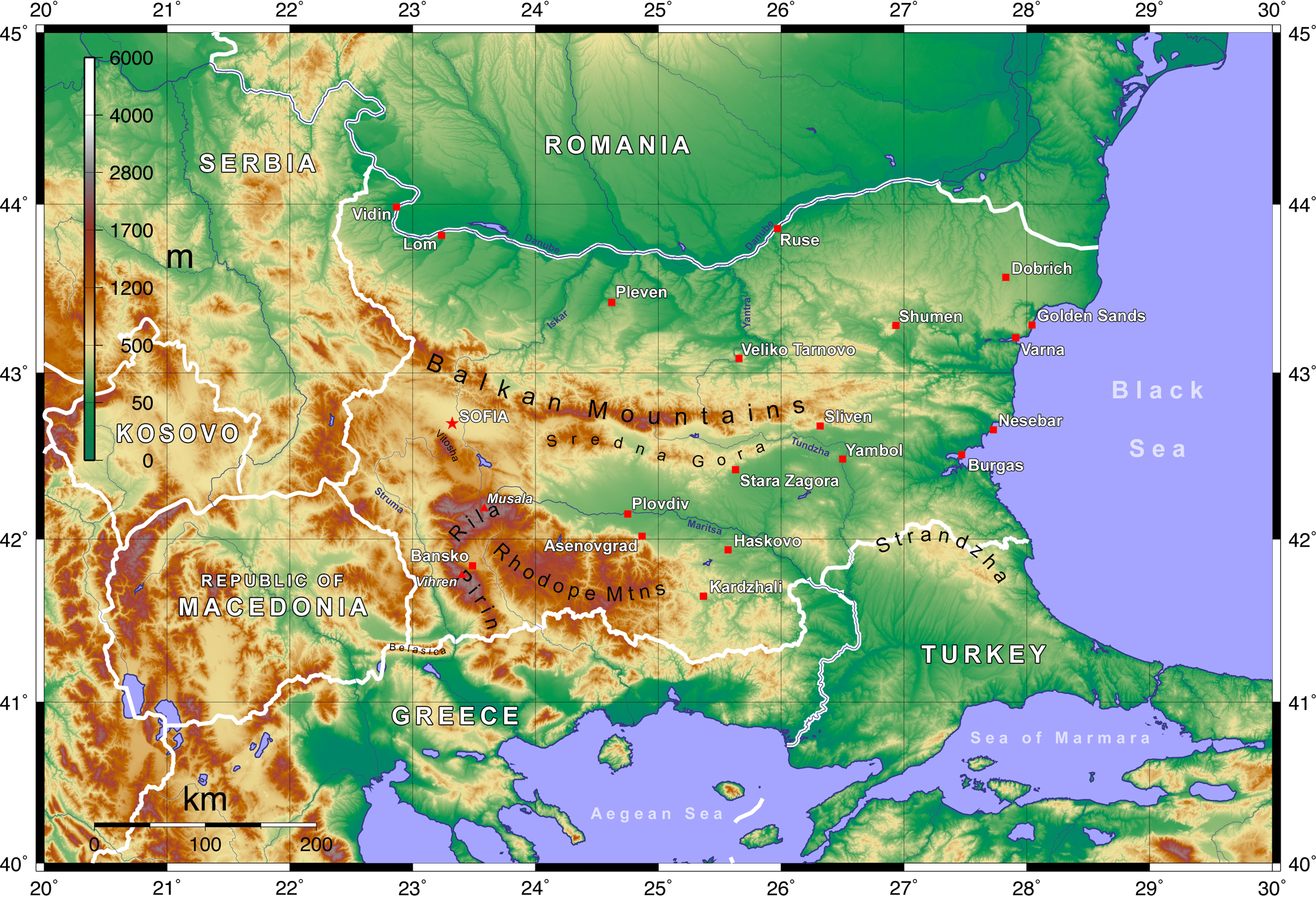
The land border between Bulgaria and Turkey currently serves as the southeastern frontier of the European Union, and it also Turkey’s most vulnerable one. Whereas Turkey’s eastern borders are separated from the majority of the Turkish population by over a thousand kilometers of hills and mountains, the distance between Istanbul and the Turkish-Bulgarian border is less than 200 kilometers, and the terrain is flat the whole way. Not incidentally, it was from the area that is today Bulgaria that the Romans conquered Byzantium (today’s Istanbul) in 173 BC, and that European forces conquered Constantinople (also today’s Istanbul) during the Fourth Crusade in 1204 AD. In fact, the Turks themselves conquered Constantinople from this direction, in 1453 AD, though in their case they approached the city from both east and west rather than from the west alone.

https://i0.wp.com/upload.wikimedia.org/wikipedia/commons/f/fd/Topographic_Map_of_Bulgaria_English.png

If Turkey were to dominate even just the southern half of Bulgaria, as its Ottoman predecessors did for nearly five hundred years between 1396 and 1885, the distance between its western border and Istanbul would effectively double. Even more important, Turkey would then be able to anchor itself on the Balkan Mountains instead of on the relatively flat lowlands which today comprise much of the border between the two countries. This would give Turkey a defensible buffer in the north, while also allowing it to outflank any theoretical threat that might emerge on its border with Greece, its long-time rival, which is also located near to Istanbul and the rest of the Turkish heartland. Obviously, the Turks would find such a state of affairs to be quite beneficial, all other things being held equal.

This is important, because there is not much reason to think that Turkey could not dominate Bulgaria if it wanted to. Turkey is a much wealthier and stronger country than Bulgaria is. Its gross domestic product is 20 times larger than Bulgaria`s, and its population is more than 10 times larger than Bulgaria`s. Turkey devotes an amount equal to 2.3% of its GDP to military spending, compared to only 1.5% for Bulgaria and 1.7% for the European Union as a whole. There is also a large Turkish diaspora living within Bulgaria, accounting for more than 10 percent of the country’s total population and more than half of the population within two of its 28 provinces.

A few decades from now, Bulgaria will probably become even weaker relative to Turkey than it is today. Turkey’s economy is expected to perform well, since the country is populous, relatively underdeveloped, and strategically located as a land bridge between Europe and Asia, a naval bridge between the Mediterranean and Black Seas, and a cultural bridge between the West and Islam. Indeed, Turkey was the second fastest growing large economy in the world between 2008 and 2012, trailing only China. Turkish birth rates are at a healthy 2.1, compared to Bulgaria’s 1.5, which is among the lowest in the world. Finally, Bulgaria is highly dependent upon exports for its economic growth, while Turkey is not. As a result, any economic slowdown among Bulgaria’s trade partners in Europe and other areas of the global economy would hurt the Bulgarians far more than the Turks.

Bulgaria is also economically dependent on Turkey. The value of Bulgaria`s exports to Turkey are currently equal to about 10 percent of all Bulgarian exports, making Turkey the country’s third largest export destination, slightly ahead of Romania and slightly behind Germany and Italy. However, Italy and Germany have economies that are 2.5 and 4.3 times larger than Turkey`s. As Turkey`s economy grows, therefore, its appetite for Bulgarian exports seems likely to grow faster than Italy`s or Germany`s would if they were to experience the same level of growth — and they are not expected to grow nearly as fast as Turkey is. As a result, it is quite conceivable that Turkey will become Bulgaria’s leading export destination in the near future, possibly by a large margin. In fact, an amount of Bulgarian trade accounting for approximately 20-25 percent of Bulgaria’s gross domestic product already passes through the Turkish-controlled Bosporus and Dardanelles Straits every year on its way to and from other markets around the world.

For all of these reasons, Turkey`s only real barrier to dominating Bulgaria is that, as a member of both the European Union and NATO, Bulgaria has been guaranteed to be economically, militarily, and politically shielded from external threats by Western Europe and the United States, both of which are much more powerful than Turkey. Russia is another country interested in Bulgaria; both Russia and Bulgaria are Slavic, Orthodox Christian countries, and the Russians sell a lot of energy to Bulgaria in order to make Bulgaria’s next-door neighbours, the Romanians (who are Latin rather than Slavic), feel uneasy, so that the Romanians will not become too pushy within their own next-door neighbour, Ukraine. Indeed, the fact that Bulgaria is not being controlled by Turkey as we speak is probably more a testament to the strength of the United States, Western Europe, and Russia than it is to Turkish timidity or Turkish indifference towards Bulgaria.

Ultimately, however, it is easy to imagine that in the future Bulgaria will become the site of a geopolitical tug-of-war that will involve Turkey, various European countries, and the United States. It is also not so difficult to imagine that the Turks will win this tug-of-war, given that they care much more about Bulgaria than the US or any European powers do, and given that Turkish economic prospects look promising. In that case, the level of independence that Bulgaria has enjoyed for the past 23 years could come to an unexpected, perhaps even violent, end. The only silver lining for Bulgaria is that it might benefit economically from Turkish growth.

the PIPEs are Calling

 After accounting for more than a third of the world’s economic growth since 2003, the BRIC economies – Brazil, Russia, India, and China – are likely to slow in the decade ahead. Here are six reasons why that is:

1.      Higher Incomes 

According to the World Bank, average incomes have reached $7000 in China, $11,000 in Brazil, and $14,000 in Russia. Unlike a decade ago, when Chinese average incomes were still around $1000 and Russian and Brazilian incomes $3000, today only India, with an average income of less than $1500, remains competitive with most other developing nations in being able to supply cheap labour, goods, and services.

2.      Aging Populations

China and Russia have populations that are aging rapidly relative to the majority of developing economies. 12% of Chinese and 18% of Russians are over the age of 60, compared to just 7.5% of people in the Indian Subcontinent, Southeast Asia, Latin America, and the Middle East, and 5% of people in Sub-Saharan Africa. China’s most populous generation is currently 40 – 50 years old, and Russia’s is 50-65 years old. By  contrast, in most other developing economies the largest generation is somewhere between 0-35 years old.

3.      Dependence on Coal

China, India, and Russia are three of the world’s four largest consumers of coal and emitters of carbon dioxide. China derives 70% of its energy from coal, almost double that of any other country. India derives 40-50% of its energy from coal, a greater share than any country apart from China or South Africa.  This makes these countries highly polluted, vulnerable to fluctuations in coal prices, and at risk of angering countries afraid of climate change.

4.      Dependence on Exports

Exports account for 30 – 35% of the economic output of China and Russia. This is compared to only 10 – 15% for the US, Japan, the European Union, Brazil, and Pakistan, and between 15 – 30% for most other countries. This means that China and Russia are now relatively vulnerable to economic events that are beyond their ability to control. Russia, for example, experienced a decline in its economic growth rate from 7.5% between 2003 and 2007 to just 1% since 2007, in large part as a result of the languishing European economy that consumes the vast share of its exports.

5.      Dependence on Imports or Exports of Natural Resources

India has become dependent on importing foreign oil, mostly from the Middle East. Imports now account for more than 75% of India’s oil consumption and nearly 30% of India’s overall energy consumption. This has led India to develop the world’s largest trade deficit apart from the United States and Britain, in spite of having a massive wage-competitive workforce that produce goods and services for export.

China is not nearly as dependent on importing oil as India is, since so much of its energy comes from coal it produces domestically. However, China does depend heavily on imports for a number of natural resources of which it is the world’s largest consumer. These include copper, lead, nickel, zinc, tin, iron ore, timber, rubber, cotton, wool, and soybeans. In some cases this dependence is extreme: for example, China imports 85% of the copper and nickel it consumes, even as it consumes more than four times as much copper and three times as much nickel as any other country in the world. China also depends on imports for roughly two-third of its oil, though it is only the world’s second largest consumer of oil, still well behind the United States.

Russia’s economy, on the other hand, has become too dependent on exporting natural resources. An estimated 30% of Russian gdp comes from the production and sale of fossil fuels alone, even as Russia is also a leading exporter of a number of other commodities, such as diamonds, timber, and aluminum. If the profit margins of oil, gas, or natural resources in general decline, so too will the Russian economy. To a lesser extent this may also be true of the commodities Brazil produces: iron ore, crude oil, soybeans, and sugar account for an estimated 40% of Brazilian exports. (Brazil’s economy, however, is not very dependent on exports in general, so it could probably withstand low commodity prices better than Russia could).

6.      Income Inequality

Brazil has the highest income inequality levels of any large country. Russia, China, and India are not far behind. These inequalities are not limited to class-based or urban-rural divisions, but also include significant provincial and regional disparities. In China, for example, the 27 million inhabitants of Shanghai and Hong Kong have an average income that is 8 and 14 times higher, respectively, than that of the 65 million inhabitants of Guizhou and Gansu. In India, the 112 million inhabitants of Maharashtra have an average income 5 times higher than the 103 million inhabitants of Bihar. By comparison, average incomes in New York City are only 2.3 times higher than they are in Mississippi.

Life after BRICs

With the BRIC economies primed to slow down, a new emerging-market acronym is needed – at least, for the type of people who like such acronyms. Goldman Sachs, who’s chief economist Jim O’Neil coined BRIC over a decade ago, has since introduced MIST – referring to Mexico, Indonesia, South Korea, and Turkey. The Economist magazine and HSBC bank, meanwhile, have been pushing CIVETS, for Columbia, Indonesia, Vietnam, Egypt, Turkey, and South Africa. Investors have responded in both cases, purchasing tailor-made financial instruments that target the MIST and CIVETS countries. Each of these instruments received over a billion dollars of investment in 2013.

Both MIST and CIVETS are flawed, however. The MIST countries have almost nothing in common with one another, apart from the notable fact that they are all among the world’s 14-17th largest economies. Average incomes in Indonesia are three times lower than in Mexico and Turkey, and six times lower than in South Korea. Indonesia`s population is nearly five times larger than South Korea`s. South Korea relies on exports for 57% of its economic output, compared to only 25% for Turkey and Indonesia. Indonesia and Mexico are both leading natural resource exporters, while South Korea and Turkey are leading resource importers. 75% of Mexico’s exports go to the United States, compared to just 4% of Turkey’s. 31% of South Korea’s exports go to China, compared to just 4% of Turkey’s and 2% of Mexico’s. 50% of Turkey’s exports go to Europe, compared to 12% of South Korea’s and Indonesia’s and 6% of Mexico’s.

The CIVETS have even less in common. Indonesia has an economy that is more than six times larger than that of Vietnam, and a population that is four and a half times larger than those of Colombia and South Africa. Turkey’s average income is nine times higher than Vietnam’s. Columbia, South Africa, and Indonesia are all major exporters of natural resources, while Turkey is one of the largest resource importers. Vietnam depends on exports for 80% of its economic output, while Egypt and Colombia depend on exports for only 18% of their economic output, and none of the other CIVETS for more than 28% of their economic output. Over 40% of Colombia`s trade is with the United States, while 50% of Turkey`s is with Europe and 45% of Vietnam`s is with Northeast Asia.

It is true, of course, that all emerging market acronyms will inevitably be over-simplistic. Even in the case of the BRICs there were enormous differences between countries: China`s economy, for example, is thought to be larger than those of India, Brazil, and Russia combined, and the populations of China and India are significantly larger and poorer than those of Brazil and Russia. That being said, the BRICs grouping still makes some sense, perhaps, because the BRICs are the only developing countries to be among the world`s ten largest economies, nine largest populations, and seven largest landmasses. Furthermore, when BRICs was invented back in 2001, China`s economy was not nearly as far ahead of Brazil, India, and Russia as it is now, so the acronym made more sense at the time.

By comparison to BRIC, therefore, MIST and CIVETS seem to make little sense. For this reason, it may be appropriate to try to create a new acronym, one that can be of greater use to investors and other people interested in emerging markets. (Yes, there is no real reason to make such acronyms at all, but since it does not seem that they are going to stop being made and trumpeted by the media anyway, there might as well be a more fitting successor to BRICs than has been given thus far). So, with that in mind, let us now introduce the PIPE economies: the Philippines, Indonesia, Pakistan, and Egypt.

Meet the PIPEs

The PIPEs share a lot of noteworthy qualities. All have average incomes between $1300-3600 – or average incomes of $2600-3600 if Pakistan is excluded. All are among the 15 most populous countries in the world. All are among the six most populous countries in which average incomes are higher than $800 and lower than $6000. All except for Indonesia have GDP’s between $230-260 billion: indeed, Pakistan, Egypt, and the Philippines are the world’s 38th, 39th, and 42nd largest economies.

(Update, a year later: So far so good. In 2014, Pakistan, Indonesia, the Philippines, and Egypt had the four best-performing stock markets in the world outside of India, Argentina, Sri Lanka, and China-sans-Hong Kong) 

None of the PIPEs is too dependent on any single part of the world to consume their exports. Rather, they are each relatively well-diversified in their trade patterns between North America, Europe, Northeast Asia, and Southern Asia. None, for example, conduct more than 15% of their trade with any single country. Each conducts between 9-12% of their trade with the United States and 9-15% of their trade with China. None depend on exports for more than 26% of their gdp’s, for an average of just 20%.

All of the PIPEs have young populations, with between 6-9 % of their populations over the age of 60. All have fertility rates between 2-3 children per mother. All except the Philippines are Muslim – and the Philippines has a relatively large Muslim minority, accounting for 5 -10% of its total population.

All the PIPEs except Egypt have external debts equal to between 28-32% of their gross domestic products; they are three of the five economies in the world to be within this range, which is slightly lower than the average for developing countries. Egypt, meanwhile, has an external debt of 14%, one of the lowest in the world.

In terms of income inequality, the Philippines is the only PIPE to score poorly, according to the World Bank’s GINI Index. However, the Philippines still ranked as less unequal than China, Malaysia, or almost any country in Latin America or Sub-Saharan Africa.

The Philippines and Indonesia are both tropical archipelagos in Southeast Asia, and possess the first and second longest non-Arctic coastlines in the world. Egypt and Pakistan are both arid states located in the Greater Middle East, and are the first and second largest countries in the world to be oriented almost completely around a single river system (the Nile in Egypt, the Indus in Pakistan).

All the PIPEs except Indonesia are among the best English-speaking countries in the developing world. The Philippines is the world`s largest English-speaking emerging market (proportional to its population), while Pakistan is tied with Nigeria for second and Egypt is fifth. Indeed, in the Philippines, 57% of the population can speak English, compared to just 1-27% for the other developing countries in East Asia. In Pakistan, an estimated 49% of the population can speak English, compared to only 15-20% for its neighbours India and Bangladesh. In Egypt, 35% can speak English, compared to less than 20% in Turkey and less than 10% in most Arab countries. (Note: these language statistics need to be taken with an especially large grain of salt). 

In Indonesia, only an estimated 20% of Indonesians can speak English, which is about the middle of the pack for developing countries; less than Thailand, for example, but well ahead of Vietnam or Cambodia. However, because Indonesia is by far the most linguistically diverse country in the world, it may be that its proficiency in English will increase rapidly, so that English will join or perhaps even replace Bahasa Indonesia as the country’s primary lingua franca. Indeed, less than 10% of Indonesians speak Bahasa as a first language, and an estimated 90 million Indonesians barely speak Bahasa at all.

As a result, with Indonesia’s former colonial language, Dutch, having long disappeared from everyday life, many Indonesian children living in urban areas are now learning English significantly better than they are Bahasa. Indonesia was the world’s fourth-fastest adopter of English in 2013, for example, according to English First. In fact, Indonesia’s move towards English is not only due to its linguistic diversity, but also because it attracts more global tourism than any country in Southeast Asia apart from Thailand, and because it has close economic relationships with its two English-speaking next-door neighbours, Australia and Singapore.

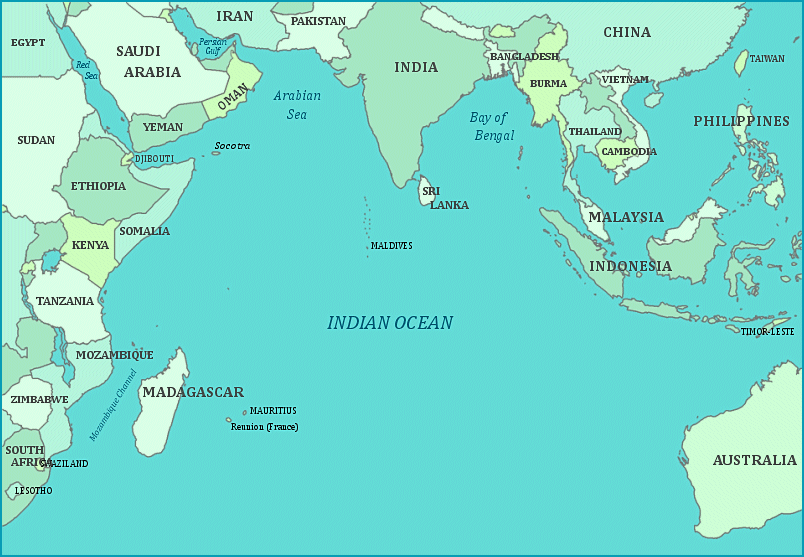
All of the PIPE’s are located in areas that are likely to become the new centers of global trade in the years and decades ahead. As the economies of Asia and Africa emerge, the waterways linking the Indian Ocean to the Pacific and the Mediterranean are likely to become by far the most heavily trafficked trade corridors in the world. Indonesia and Egypt surround the two most important of these waterways: the Suez Canal and the Indonesian Straits. One of the Indonesian Straits, the Strait of Malacca, is in fact already the most heavily trafficked waterway in the world.

indian ocean

Pakistan, meanwhile, is centrally located in the Indian Ocean, almost exactly halfway between the Mediterranean and the Pacific. Pakistan also directly borders the Strait of Hormuz, the channel through which an estimated 35-40% of the world`s seaborne oil shipments and much of the world’s liquefied natural gas pass through each year. Finally, Pakistan is, along with Iran, the only country to border the oceanic trade routes of the Indian Ocean and the overland trade routes of Central Asia simultaneously.

The Philippines is also favorably located relative to the world’s major trade routes. Along with Indonesia, the Philippines is the only country situated in the part of the Pacific Ocean that connects Northeast Asia to both the Indian Ocean and  to Australia and New Zealand. In addition, the Philippines is, to a greater extent than any other Southeast Asian naion with the exception of Indonesia and Malaysia, located amidst the main crossroads of trade between Asia and the Americas.

trade routes

None of the PIPEs are dependent on coal for more than 22% of their energy usage, for an average of just 14%. Only Indonesia derives a significant share of its wealth from exporting commodities — and even Indonesia is not dependent on commodity exports when compared to many of the world’s other resource-rich developing economies. Exports are only equivalent to 24% of Indonesian gdp, compared, for example, to between 55% and 95% of the gdp’s of leading energy exporters like Saudi Arabia, Kuwait, the United Arab Emirates, Libya, Angola, and Azerbaijan.

Also unlike many other commodity exporting economies, Indonesia is not overly dependent on the price of oil and natural gas. Rather, in addition to being the world’s 7th largest net exporter of natural gas and 20th largest of oil, Indonesia is also the world’s largest exporter of coal, rubber, tin, nickel, coconut oil, palm oil, and aluminum ore.

Of course, the PIPEs are not risk-free environments. Like many other developing nations, the flip-side to their economic growth potential is their vulnerability to natural disasters and political upheaval, both of which may intensify as a result of factors like population growth or climate change. In addition, developing countries also tend to have a lot of exposure to the Chinese economy, the growth of which may be likely to slow or even crash at some point in the years ahead.

Indonesia and the Philippines could be particularly vulnerable to dangers such as these. While their direct trade exposure to China is relatively low, it is still high compared to most countries outside of East Asia. Plus, Indonesia and the Philippines trade a fair amount with other East Asian states, some of which have enormous trade relationships with China.

Finally, even though the fact that the Philippines and Indonesia have the world’s longest tropical coastlines may lead to great opportunities for their tourism and trade, it could also present serious storm and flooding threats. They are also at risk from earthquakes and, in some cases, volcanoes. The Indian Ocean tsunami of 2003, in which an estimated 200,000  people were killed in Indonesia alone, is of course the most tragic manifestation of such dangers to have yet occurred in the twenty-first century.

Turkish-Israeli Geopolitics

Friday’s American-brokered Israeli apology to Turkey over the events of the Gaza flotilla incident of 2008 was a significant diplomatic event, one deserving of the tremendous amount of media attention it will undoubtedly receive when the weekend ends. However, the apology is still just politics. What is much more interesting is the geopolitics of Turkish-Israeli relations. In the view of geopolitics, personal apologies matter little. What are important, rather, are the capabilities and self-interests of nations as a whole.

The basic realities of Turkish-Israeli geopolitics were transformed in 1991, when the Soviet Union collapsed. Before then, Turkey had been surrounded by Armenia and Georgia (Soviet Republics), Bulgaria (a Soviet vassal),  Iraq and Syria (Baathist Soviet allies), and Greece (a Slavic country, which had a popular Communist party and a rivalrous relationship with the Turks). The Russians desperately wanted influence in Turkey in order to gain access to the Mediterranean. As a result, Turkey looked to the United States to protect its autonomy from Russia and ensure its access to the global economy.

https://i0.wp.com/worldhistoryatyhs.wikispaces.com/file/view/50s-cold-war-map.jpg/144868607/50s-cold-war-map.jpg

The United States became closely allied with Israel in 1973, meanwhile, supplying it with arms during the Yom Kippur War. Israel was useful to the United States because it blocked Egyptian-led pan-Arabism,  could be used to help guarantee Western influence over the Suez Canal, and was generally popular among American Jews (and among many Christians). Israeli strength also forced Syria to focus on its southern border, potentially reducing the pressure it could exert in other directions, such as towards Turkey.

Also important during the Cold War was that oil prices averaged less than thirty dollars a barrel, adjusted for inflation. As a result, the economic clout of Persian Gulf nations like Saudi Arabia and Iran was relatively small. Turkey, which  did not have a large economy at the time, did not need to import much from these states. Its economy was tied far more to North America and Europe than it was to the Middle East.

Now look at today’s world. Russia’s borders are nowhere near Istanbul. Iraq and Syria are chaotic and disunited. Oil prices are around 110$ a barrel, and were above 140$ in 2008. Turkey is extraordinarily dependent on imports of Russian energy, a dependency it would like to reduce with imports from Muslim countries in the Persian Gulf and Central Asia. Most importantly, Turkey’s economy is now the world’s sixteenth largest, and grew more rapidly than any significant country apart from China in recent years. Indeed, whereas in 1986 Turkey’s economy was nearly three times smaller than Iran’s, today it is approximately one and a half times larger than those of Iran or Saudi Arabia, and roughly quadruple the size of any Middle Eastern economy if oil and natural gas are excluded.

Turkey’s economic and political influence is gradually expanding into the disorganized regions that surround it. In the Balkans, the Caucuses, and the Middle East, reaching out to Muslim populations – Arabs, Persians, Bosnians, Albanians, Azeris, Chechens, etc. – is a natural and effective way for Turkey to become influential. As a result, non-Muslim countries in the region, such as Russia, Armenia, and Serbia, will probably become less friendly to Turkey in the future if its power continues to grow. This does not mean that Turkey will be allies with every Muslim group or enemies of every non-Muslim group. It does mean, however, that Turkey may be in an early phase of reconstituting itself as a leader of the Muslim world, a position it held between the Fall of Constantinople in the fifteenth century and WW1 in the twentieth century. And of course, it is particularly hard to become a leader of the Muslim world when you are too chummy with Israel.

That said, it is also not in Turkey’s interests to break completely with Israel, at least not yet. Israel is still a very powerful country in the Middle East. Because of its technological prowess, Israel will perhaps become even more powerful compared to its neighbors in future years (though perhaps not, since its population is relatively small). Israel also continues to have the support of the United States, the world’s sole superpower. Thus, it is likely that Turkish relations with Israel will bend before they break, if indeed they ever do break. The Gaza flotilla incident of 2010 was one example of such bending. In the future, Turkey will have many more opportunities to sour its relations with Israel, as there are sure to be violent flare-ups between Israel and Arab populations that it can choose to criticize.

To predict when Turkey might break completely with Israel, though, two areas to watch are Bulgaria and Greece. Because these countries occupy the only vulnerable approaches to the heartland of Turkey surrounding Istanbul – Greece from the sea and Bulgaria on land – Turkey will want to lure them into its sphere of influence if it ever becomes powerful enough to do so. So long as the US remains a superpower, however, it may see such a move as a challenge to the alliance systems it has formed in Eastern Europe and the Eastern Mediterranean. Europe, and specifically countries like Romania and Russia, may not be too enthused by this either. As a result, Greece and Bulgaria are the areas where Turkish relations with the US may be most likely to worsen in the decades ahead — perhaps even more so than in Iraqi Kurdistan, which the US has formed close ties with during the past 25 years, but which the Turkish government is ambivalent about because it fears Kurdish secessionism and militancy within eastern and central Turkey. Worsening relations between the US and Turkey could mean a shattered relationship between Turkey and Israel.

Top 10 Myths about the Global Economy

The 2000’s was a decade of rapid economic change. The Chinese economy grew enormously, and to a lesser extent so did the economies of Russia, Turkey, Saudi Arabia, Brazil, South Korea, India, and others. Mobile phones, smartphones, and the Internet changed the way billions of people live their lives and conduct business. Near the end of the decade there was a major shock to the global economy, dropping growth from about 4% between 2005 and 2007 to 1% between 2007 and 2009. The slowdown thrust millions of people into unemployment.

One of the byproducts of such speedy transformations has been confusion regarding the present configuration of the global economy. According to a 2011 Gallup poll, more than half of Americans believe that the world’s largest economy is China, whereas only thirty percent believe, rightly, that it is the United States. While some of the blame for ignorance of this kind should presumably go to the American education system and media, its root cause is probably just that the world has been changing so fast that people have not had the time to catch up to what is really going on.

With that in mind, in this article we have tried to compile the ten most widely held myths about the global economy. They are as follows:

1.      China Owns All Of America’s Debt

Contrary to popular belief, China only owns about 8 percent of American government debt and 2.7 percent of total American debt. This is not so unique: Japan, for example, owns 6 percent of American government debt, and England owns 2.5 percent of American government debt. China also does not receive as much leverage over the United States from these debt holdings as is commonly thought, because its economy is considerably more dependent on trade with the United States than the American economy is dependent on trade with China. China’s exports to the United States are equal in value to around 6% of China’s gdp, whereas American imports from China are equal in value to only around 1.8% of American gdp. Chinese leverage over the United States is also compromised by the fact that the United States military dominates the Indian and Pacific Oceans that China requires access to for nearly all of the imports and exports it depends on.

2.      China Will Soon Overtake the United States

For China’s economy to equal America’s even ten years from now it would have to grow at an average of 9 percent in real terms, assuming the economy of the United States would only continue at the relatively unimpressive rate of 2.5 percent per year it is currently growing at, and that exchange rates remain at their present rate. This would be a remarkable feat; in its entire mod­ern history China has only twice averaged an annual growth rate of more than 9 percent over the course of a decade, and no country in modern history has grown at an average of more than 10 percent over a period of five and a half decades, which China would accomplish if it  were to grow at such a pace over the next ten years. To say that China will definitely achieve such growth, therefore – when it is facing a huge number of challenges, including high commodity prices worldwide and slow growth among the Japanese and European consumers of its exports – is a bit of a reach. And of course it is also possible that the American economy will grow faster than it is expected to in the years ahead.

3.      America Doesn’t Make Anything Anymore

It has become popular to argue that the United States is becoming economically or even morally bankrupt because it no longer produces tangible goods, but instead focuses on service-sector industries like fast food and finance. The fact is, however, that America does produce tangible things: it still boasts the world’s first or second largest industrial sector (depending on which data you accept), even as the share of its GDP that the sector accounts for has shrunk significantly over the course of the past generation. America arguably manufactures more than China does, and it certainly manufactures far more than Japan and Germany do. In fact, because energy prices in the United States have recently become much cheaper than in Europe or Japan, the US may now also be able to grow its high-end manufacturing base faster than those of other large developed economies.

4.      2008 Was the Worst Recession Since The Great Depression

Okay, this myth may technically be true, perhaps. Still, by everyone constantly repeating it, the idea that 2008 was unprecedentedly similar to the Great Depression has been widely and wrongly perpetuated. The fact is that for most large economies – with the possible exceptions of Spain and Italy, and perhaps a few others – the 2008 crisis and the ongoing European crisis it spawned are actually more similar to the string of recessions that have occurred since the Great Depression than they are to the Depression itself.

Indeed, there might even be a case to be made that 2008 was the least painful of the major American economic crises to occur since the Great Depression, for instance because today’s unemployed have access to technologies that did not exist in previous recessions. Certainly the recessions of the 1970s and early 80s are too often overlooked in this discussion, perhaps due to nostalgia. In any case, it is still too early to tell. The Great Depression in the US saw little economic or employment growth for an entire decade, so at the very least we will not find out how apt the comparison is for  several more years.

 5.      Greece Matters

Greece`s economic problems have been discussed so often in the news that many people have gotten the idea that the country is a significant contributor of Europe’s overall economic crisis. It is not. Though extremely troubled, Greece is actually too small to affect Europe in any meaningful way beyond serving as a harbinger of or catalyst to its real problems – which include, for example, fifty percent youth unemployment in Spain, the world’s twelfth largest economy. The entire Greek economy is actually only about the size of that of Maryland; it is smaller than 16 other European economies. In other words, believing that Greece is the cause of Europe’s problems is sort of like believing that poor sales of snacks is why Blockbuster went bankrupt.

6.      India Is a Major Economic Power

Despite having a population of 1.3 billion people, India has a nominal economic output that is only about as large as those of Canada, Spain, or Mexico. Though India is undoubtedly a regional economic power, boasting an economy larger than those of Pakistan, Bangladesh, Saudi Arabia, Iran, Sri Lanka, and Myanmar combined, it is not yet a global power, and does not belong in the same breath with China as it is so often put.

One reason for this confusion is that economic size is often adjusted for purchasing power parity rather than looked at nominally, which puts India as the third largest economy in the world. While ppp-adjusted gdp is by no means irrelevant, it ignores the fact that India is one of the world’s most import-dependent economies: it is, for example, the largest or second largest importer of coal, oil, and weapons, and imports equal about 30% of its gdp, quite a bit higher than China and much higher than the US or Japan.  As a result, India’s exchange rates – i.e. its nominal gdp – cannot be ignored. Of course, India may still become a major economic power very soon. It might even wind up the world’s biggest economy at some point. But don’t be fooled: today India is a just an impoverished, second-tier economic power, with comparatively little say in world affairs beyond its own region.

7.      It’s Over For Japan

A rapidly aging population, two decades of economic stagnation, a highly publicized nuclear meltdown, and the spotlight-stealing dynamism of its Chinese and South Korean next-door neighbors has flipped perceptions of Japan from that of the rising power of the world in the early 1990’s to a fallen one today. Behind Japan’s low-growth exterior is an economy that is still the world`s third largest by far, however, bigger than those of Germany and England combined. In fact, if instead of using gross domestic product as a measuring stick you use the United Nations’ Inclusive Wealth Index – which attempts to measure not only growth itself but also the medium-term socio-political and financial sustainability of such growth – Japan’s economy ranks second, with a rating greater than those of China and Germany combined. So don’t count Japan out just yet.

8.      The World Is Flat

Globalization is real, but it is not yet as real as many people think. Here are a couple of statistics that should prove this: only an estimated 35 percent of people in the world have even the most basic access to the internet; North America relies on extra-continental trade that is equal in value to only around 7% of its economic output; Europe relies on extra-continental trade that is equal in value to only around 12% percent of its economic output. Among large economic regions only Northeast Asia is significantly globalized in its trading patterns, buying huge quantities of natural resources from the Persian Gulf, Southeast Asia, and the rest of the world,  and selling huge quantities of manufactured goods to North America, Europe, and the rest of the world.

But even Northeast Asia is far from being truly globalized. China, for instance, trades roughly 75 percent as much with Japan and 60 percent as much with South Korea as it does with the United States, even though the United States’ economy is more than three times larger than that of Japan and more than thirteen times larger than that of South Korea.For now, therefore, the world is not flat: local, regional, national, and continental links still remain economically more important than global ones.

9.      China Has A Massive Surplus

Politicians around the world often complain that China floods their markets with unnaturally cheap goods but is not willing or able to buy anything back in return. The fact is, however, that China’s economic surplus is not as large as it is generally portrayed, but only seems so because statistics falsely tend to treat Hong Kong and Macau – former British and Portuguese protectorates, now semi-autonomous administrative districts – as if they are still not part of China, though they both speak Cantonese and were officially integrated into the country’s political system in the late 1990s. Paul Krugman wrote an essay on this topic back in 1997, when China was acquiring formal control of Hong Kong back from the British.

Being metropolises, Hong Kong and Macau both import much more merchandise than they export; they can afford to do so because of sales of services – like tourism and finance – and through money that their wealthy residents earn on property or businesses that they own in other parts of China and throughout the world. Thus, when Hong Kong and Macau are counted, China’s trade surplus shrinks by about 15 percent, becoming significantly smaller than those of Germany, Russia, or Saudi Arabia, and smaller in proportion to total economic output than 10 of the world’s 25 largest economies. This reflects the fact that China actually does import a decent amount of manufactured goods, and a massive amount of natural resources, from countries around the world.

10.    It`s All About Culture

Lots of people believe that culture is the driving force of economics – that lazy Greeks, efficient Germans, ‘backward’ Arabs, Confucian Chinese, responsible Canadians, and innovative Americans are the determining players of the world we live in. This is mostly nonsense, in my opinion. Not only may such cultural descriptions be over-exaggerated stereotypes, they also fail to take into account the fact that culture – and, relatedly, politics – does not emerge from a vacuum, but instead stems from more fundamental influences like geography and historical circumstance. Indeed, it should not come as a surprise that physical geography alone does a far better job at explaining present economic outcomes than culture does.

Take Europe, for example. Its north-south economic split is not, as many people think it is, primarily the result of Siesta-inclined Mediterranean cultures, but rather is due to the fact that the Mediterranean region is fairly dry and almost entirely hilly or mountainous, whereas the North European Plain and England are mostly flat and filled with navigable rivers. This has led the two regions to develop very different social and political dynamics, and given a sharp economic advantage to northern Europe ever since the discovery of  trade routes to Asia that circumvented the Mediterranean.

Similarly, the few areas of Mediterranean Europe that are flat, fertile, and easily accessible by water (which are located almost entirely in southern France, northern Italy, and Catalonia) occupy less than 20% of the land in Europe that is situated within 400 km of the Mediterranean, yet account for more than half of its wealth. Geo-economic patterns such as these are hardly unique to Europe, in fact. For example, nearly every country in the world to the north or south of the Tropics has a per capita nominal gdp of more than $10,000, whereas nearly every country within the Tropics has a per capita nominal gdp of less than $10,000.

You Didn’t Build That

There is a widely held belief in Western society that culture, institutions, and history determine which countries become wealthy and which do not. In a certain sense this belief is accurate: rule of law is clearly superior to anarchy, hard work and generosity are superior to laziness and selfishness, a peaceful history is superior to a war-torn one, and so forth. However, this argument still leaves a crucial question unanswered: what influences the molding of culture, institutions, and history in the first place?

Part of the answer to this question must obviously be geography, the existence of which, unlike culture, predates humanity. However, mainstream opinion tends to be resistant to this view. While it accepts that the forces of geography are powerful, it does not agree that geography deserves most of the responsibility for determining the economic winners and losers of the present age.

A recent illustration of this is “Why Nations Fail: The Origins of Power, Prosperity and Poverty”, a highly acclaimed book coauthored by MIT economist Darren Acemoglu and Harvard professor James Robinson in 2012. The book argues, among other things, that geography-oriented approaches to economics are for the most part incorrect, as according to the authors such approaches fail to explain why North Korea is so much poorer than neighbouring South Korea, Zimbabwe is so much poorer than neighbouring Botswana, Haiti is so much poorer than neighbouring Dominican Republic, and northern Mexico is so much poorer than neighbouring American states like Arizona and New Mexico. They claim instead that it is the “inclusivity” of a country’s institutions that determines more than anything else its economic fate.

Is mainstream opinion correct on this matter? Or does it persist, perhaps, in part because its abandonment in favour of a more geographical view of economic development would seem to mean accepting a world where the fate of our lives and our countries has not been in our own hands, and where we in the West could no longer pat ourselves and our forefathers on the back for achieving our current level of prosperity and freedom relative to other societies?

Here’s the truth of it: geography has been by far the dominant force in determining which countries achieve wealth and which do not. If you don’t believe this, take a look at the following statistics:

The third largest economy in the world, Japan, has by some measures the world’s longest coastline if you exclude Arctic and tropical regions. The United States, the world’s largest economy, has the second longest coastline if you exclude Arctic and tropical regions. China, the world’s second largest economy, has the third longest. Britain, the world’s sixth largest economy, has the fifth longest. Italy, the world’s seventh largest economy, has the sixth longest.

The United States has by far the world’s largest system of interior waterways outside of the Arctic and the Tropics. China has the second largest. Germany, the world’s fourth largest economy, has the fifth largest. France, the world’s fifth largest economy, has the fourth largest. India, the world’s eighth largest economy, has the sixth largest.

Roughly three-quarters of Africa’s landmass is located between the Tropics of Cancer and Capricorn, between which lies the equator. Six of Africa’s eight largest economies, however – South Africa, Egypt, Algeria, Morocco, Tunisia, and Libya – are located outside of the Tropics.  10 out of the 17 largest countries in East Asia are located either entirely or almost entirely within the Tropics. East Asia’s four largest economies, however – China, Japan, Australia, and South Korea – are located either north or south of the Tropics. Almost two-thirds of South America is located within the Tropics. South America’s second and third largest economies, however –  Argentina and Chile –  are located outside of the Tropics, while about 60 percent of the wealth of its largest economy, Brazil, which is generated in the 10 percent or so of Brazilian territory that is located outside or almost outside of the Tropics.

World_map_indicating_tropics_and_subtropics

In China, more than half of all economic output is generated within the 10 percent or so of the country’s territory that is situated within 400 km of the sea. In Brazil, nearly two-thirds of all economic output is generated within the 20 percent or so of the country’s territory that is situated within 300 km of the sea. In Australia, more than 90 percent of all economic output is generated within the 15 percent or so of the country’s territory that is situated within 200 km of the sea. Similar patterns appear to various extents in most countries.

Deserts and mountains are not generally conducive to economic growth. The only mountainous country that  has a large economy and a high standard of living is Switzerland, which benefits from being located in between Germany, France, Italy, and Austria, while simultaneously having had its mountains insulate it from the devastating wars that wracked Europe throughout its history. The only wealthy desert countries that have high standards of living are those, like Kuwait, Qatar, or the United Arab Emirates, that also possess huge deposits of easily-accessible oil or natural gas.

Of course, there are cases where geography cannot easily be employed to explain economic disparities between two areas. When viewed in the context of the statistics listed above, however, these instances appear to be too small and anomalous to serve as a meaningful rebuke of geography’s influence. Indeed, some of the places most commonly listed as examples of geography’s limitations are arguably misunderstood by the people who claim them as such.

Take Korea, for instance. The hugely divergent standard of living between its dictatorial North and democratic South is one of the most striking and most widely cited cases of a place where geography does not seem to be able to offer an explanation for economic outcomes. Upon closer inspection, however, this may not be entirely the case.

After all, it was the North`s strategic geography, sharing a 1400 km long border with China and occupying a position alongside the narrow entrance to the Bohai Sea that most of northern China (including Beijing) is dependent upon in order to access the Pacific Ocean, which prompted the Chinese to sacrifice many hundreds of thousands of their citizens in order to push the American and South Korean armies southward during the Korean War of the 1950`s. In doing so, the Chinese ensured the continued existence of the North’s isolationist regime, which they have supported ever since in order to prevent a united Korea from forming. Thus, while the totalitarianism of the Kim family is undoubtedly the proximate cause of North Korea’s problems, geography in a certain sense is its root cause.

a

Indeed, the reluctance of East Asia’s other great power, Japan, to push for Korean unification may also have a bit to do with geography. Korea is only 200 km away from Japan, which is much  closer than Japan is to any other part of mainland Asia. This proximity historically allowed an intense animosity between the two countries, which in recent decades has arguably made the Japanese wary of the prospect of a reunified Korea that could potentially ally itself with other powers like the Americans or Chinese. The Koreans often resent the Japanese much more than they do the Chinese. Meanwhile, even the Russians may have an ongoing geopolitical interest in Korean weakness and fragmentation, since the Korean border is only about 100 km from Vladivostok, which is the only significant port city in all of mainland Pacific Russia.

Finally, it is perhaps worth mentioning that South Korea was itself a pretty harsh dictatorship well into its modern economic emergence; it used to have much more in common with North Korea than it does today.  Also, North Korea is, unlike South Korea, an extremely mountainous country, and extremely mountainous countries tend to be quite poor.

Geography and the United States 

One reason that geography is often underestimated as a driver of economic development is that once a geographically-lucky country becomes rich, it can afford to build infrastructure that can, to a certain extent, free it from its dependence on that same geography. The modern United States, for example, could afford to ignore conventional geographical forces when choosing to develop its desert cities like Las Vegas, Phoenix, or even Las Angeles (though of course, these cities exist for a different geographic reason: they are sunny and warm). More generally, the US today has such extensive road, railway, pipeline, and air travel networks that its river and coastal waterway networks are no longer so significant. As of 2011, the US transported more than twice the tonnage of goods by rail than it did by water, and almost 15 times more tonnage of goods by truck than by water.

If, however, you were to wind back the clock by 100 or 200 years, the map of leading US cities would seem to be highly determined by geography. New York City has been the largest city in the US for most of the country’s history. It is optimally situated from a geo-ecomomic perspective, with a very long and sheltered coastline (Manhattan and Long Island are both narrow islands, after all, while Jersey City and the Bronx are both long narrow peninsulas and Staten Island is, of course, also an island),  direct access to the Great Lakes-St Lawrence River network by way of the Hudson River (access which all other Northeastern US cities lack; see map below), and a position directly in the centre of the Boston-to-Washington D.C. region.

USA_topo_en

canal_map2

The Boston-to-Washington D.C. region has a temperate, coastal climate as well as  proximity to the Northern Atlantic – in contrast to the Carolinas, Georgia, or Florida, where the climate is often subtropical and the coast is both further south and further west. Boston-to-Washington D.C. is also where one of the world’s densest concentration of commercially-suited natural harbours and inlets are located. The largest of these, Chesapeake Bay, is where the twin cities of Washington and Baltimore are situated. Washington is located off the bay, however, up the Potomac River, for security reasons. Yet this did not prevent the British from setting most of it on fire, including the White House and the Capitol,  during the War of 1812.

Chesapeakewatershedmap

pop dens
US population density/major city map, in modern times

The US’s second largest city between the 1890s and 1990s was Chicago, which is where the gigantic Greater Mississippi river basin comes closest to joining with the equally significant Great Lakes-St Lawrence River basin. Chicago is also due west of New York City, and just 400 km north of St Louis, the place where the Mississippi and Missouri Rivers converge and then meet with the Ohio River just 200 km to the south (see map below). St Louis was the US’s fourth largest city between the 1890s and 1920s, and was the US’s largest city outside of the Boston-to-Washington D.C region or Chicago from the 1870s until the 1920’s.

America_rivers

In the 1840s, the US’s largest city apart from New York City was New Orleans, which is located at the exact point where the Mississippi River meets the Atlantic Ocean. New Orleans was also the US’s largest city outside of the Boston-to-Washington D.C. area from the 1820s until the 1870s. In fact, from the 1840s until the 1870s New Orleans was 2-4 times more populous than any other city in the entire southern half of the US. While today New Orleans is estimated to be just the US’s 50th largest city, it remains far and away the country’s largest port by tonnage handled, and is only 500 km from Houston, which has become the US’s fourth most populous city and second largest port by tonnage handled.

After overtaking the South Carolinian city of Charleston in the 1810s, New Orleans was not surpassed in population by any US city south of St Louis until the 1880s, when it was overtaken by San Francisco. Though today San Francisco may be much smaller than Las Angeles (though the Bay Area as a whole remains the 5th  largest urban area in the US),  as recently as 1890 it had a population six times larger than that of Las Angeles. San Francisco was blessed by geography, not only possessing the extremely large and sheltered San Francisco Bay, but also a location in the only spot where the Pacific Ocean directly abuts the Central Valley of California. It is also located around the midpoint of that valley’s length.

USA_topo_en1

Ironically, even as conventional wisdom has falsely proclaimed that geography is not as important as culture, this view may soon become true. Technology will continue to reduce the conventional influence of geography, and may therefore put the fate of the world more firmly into human hands (in a certain sense, at least). Even just in the next decade, it is plausible that there will be billions of new Internet users, hundreds of millions of new city-dwellers, and tens of millions of new millionaires. The future seems increasingly likely to be one in which we finally become free of geography’s mindless determinism. But for now we are not.