Image of the Day, November 24, 2015: Turkish-Russian Geopolitics

black-sea-map

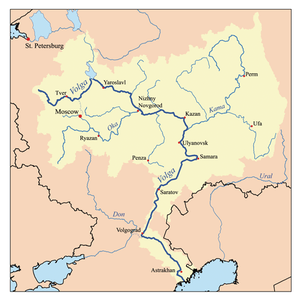
(above — Black Sea drainage basin; below — Volga river drainage basin)

volga


Russian-Turkish Geopolitics:

The economies of Russia and Ukraine depend on exporting bulk goods like oil, coaliron oregrainuranium, and manufactured goods. The easiest way for Russia and Ukraine to transport these goods is via ship or barge rather than by truck or train, for a number of reasons:

  • ships are generally the most efficient way of moving bulk goods long distances
  • the railways of Russia and Ukraine use a different gauge than those of other European countries and so do not directly connect to one another in most cases
  • most of the import markets for grain are in North Africa, the Middle East, or South Asia, and most of the import markets for goods like coal, iron ore, and Russian-made or Ukrainian-made weapons are in Asia
  • relying on land transport would make Russia and Ukraine dependent on Eastern and Central European nations like Poland, Romania, Italy, and especially Germany. It might also make Russia reliant on Ukraine or Belarus, which sit in between Russia and European markets.
  • The Volga-Don river system (the two rivers are connected to one another via a canal, next to Volgograd – formerly Stalingrad – which solves the problem of the Volga flowing into the landlocked Caspian Sea) is where nine of Russia’s sixteen largest cities are located, including Moscow
  • The Volga and Don rivers in Russia and the Dnieper and Dniester rivers in Ukraine are wide, deep, long, and relatively slow-flowing, and as such can be used by large vessels. Moreover, their extreme width – they are often about 5 km across, and far wider than that in many places – has made building bridges across them expensive, further constraining land transport alternatives.The Volga and Dnieper are especially visible in the satellite image below:

Russia and Ukraine have two main options for their water transport: via the Baltic Sea or via the Black Sea. The Baltic route has a number of crucial limitations too:

  • Ukraine does not border it directly, and Russia barely borders it directly
  • It generally freezes over a lot during the winter, particularly the Gulf of Finland where Russia’s main access to it, next to St Petersburg, is located
  • The populations of Russia and Ukraine mainly live in areas where the rivers flow towards the Black Sea rather than the Baltic
  • Accessing the Atlantic Sea via the Baltic would make Russia dependent on Baltic Sea powers like Germany, the Scandinavians, and perhaps even Poland, Finland, or Britain
  • The Baltic is an extraordinarily out-of-the-way route for exporting grain to the Middle East and Asia, or other goods and commodities to Asia
  • Most of landlocked central and eastern Russia and all of Russia’s sphere of influence in Central Asia are located much closer to the Black Sea than to the Baltic

If Russia and Ukraine are to use the Black Sea to reach international markets, however, they must be able to ensure passage through the gulfs on either side of the Crimean Peninsula, as well as through the narrow Turkish Straits next to Istanbul and through the Aegean Sea occupied by Turkey, Greece, and the Greek islands. Given that in recent years Russia has seized Crimea from Ukraine, involved itself militarily in south-eastern Ukraine, and built up the area around Sochi along the Black Sea, while at the same time Turkey’s economy has expanded and Greece’s has practically collapsed, the relationship between the Russians and the Turks has now become of particularly great importance.

Some other Turkish-Russian issues to watch:

  • The Syrian Civil War, which Russia has entered into more directly in recent weeks, and in which Russia and Turkey generally find one another on opposite sides
  • Turkey has become Russia’s main vacation destination. With Russia’s population aging and desiring to get away from Russia’s dark, cold, long winters, and with the recent Sinai peninsula attack on the Russian plane flying out of the resort haven of Sharm el Sheik threatening Russian tourism to Egpyt, which is Russia’s second largest vacation destination, this is a big issue.
  • More than 10 percent of Russia’s population is Muslim, and Russia also has a sphere of influence in Muslim Central Asia, in resource-rich Turkic countries like Kazakstan (where very large numbers of Russians live), Uzbekistan, and Turkmenistan.
  • Turkey wants to wean itself off its dependence on importing Russian energy, and then eventually supplant Russia as Europe’s energy supplier by connecting European markets to the energy producers in the Middle East, Eastern Mediterranean, and Central Asia
  • Turkey and Russia have both historically wanted influence in Bulgaria, a Slavic Christian Orthodox country, and Greece, a Christian Orthodox country. Russia has  looked to these countries as a source of leverage over Turkey, since the city of Istanbul is exposed to the borders of both and reliant on passage through the Greek Aegean. Bulgaria and Greece could also provide Russia with a winter vacation destination and, if intermodal transportation can become more efficient, a way to access the Mediterranean without passing through the Turkish Straits.
  • The Balkans continues to have tensions between Orthodox, Catholic, and Muslim groups – with the Orthodox closer to Russia and the Muslim ones to Turkey – and between Slavic and non-Slavic groups. Meanwhile, the Caucasus continue to have serious tensions between Christian Armenia, which is close to Russia and despises Turkey, and Turkic Muslim Azerbaijan, which is close to Turkey. Turkey and Russia are also the only two countries apart from Azerbaijan and Armenia to border Georgia, and in the past Russia has accused Georgia and Turkey of helping groups in the Russian Caucasus in places like Chechnya.

Europe and Arabia: A Geopolitical Perspective

As different as the Quran is from the New Testament, or the Constitution of France is from the Constitution of Saudi Arabia (which is, in fact, the Quran), these differences are arguably less important than those which seperate the geography of Europe from the geography of the Arab world.

Europe is a region of islands, peninsulas, mountains, rivers, forests, and marshes: natural barriers that have historically hindered the development of a unified European identity. The Arab world, on the other hand, is in effect an enormous coastal desert, stretching for nearly 8000 km from the Atlantic to the Indian Ocean and yet, with the exception of some notable mountain ranges around its edges, containing few internal barriers of any sort. This comparatively open landscape of the Arab world has allowed it to achieve a level of linguistic, religious, and cultural unity that Europe has rarely if ever been able to match.

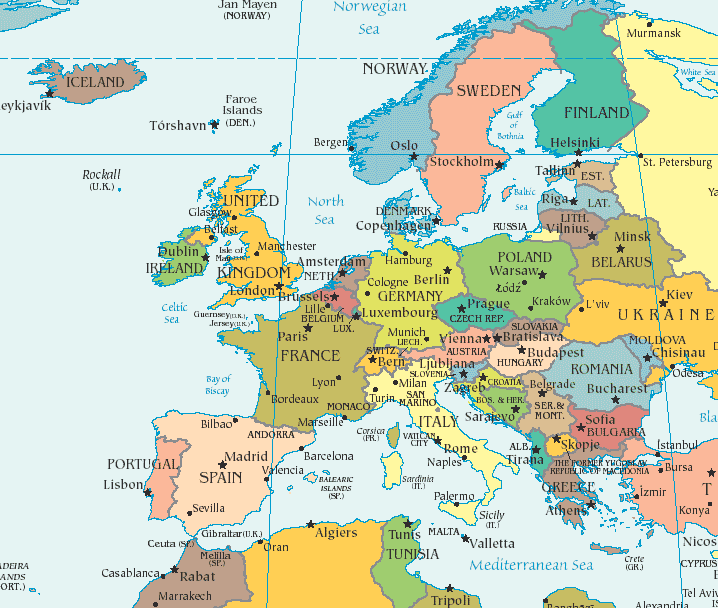
europe-medium

While the Desert and its coastal seas act as unifying force within the Arab world, the fact that significant supplies of freshwater can be found in just a few scattered areas within its gigantic territory (mostly in mountains, as in Morocco, Algeria, and Yemen, or in rivers, as in Egypt, Sudan, and Iraq) has meant that the pan-Arab identity it has fostered must compete with a wide assortment of intra-Arab identities, which in most cases have been far better than pan-Arabism at winning the allegiances of their inhabitantsIn addition, the geographic division between the Middle East and North Africa has led to sharp ethno-linguistic and political divisions between Arab and Berber peoples within countries like Morocco and Algeria.

The desert geography has also tended to make the Arab world relatively poor. This too is in stark contrast to Europe, which has become rich as a result of the commercial navigability provided by its numerous slow-flowing rivers, long coastlines, and sheltered seas and fjords, as well as by its luck in possessing a temperate climate and natural resources like freshwater, farmland, timber, and coal — and proximity to the natural riches of the Americas that it was able to access and exploit.

These opposing geographies have underlain the great historical contest between the “civilizations” Europe and the Arab world have cultivated for themselves. The advantage was first with Europe, arguably, as Italy, led by Rome, was able to conquer the entire Mediterranean basin as well as Mesopotamia, defeating the Carthaginians (a powerful Semitic empire based out of what is now the Arab state of Tunisia, which had controlled much of North Africa and Spain and was ethnically linked to the Phoenicians in the Eastern Mediterranean) and other African and Middle Eastern groups in the process. Even following the decline of the Christian Roman Empire, most of the inhabitants of the Middle East and North Africa continued to be ruled by Rome’s successor, the Greek-led Byzantine Empire (which was also Christian), for several hundred years.

Eventually the tables turned, however, and around 600 CE the Arabian Peninsula united under Muhammad and then expanded its control outward during the rule of his immediate successors, quickly conquering Spain, most of France (for a very brief period), and a large part of Asia. In turn, the Arabs were invaded and occupied by Central Asian groups like the Mongols and Turks; however, in a sign of Arab influence, most of the conquering Turks ended up adopting the religion of the conquered Arabs, and long outlasted the Mongols.

While the Arabs then lost their beloved Spain after a more than 700 year long struggle with Christian forces to keep hold of it, the Muslim Ottoman Turks made up for the loss by conquering all of southeastern Europe as far as the Austrian capital of Vienna, which they besieged in 1529 and again in 1683. Muslims also continued to spread the faith into Southeast Asia: many of the ancestors of people living in what is now Indonesia, which today has the largest Muslim population of any country in the world by far, adopted Islam during the 1400’s, almost a millennium after the death of Muhammad.

Of course, the Europeans ultimately regained the advantage over their Muslim neighbours. During the late 1400’s the Portuguese first sailed a route to India which avoided passing through Turkish or Arab-held territory, while, around the same period, the Spanish reached the Americas and the Russians surged into Muslim Turkic Central Asia, conquering territory they mostly continue to hold today. The greatest blow to Islam then fell in the 1700’s and 1800’s, as the Muslim Mughal Empire, which at its height had governed over almost a quarter of the world’s population, lost its hold on the Indian subcontinent to the British. The colonizing Europeans also took over Muslim populations in places like Africa and Southeast Asia.

During the 1800’s and early 1900’s, the Ottoman Turks forfeited southeastern Europe and the Arab world in a series of assaults aimed at them by European powers like the British, French, Russians, and Austrians. The Persian empire was heavily intruded upon by both the British and Russians. Finally, in the 1970s, the last super-sized Islamic state, Pakistan, was divided into two separate countries, Pakistan and Bangladesh, which do not even border one another anymore since India lies between them. Today Pakistan and Bangladesh are the world’s sixth and eighth most populous countries, respectively.

For many people, the battle between Europe and Arabia, or between the West and Islam, continues to this day. After losing its main source of wealth when Europe stole the control of trade with India and China away from it, most of the Middle East seemed likely to become somewhat irrelevant to global politics. Instead, it gained a new source of wealth in the modern era: oil. As recently as 2010, more than 15 percent of world oil production occurred in Saudi Arabia alone, while an additional 15 – 20 percent occurred in other Arab countries and 40-50 percent occurred in the Muslim world as a whole.

The Muslim world also accounts for close to a third of world natural gas production (led by Iran, Qatar, Saudi Arabia, and Algeria), and is estimated to possess over 60 percent of the world’s “conventional” proven reserves of natural gas (not including gas from shale) as well as over 50 percent of non-shale oil reserves and over 75 percent of oil reserves that are neither from shale nor from oil sands.

Today, partly as a result of the energy wealth it has gained during the past century, the Arab world has a population of approximately 380 million (in contrast to a century ago, when its population was significantly smaller than even any of the major European nation-states were at the time, without even counting the Europeans’ overseas empires) and a nominal gross domestic product of just under 3 trillion dollars. This means that, if the Arab world could somehow reunite politically, it would have the third largest population and fifth largest economy in the world. It would, in other words, become a Great Power again.

Needless to say, few of the Arab world’s neighbours want to see any serious pan-Arab union come into being. Arab unification was in fact very briefly attempted in modern times, in a formal sense, with the joining of Egypt and Syria to form the United Arab Republic, which lasted from 1958 to 1961. From a purely geopolitical perspective, the potential of such cooperation between Arab countries is especially worrying to regions like Europe because of the Arab world’s shared religious identity – and to a lesser extent, shared cultural traditions and linguistic affiliations – with other parts of the Middle East and Muslim world.

(The “classical” version of the Arab language, which is understood by scholars and clerics in every country of the Islamic world –  and by many other people too, to varying extents – because it is the language of the Quran, is one potentially important example of a unifying factor throughout the Middle East).

If combined with non-Arab Middle Eastern neighbours Turkey and Iran, the population of the Arab world would rise to more than 530 million and its GDP would rise to more than 4 trillion dollars. The states that comprise the Organization of Islamic Cooperation, meanwhile, have a combined population of approximately 1.6 billion and a GDP of approximately 7 trillion dollars — and they do not even include the estimated 180 million Muslims living in India, 25 million living in China, 16 million in Russia, or 20 million living in the European Union.

While in the West there is much talk of the Muslim world being stuck in an economic decline, Muslims actually continue to have a higher per capita income than Hindus do, or than Christians in Sub-Saharan Africa do. Many Muslim countries have a higher per capita income than China does, even today following decades of rapid Chinese economic growth. The past decade has in fact been a terrific one for most Muslim economies, with oil and gas prices rising sharply, the developing world as a whole growing solidly, and a number of countries with large Muslim populations, most notably Indonesia, Turkey, India, and Nigeria, growing very quickly.

Apart from economic growth, the Muslim world’s geopolitical trajectory has also been positive in the past generation, mainly as a result of the collapse of the Soviet Union having freed about 60 – 90 million Central Asian Muslims (the exact number depends on whether or not you count  Afghanistan as part of Soviet-occupied Central Asia) from Russian rule, along with the resource-rich, centrally-located region of Eurasia they inhabit.

Since then, some Muslims have been hoping or pushing for a further Islamic geopolitical revival, which many non-Muslim countries would obviously not be happy to see. Pan-Islamic sentiments have, to varying extents, found their way into local and regional disputes between Muslims and non-Muslims throughout the world, in places like Kashmir, western China, Palestine/Israel, various African countries, various Southeast Asian countries, the Caucuses (both within Russia and without), and the Balkans. Arguably, technologies like the Internet have been strengthening pan-Islamic identities as well.

The West has, of course, generally aimed to gain influence within the Arab world, in part to prevent it from ever becoming too closely united. Europe, Russia, and the US have historically been focused on gaining influence in Egypt, for example, as Egypt has by far the largest population of any Arab country, is more internally stable and united than any other large Arab country, and is strategically located, sitting directly in the centre of the Arab world and encompassing the Suez Canal.

The West has also focused on gaining influence in the Persian Gulf, in particular by allying itself closely with the tiny energy-rich Gulf monarchies (Kuwait, the UAE, Qatar, Oman, and Bahrain), as well as with  the royal family of Saudi Arabia and, not too far away, the Israelis, the Iraqi Kurds, and the royal family of Jordan. Given that the West is in some ways more powerful today than at any time in history (largely as a result of the rise of the US, which was completed with the fall of the Soviet Union), and that the Persian Gulf region is sharply divided between Arabs and Iranians, Sunnis and Shiites, and Iraqis and Saudis, gaining influence there has not been too difficult for the West to achieve.

And so, even leaving aside social values or issues explicitly tied to religious belief, many Arabs believe the West is acting unjustly or aggressively towards them. Most believe that the current political borders of the Middle East are artificial, imposed on them a century ago by ignorant or sinister British and French politicians. There is certainly truth to this, though, in defence of the British and French, some of the borders that were drawn actually did accurately reflect some of the existing social and geographic divisions within the Arab world.

With a number of possible exceptions, such as Kuwait and Lebanon (which arguably should not have been created as independent states), Israel and Palestine (which arguably should have been created as a single state, perhaps even including neighbouring Jordan as well), and Kurdistan (which arguably should be created out of parts of Turkey, Iran, Iraq, and Syria, though even this is more complicated than it is often portrayed), it is not clear that the borders in the Middle East could actually be all that improved upon. But of course, this is a topic worth debating in much greater detail.

It is also not only the Christian world that has been responsible for messing with the “natural” borders of Arab lands. Iran and Turkey, for instance, both refuse to give up Arab-inhabited regions of the Fertile Crescent they possess; a more consistent geographic or cultural rendering of Middle Eastern borders should perhaps have included Turkey handing over its province of Hatay to Syria (as Syria still officially claims it should) and Iran handing over its province of Khuzestan to Iraq.

Yet most people who complain of Western-imposed artificiality among the borders of the Arab world are not concerned with either of these areas, even though both are significant to the politics of the region (especially Khuzestan). Indeed, while Arab bitterness toward Europe’s past imperialism remains wholly justifiable, complaints of imperialistic European map-drawing in the Arab world nevertheless tend to be somewhat exaggerated. If you want to see truly unfair and dangerously-drawn borders the Europeans were responsible for, you should not even begin to think of the Middle East, but look instead to regions like West Africa or Central Asia.

west-africa-map

cas923

The Other Greek Economy

Four months ago, Greek politics dominated the news. Even the Chinese stock market downturn, in which the Shanghai index dropped by over 30 percent in the month leading up to the Greek referendum, took a far backseat to Athens on every broadcast. Greece’s own stock market fell nearly to 26-year lows at the time, was shut down for five weeks in July, and then, immediately upon reopening, set a modern record by losing more value in a day than even Wall Street had on Black Monday in 1987. Even today the Athens index remains 11 percent lower than it was during its midsummer hiatus.

(All graphs compiled by author unless otherwise stated)

The media’s focus has completely flipped since then: it is now China’s economy and its impact on commodity prices that has the world’s attention. Even the re-election of Greek Prime Minister Alexis Tsipras and his political party Syriza a month ago barely made a blip in American news coverage; it fell well behind other stories like the visits of Pope Francis and Xi Jinping to the United States, the ongoing migrant and refugee flows into Europe, and the Volkswagen emissions-hiding scandal. One wonders if the Greek economy will soon grab the global spotlight once more as it has periodically been doing for almost a decade now, or if new media and economic patterns are emerging instead.

This article is not just about Greece, however. It is also about the world’s only other Greek-speaking state, Cyprus. The Greeks and Greek Cypriots have a lot in common with one another, financially speaking. Both use the euro as their currency, both have been struggling with severe bailout-related crises, and both depend quite heavily on imported oil. (See the two graphs below; also, notice in the graph above how the Athens stock market index responded to the two US invasions of Iraq, which many investors worried would cause the price of oil to spike in the short-term).

This dependence on imported energy, like that of other struggling European countries such as Spain and Portugal – and in stark contrast to Scandinavia, Britain, the Netherlands, and most of Eastern and Central Europe, which produce a lot more of their own fossil fuels or else have less energy-intensive economies- has generally been overlooked in the popular narrative of the Eurozone crisis, which has instead tended to emphasize cultural differences that exist between northern and southern European countries. Yet while it has been much more common to explain Europe in terms of thrifty, efficient Germans and nifty (or shifty) tax-dodging Greeks, the cost of importing energy was perhaps even more significant a factor in weighing down Europe’s Mediterranean economies relative to northern Europe when crude oil was still at well above $100 per barrel.

[Even Italy, which unlike other southern European economies is a mid-sized oil producer in its own right, with a slightly higher oil production than Germany or than the combined oil production of France, Spain, Turkey, and Greece, has still been hurt by energy economics: it is the world’s third largest natural gas importer, and was a leading customer of Libya before Gaddafi was overthrown. Still, Italy’s unemployment rate has not been nearly as high as Spain’s or Greece’s in the past decade (though notably, when oil prices were low around the turn of the millennium their unemployment rates were roughly the same), and indeed, Italy’s unemployment rate has even been lower than that of southern France].

This year, in contrast, when oil and gas prices have plunged, Spain has been the fastest-growing economy in Western Europe, experiencing a bigger GDP gain than it has in any year since 2007. Portugal and France are also thought have grown by a relatively decent amount, and Italy to have avoided recession. The two Greek economies are looking at Spain and hoping for a similar much-needed bounce.

Cyprus – or, more accurately, the 63 percent of Cyprus’s territory and 76 percent of Cyprus’s population that is governed by Greeks rather than by Turks – retains close ties to mainland Greece. Cyprus and Greece tried to unite formally in 1974 under the control of a Greek military junta, prompting a Turkish invasion of the island, and today Cyprus remains dependent on Greece for an estimated 20 percent of its trade as well as  for much of its foreign investment. Had the Eurozone Grexit actually occurred as many expected it would, it could probably have triggered a “Cyprexit” as well, which doesn’t have quite the same ring to it.

Cyprus’s relations with Turkey remain poor, meanwhile, and Turkish-inhabited Northern Cyprus continues to go diplomatically unrecognized by every country in the world outside of Turkey. That said, in 2008 the wall between Greek Cyprus and Turkish Cyprus that ran through the largest city on the island, Nicosia, was taken down, and in 2014, a decade after a failed reunification referendum in 2004, reunification talks were renewed between the two sides.

Now could be a good time to think about investing in Cyprus, not only because of how un-repeatably poorly it has done in recent years or because of the “White Swan” possibility that it could surprise the world by signing a deal that would finally reunify its two estranged halves, but also because its economy could perhaps benefit more than any other in Europe from today’s lower oil prices.

Indeed, Greece too, as well as other nearby countries like Serbia, Bulgaria, Croatia and to a lesser extent Turkey, could similarly benefit from the mix of relatively low oil prices and extremely low expectations. Growth in these countries could also benefit Cyprus, particularly if technology increasingly allows Cyprus to become even closer with its fellow Greeks in Greece and Turks in Turkey.

(Cyprus is located about 900 km from Athens, where around a third of Greece’s 11 million people live, and 750 km from Istanbul, which is the world’s fifth largest city by some measures. Cyprus is, in fact, located closer even to Moscow, Lahore, or Addis Ababa than it is to its fellow Eurozone members in Dublin or Lisbon).

Cyprus’s general stock market index has already fallen by 24 percent in the past year and by over 90 percent since 2011, so it might now be possible to pick up some valuable Cypriot assets for a cheap price.

Here are ten other things about Cyprus and Greece to consider:

1. Cyprus speaks English better than most other European states (with the exception of Scandinavia, the Netherlands, Switzerland, and Austria, which are also excellent at English) because it was controlled by Britain from 1878 until 1960, maintains a British air force base today where over 8,000 Brits continue to live along with their families and thousands of Cypriot employees, and has a large international tourism sector. Cyprus’s neighbors, namely Greece, Israel, and Lebanon, are also great at English. Egypt, another former British-ruled neighbor that attracts lots of tourists, is not too bad at English either, and is getting better because its population is still extremely young.

english %

Note: Second-language statistics are difficult to be certain of, so you should take this graph with a large grain of salt.

2. Cyprus and Greece are both not too dependent on exports of goods and services, compared to other European countries. In fact, as the graph below shows, Greece is the only small economy not to be dependent on exports; the other six countries closest to the top of this list are Europe’s six largest economies. Not being too dependent on exports is probably a good thing for Greece and Cyprus right now, considering that economic growth in Europe and the world has not been strong this year.

exports
(You will notice, for example, that Ireland is by far the most dependent on exports, which may be part of the reason it was hit especially hard during the global financial crisis and recession around 2008. In contrast, Turkey, which may be the least export dependent, bounced back strongly from the global recession, notching an estimated nine percent GDP growth in both 2010 and 2011).

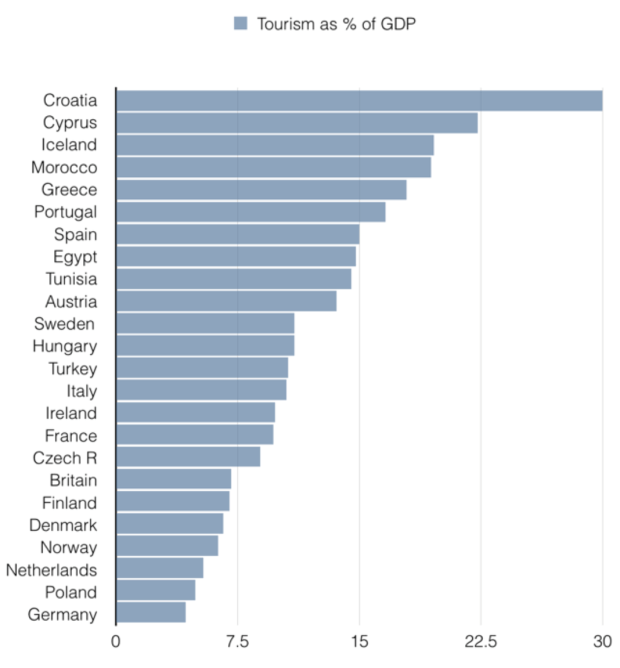
3. Cyprus, even more than Greece, is economically dependent on tourism. Going forward, both hope to attract aging northern Europeans – including Russians, who like Greeks are Christian Orthodox – fleeing the winter and now being able to vacation abroad more easily because of technologies like the Internet. With Russia having frigid winters, a population of 144 million (by far the largest in Europe), and a Baby Boomer cohort that is now almost 60 years old on average and mostly cannot afford to travel to more distant and more expensive summer vacations in places like Spain, Italy or France, both Cyprus and Greece are hoping for a big tourist increase in the years ahead.
tourism

One area to look to here is Turkish-Russian relations. Turkey has become the biggest destination for Russian tourists in recent years, but if the relationship between the two regional powers deteriorates again as historically it has on many occasions (in fact they have already begun to deteriorate in the past week), more Russians could be steered toward Greece, Cyprus, and the Balkans instead, as well as toward countries like Egypt which has been Russia’s second most popular tourist destination in recent years.

Another place to look is the Caucasus, both within Russia and without: any renewed militancy in that region could threaten Russia’s tourist infrastructure build-up around Sochi along the coast of the Black Sea. The same is true for the Balkans, where dormant conflicts in tourist havens like Croatia could, if they were to turn violent once again, make Cyprus and Greece more appealing alternatives.

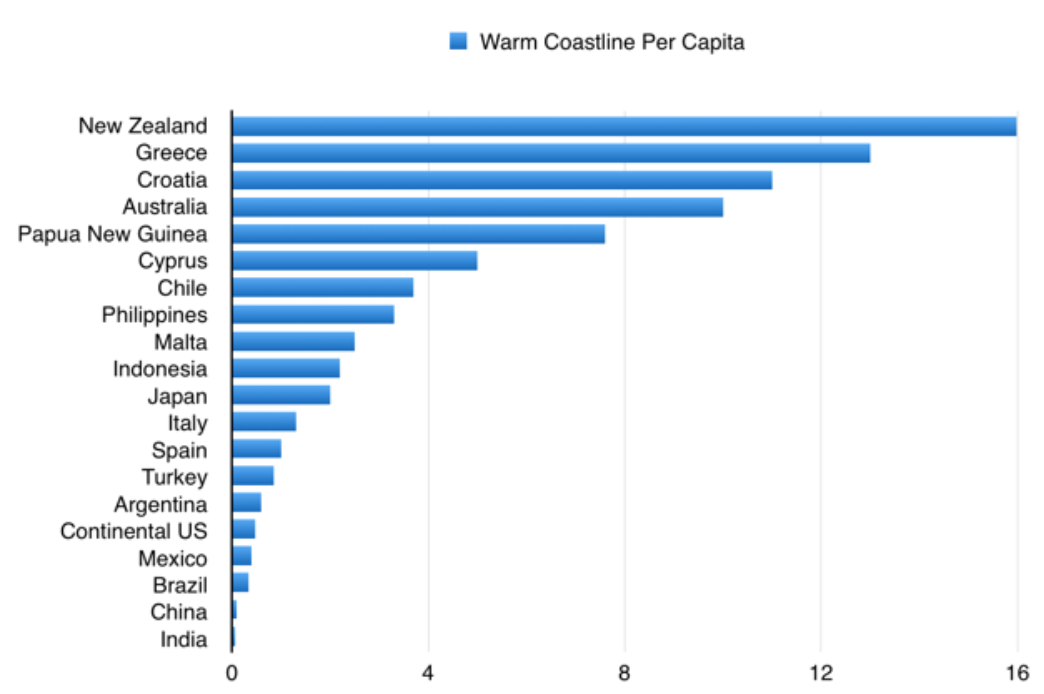
4. It is difficult, and in a certain sense effectively impossible, to find good statistics on the length of countries’ coastlines, as a result of the coastline paradox. That being said, I have given it a rough shot, and come up with the following stats:

coastline

It shows that, along with the remote New Zealand-Australia-Papua New Guinea region in the southern Pacific, the Greece-Cyprus-Croatia region has by far the world’s longest warm-climate coastline per capita. In fact, even Turkey, with a population of 74 million, does not do too badly in this respect since it has lengthy coasts along the Mediterranean, Aegean, and Black Sea. Considering how much people like owning seaside land, this could be a good characteristic to have. Nearby Italy also does somewhat decently, because of its long peninsular shape and its islands of Sicily and Sardinia, which are the only two Mediterranean islands with a larger population than Cyprus.

5. According to the World Bank, Cyprus has one of the lowest “total age dependency ratios” in the world and, with the exception of Slovakia, the lowest total age dependency ratio in all of Europe. The total age dependency ratio measures the number of people in a country aged 15 and under or 65 and older relative to those aged 15-65. Cyprus has very few children or seniors relative to the size of its working-age population, which is arguably a very good thing to have. Greece, on the other hand, does not have this, as you will notice on the graph below.

Total Age Dependency Ratio

Cyprus also has the lowest share of its population aged 80 years old or older in Europe with the exceptions of Slovakia and Ireland. Cyprus’s neighbors – Israel, Lebanon, Turkey, and Egypt – have even smaller shares of their population aged 80 years or older. Greece, in contrast, has the highest share above 80 in Europe with the exception of Italy, which is likely part of the reason its public finances are so strained. Other troubled economies like Spain, Portugal, and France are at the very bottom of this 80-and-up list, along, interestingly, with Germany.

80+ ratio

The same is true of the “Old Age Dependency Ratio”, which is the number of people a country has aged 65 years and older relative to those it has aged 15-64.

old age ratio

6. Outside of Scandinavia or the former Soviet Union, both Greece and Cyprus have some of the most land per capita in Europe, as can be seen in the graph below. So too do some of their neighbors, like Turkey and other Southeast European countries. This relative wealth of land could be good for Greece and Cyprus, but there is also a catch: Greece, and especially Cyprus, are lacking in freshwater. Indeed as the second graph below shows, Cyprus is the most water-strained country in Europe.

pop density
figure05_03.png.75dpi
Graph Source: European Environment Agency

And of course, many of Cyprus’s Middle Eastern neighbors are in very poor shape on this front as well, though some, like Israel, are trying to come up with technological solutions for their freshwater shortages – and both seawater desalination and wastewater treatment are significantly cheaper to do when energy prices are low as they have become in the past year.

Two months ago, by the way, Turkey finished constructing a freshwater pipeline to Northern Cyprus which, at 80 km in length, is the longest underwater water pipeline in the world. It is supposed to have a significant effect upon Northern Cyprus’s agricultural production. Greek Cypriots are wary of becoming dependent on this pipeline, however, and Turkey is far from being rich in freshwater itself.

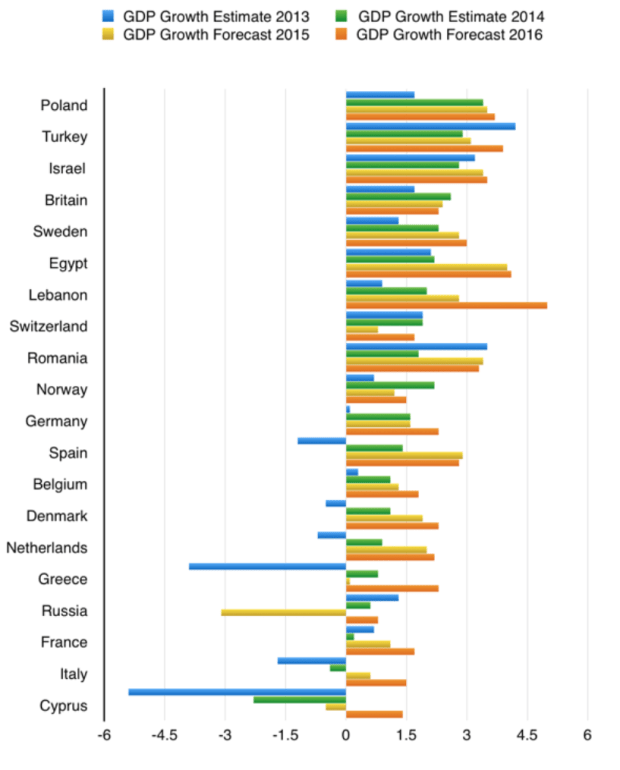
7. This graph below shows that Cyprus’ economy performed abysmally in 2014 and especially in 2013, yet is expected to finally start growing again in 2016. Greece, meanwhile, already started growing again in 2014 and is forecast to do so even more in 2016 while Cyprus’s closest neighbors, Lebanon, Israel, Turkey, and Egypt, are expected to grow quite quickly in 2015 and 2016.
gdp growth europe

Other Mediterranean economies, particularly Spain, are also expected to recover from their poor performances in recent years, and Russia is expected to start growing again in 2016 after the sharp contraction it has been experiencing in 2015. Three other countries in Cyprus’s general neighborhood, Syria, Ukraine, and Libya, have of course also been doing horribly in recent years, and will hopefully recover as well.

8. Britain has had very strong economic growth this year compared to many other countries in Europe or the developed world. This could help Cyprus since the two countries retain ties in a number of different ways, even beyond the tourist or banking sectors. Britain is in fact home to a large Greek Cypriot diaspora, most of (the first generation of) whom left the island when the Turks invaded in the mid-1970s. Today the Cypriot population in Britain is about 20-25 percent as large as that of Greek Cyprus itself. With London and Cyprus over 3,000 km apart from another, British economic growth as well as distance-shrinking technologies like the modern Internet could help the Cypriots benefit from their British connections.

Another country with potentially close ties to Cyprus, as we have already discussed, is Russia. Russia’s economy had a bad year as oil and other commodity prices fell, but it is nevertheless expected to start growing again at a fairly decent pace in the years ahead, at least relative to more developed Western European economies.

Moreover, it is not impossible that Russia’s slowdown could actually benefit Cyprus, if wealthy Russians worried about their domestic situation decide to start parking more of their assets abroad in these countries. That said, Russians may be less likely to do so than they used to be, because in 2013 the Cypriot government used the excuse “it’s just the money of shady Russians” in order to help justify its seizure of cash from Cypriot bank deposits in accounts with over 100,000 euros in order to pay off Cypriot debts.

9. Cyprus has resources it can use to play a role in the global battle against coal production. As of 2011, it generated more solar power per capita to heat space or water than any other European country: 611 W per capita, compared, for example, to 385 W for Austria and 253 W for Greece, and 120 W for Germany, which were some of the other top solar producers in the region. Cyprus and Greece also potentially have wind power because of their long coastlines per capita and because of their many windy cliffs and hilltops.

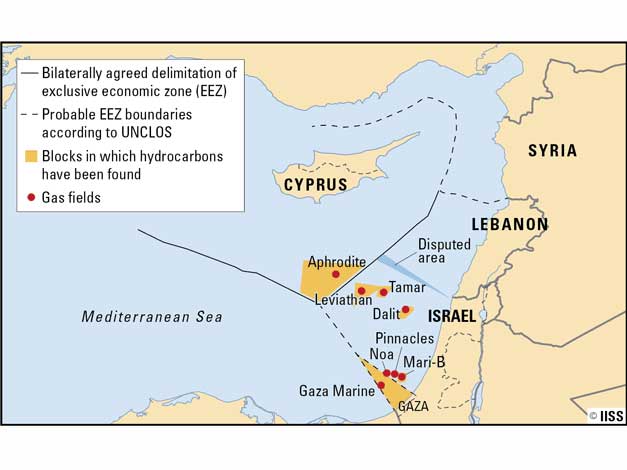
Cyprus, and perhaps Greece as well, may also have large reserves of offshore natural gas. The Eastern Mediterranean around Cyprus has been the site of some of the world’s largest discoveries of late, not only in Cyprus, but also in neighbouring waters off the coast of countries like Israel. Less than a month ago, in fact, the Italian energy company ENI may have found the Mediterranean’s largest discovery ever in Egyptian waters not too far from Cyprus’s. The Egypt gas find could put Cyprus’s gas production dreams at risk, though in theory it could also help justify the construction of an underwater pipeline to Europe that both countries could feed their gas into.

Gas-Claims-in-the-Eastern-Mediterranean468x351

At present, Cyprus faces logistical challenges in exporting its gas to Europe, particularly if it does not want to be dependent on exporting via a yet unbuilt pipeline that would run underwater to Turkey, which has an estimated construction cost of 3 billion dollars, in comparison to the estimated 10 billion dollar gas liquefaction and export terminal that it has been considering building instead.

Still, its gas could ultimately prove valuable if, for example, Western Europe’s relationship with Russia continues to deteriorate, if gas production in fields in the North Sea continues to drop, if its gas supplier Algeria undergoes any political instability like it faced in the 1990s as its leader Abdelaziz Bouteflika (who has ruled since 1999 and is now thought to be 78 years old) continues to age or passes away, or if government pricing of carbon emissions rise a lot and thus make gas ever more desirable when compared to coal.

10. Cyprus’s position next to the Suez Canal, which was expanded this year, puts it in a position astride some of the world’s major shipping lanes. By sea, Cyprus is halfway between Mumbai and London, and halfway between New York and Kuala Lumpur. Cyprus’s ability to leverage its central shipping position to become a significant manufacturing economy has thus far been limited by its lack of a sizeable labour force, as its population is barely more than a million. Going forward, however, as machines become used more and more in industry in place of human labour, Cyprus’s manufacturing output could perhaps take off, if – a very big if – it can produce a skilled workforce to run its industries and cheap energy to power them.

Greece, similarly, has an enviable position near Suez and at the point where the Black, Adriatic, and Mediterranean seas converge, and has more natural harbours and sheltered seas than perhaps any other country in the world. It is in fact these protected coasts which allowed its city-states and kingdoms to dominate regional commerce throughout most of antiquity, and to have more registered merchant vessels in the present day than any other country in the world apart from China.

20151017_INC168
Greece_map_01
In theory, Greece could save ships traveling between Asia and Europe from taking their usual lengthy detour through the western Mediterranean and northern Atlantic. The Greek port of Piraeus next to Athens already handles more containers ever year than all but three other ports among Mediterranean EU countries and eight other ports in the EU as a whole. By 2016 it may become the Mediterranean’s largest port. As of 2013, according to Eurostat, Greece handled approximately 5 percent of the European Union’s “gross weight of seaborne goods handled”, which is a lot considering that Greece only accounts for an estimated 1.3 percent of the EU’s overall GDP.
mediterranean-relief-map-4578708

Similarly, Russia could be likely to look to Greek ports as a way of carrying out trade that bypasses the Turkish Straits that separate the Black and Mediterranean seas and the Skagerrak Strait that separates the Atlantic from the Baltic Sea. Given Russia’s escalating involvement in the Syrian civil war, which is hurting Russia’s relationship with Turkey while at the same time making it need to send supplies into the Mediterranean through Turkish waters, Russian access to Greek ports could become especially important.

In order to do this, however, Greece would need to overcome the political and geographical challenges of transporting goods overland between Greek ports and European (or Russian) markets via Southeastern Europe. In addition to logistical challenges, doing so would also represent a direct challenge to the established megaports of the Netherlands and Belgium, as well as to the hopes of Italy which would like to achieve a similar goal for the coast along its own southern heel.

That said, there may actually be some reasons for Greece to be hopeful in this area. Greece’s ports are roughly 20-40 percent closer the Suez Canal by ship than southern Italy is, and Greece has far more and better sheltered harbours than southern Italy does. What Greece really needs, however, is a much cheaper way of transporting goods via its rugged mountain roads, as well as a cheaper way of transporting goods intermodally so that it would not be too expensive to unload goods at Greek ports, take them by land to the Danube River (which is 400 km from Thessaloniki and 850 km from Athens), and then load them back on to barges or trains in order to get them to their final destinations in Europe. (The Danube-Main-Rhine canal was completed in 1992, and can handle barges up to 190 metres long and 11.5 metres wide, with a depth of 2.7 metres).

I don’t want to dig in to this topic here, but I suspect there are technological reasons to think that both of these challenges might actually be overcome in the not-too-distant future. In fact it may wind up being the political factors, rather than the purely logistical ones, that are more difficult for Greece to get past. In particular, Bulgaria, Romania, or Hungary could put up formal or informal trade barriers that make it difficult for such a trade corridor to become prominent, and the former Yugoslavian countries in the Balkans could be too unreliable to provide alternative overland routes.
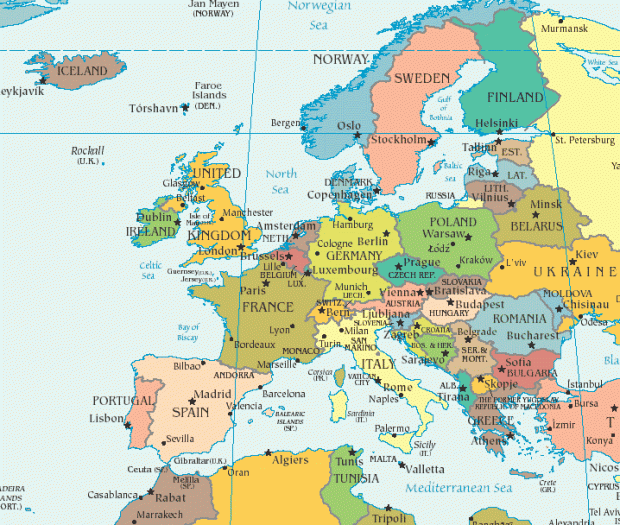
Europe-map


Why Israel Won’t Let the West Bank Go

let my people go

Most of Israel’s critics argue that any Israeli claim to the moral high ground is compromised by the fact that the Israeli military has been dominating the West Bank since 1967, thereby denying the Palestinians the ability to ever form their own state. While of course there is some truth to this argument, it nevertheless ignores a critical point: Israel believes it must control the West Bank, at least for now, in order to ensure its own continued safety over the long-term.

Even though religion is the key motivator for most of the Jews and Christians who have settled or support Jewish settlement within the West Bank, Israel’s desire to control the West Bank is not ultimately rooted in religion, but rather in physical geography and presumed strategic necessity.

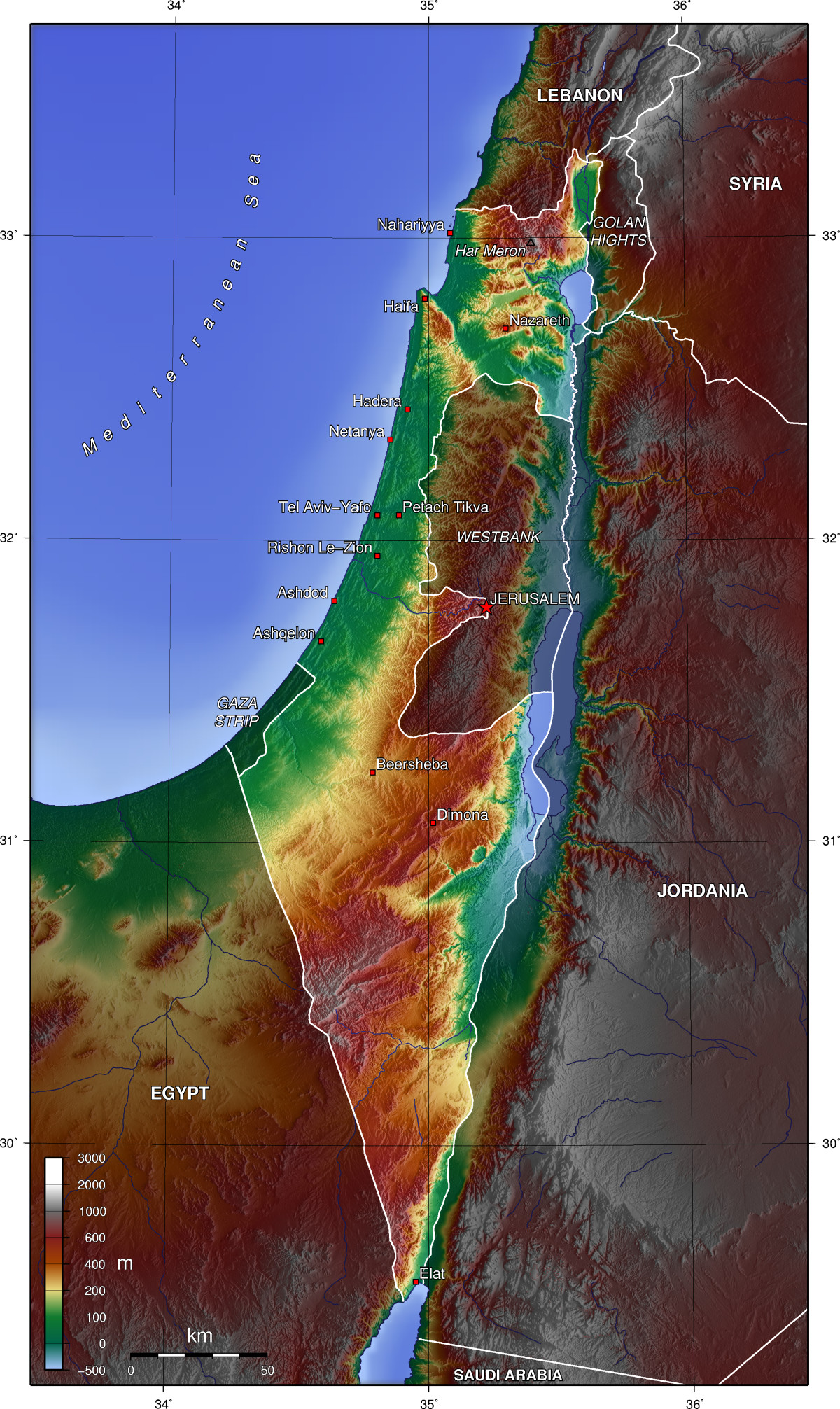
By dominating the West Bank, Israel gains control over the Jordan Rift Valley, a steep-walled, incredibly deep canyon containing a number of the points on earth that are the furthest below sea level, through which the Jordan River (which is really more like a stream) flows into the Dead Sea. The rift valley has historically served as an excellent defensive barrier against invasion or incursion. Israel uses it both as a defensive border with Jordan and as a barrier separating the estimated three million Palestinians living in Jordan from the three million Palestinians living in the West Bank. Israel is hardly alone in wanting control over this valley: about seven different African states also use the Jordan Rift Valley (in Africa it is called the Great East African Rift Valley) as an international border.

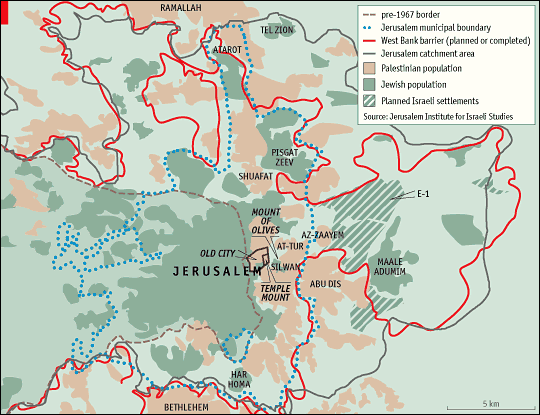
Even more important, the West Bank allows Israel to control the hills and highlands that surround Jerusalem on three sides and directly overlook nearly every other major Israeli city. The average elevation of a West Bank hill is about 700-1000 metres above sea level.  Tel Aviv, in contrast, sits roughly at sea level, with its downtown core just 20 km away from the West Bank and with a number of its suburban areas, like Modi’in or Rosh Ha’ayin, within 2 – 10 km of the West Bank. The Jordan Rift Valley, meanwhile, sits around 200-400 metres below sea level. And the centre of Jerusalem is within 2-4 km of the West Bank in every direction except due west.

Israel_topo_en

CSF999

(Source: The Economist)

Managing the West Bank also lets Israel have control over any movement between West Bank Palestinians and Palestinians living within the pre-1967 borders of Israel, the latter of whom account for an estimated 20 percent of all Israeli citizens. Most Israeli Arabs outside of Jerusalem live in a region of hills and low mountains that is just around 20-60 km north of the West Bank, within which they make up about 50-75 percent of the regional population. This region also happens to be strategically crucial for Israel, as it borders Lebanon and overlooks Haifa (Israel’s largest port and third largest city) and the Jezreel Valley, the latter being Israel’s route to the the Sea of Galilee and Golan Heights, which is where the majority of Israeli freshwater is located and which serves as a relatively defensible Israeli border with Syria, Lebanon, and Jordan.

Israel’s continued occupation of the West Bank, then, is most likely the result of Israel’s intense desire for security, rather than the result of the Israeli government being a uniquely radical one. Indeed, it is possible that the Israeli government’s support for religious Jewish civilians settling the West Bank is based for the most part on the notion that these settlers are likely to help cement Israel’s strategic control over the region, rather than being a result of, as most critics of Israel believe, the Israeli government’s having been cowed or infiltrated by religious Jewish extremists. Of course, this does not mean that extremist views have not also become much too influential within Israeli politics.

The idea that Israel faces meaningful threats is not some outdated relic from the earlier days of Zionism when the country’s power was not yet fully-formed. To the contrary, it was only a decade or so ago, between 2001 and 2005, that a thousand Israelis were killed by Palestinian militants, most of them in suicide attacks. Relative to the size of Israel’s population, that would be the equivalent of about 45,000 Americans being killed, roughly nine times more than have died in Iraq and Afghanistan combined. In addition, Israeli attacks during this conflict claimed the lives of an even larger number of Palestinians.

Perhaps more worrying than the prospect of another intifadah, however, is the possibility – however unlikely – that Israel could suffer thousands or even millions of casualties by militant groups or individuals armed with weapons of mass destruction. This threat too may inform Israel’s continuing presence in the West Bank. If, for example, a country that has nuclear weapons, such as Pakistan, were ever to collapse into extreme chaos, one of Israel’s main defences would probably be to seal its own borders, and perhaps also to establish buffer zones in areas like the eastern Sinai Desert or southern Lebanon, until it could ascertain whether or not any such weapons were likely to have gone missing.  The goal would be to protect its core territories between Tel Aviv, Jerusalem, Haifa, and Be’ersheva.

This strategy might be an effective one, not only because Israeli borders are fairly short and carefully guarded, but also since it is extremely challenging to properly adapt a nuclear weapon for a missile – particularly a long-range missile – and because Israel has a relatively sophisticated missile defence system that it hopes to continue to improve over time. The weak link in the defence, however, could be the Palestinian territories, in which there are long-established smuggling, militant, and short-range missile networks as well as borders which are adjacent to major Israeli cities.

The West Bank poses a danger in this sense, because it directly borders and surrounds Jerusalem, overlooks the suburbs of Tel Aviv and Be’ersheva, and has a long external border with both Israel and Palestinian-inhabited Jordan. Indeed, the West Bank’s border with Jordan is more than 10 times longer than Gaza’s border with Egypt; the West Bank’s border with Israel is more than 6 times longer than Gaza’s. As such, Israel’s ability to respond to a nuclear threat arguably appears to depend on its ability to control the border of, or movement within, the West Bank. If you think this sounds paranoid, you may or may not be right – but still it is not surprising that security officials who live in dangerous places like Israel often think this way. The memory of the Holocaust also looms large in these considerations.

This does not mean that there is not a strong religious current running through the Israeli government and helping to drive its policy of expanded settler activity, or that the Israeli government’s alliance with portions of the religious right-wing is not a cynical one. Indeed, by issuing a claim on the West Bank that appears to be irrational – namely, that Israel has a right to it because Jews controlled it during parts of the Biblical era, or that God Himself granted it to the Jewish people – the religious right often dilutes and, in effect, undermines the true security-based explanation for Israel’s ongoing occupation of the West Bank.

Given that Israeli politicians understand Israel’s security situation extremely well, as many are themselves former military commanders or security officials, this also suggests that the Israeli government has been at least somewhat disingenuous with regard to the offers it has extended for a two-state solution in recent years or decades. Unless real trust is formed between Jews and Palestinians, or unless Israeli technology reaches such an advanced state that geographically-rooted security considerations are finally rendered meaningless, it seems unlikely that the Israeli leadership would ever remove its military from the West Bank in its entirety. Israel might not even be willing to remove much of its civilian settler population within the West Bank, as that can double as a security and intelligence force or political bargaining chip in times of crisis. The government’s offers to do so during peace talks, therefore, were perhaps never wholly intended to succeed, but may instead have been extended mainly in order to placate outside observers like the United States and Israeli peacenicks.

Clearly, the Israeli government has made, and continues to make, important mistakes. Many of its actions may even be cruel or counterproductive. Still, it is worth remembering that the primary motivation for the Israeli occupation of the West Bank is its very real and plausibly even existential security concerns, rather than its religious land-claims or nationalistic expansionism. The geopolitics of Israelis and Palestinians are simply intertwined now, and both must somehow find a way to make the best of a very dangerous – and, especially for the Palestinians, very tragic – situation. Getting God out of politics might be a good place to start.


Iran’s Weakening Position

Iran_topo_en

Originally written for Times of Israel

There is a fear in Israel that, with the signing of the nuclear deal two days ago, the United States may soon become allies with Iran. While this is not an irrational fear, it is important to remember that such an alliance actually already took place about a decade ago – and Israel made it through it in one piece. Back in 2001 and 2003, the United States effectively aided Iran by toppling the Sunni Arab government of Iraq and the Sunni Pashtun government of Afghanistan, paving the way for a Shiite, Iranian-influenced government in Baghdad and for empowered Shiite and Tajik (who are Persian-speaking) factions within northern and western Afghanistan.

The worry at that point was that Iran would build on its gains in the region by spreading its influence into Saudi Arabia’s Eastern Province, which is where most Saudi energy production is located and is, unlike the rest of Saudi Arabia, primarily inhabited by Shiite groups. Had that happened, or had Iran gained too much influence within the other energy-rich Gulf kingdoms, it would have become the dominant Muslim power in the Mideast. It was in this context that the Israeli, Saudi, and American rivalry with the Iranians intensified.

It is important to understand – and Israeli leaders do understand this, though they generally pretend not to while in public – that this situation no longer exists. Iran remains a critical country within the region, of course; but then again, so do Saudi Arabia, Egypt, Turkey, and Israel itself. The threat of Iran becoming the leading power within the Middle East is, for the moment at least, no longer significant. Indeed, the rising Muslim power of the region appears to be Turkey, not Iran — and, not incidentally, Turkey’s once-thriving relationship with Israel has deteriorated a great deal in recent years, first with the Gaza flotilla incident in 2010 and then with Turkey’s backing of the Muslim Brotherhood in 2013.

In contrast, Israel’s relationship with Iran has been improving a bit – though, again, you wouldn’t know it from listening to politcal rhetoric – as Iran’s relationship with Sunni Hamas has been damaged as a result of Hamas’ support for anti-Assad Sunni rebels (the Hamas leadership left Damascus for Doha in 2012, becoming closer with countries like Qatar and Turkey), Shiite Hezzbolah appears to be far too busy worrying about the Syrian Civil War to engage Israel in another war like it did in 2006, and Iran and Israel have increasingly found themselves allied with the same foreign countries, such as the UAE, India, and soon, perhaps, the United States.

This is not to say that Israel does not have a great deal to fear from the Iranians. But while Iran continues to grab headlines, the truth is that Iran’s regional standing is much less than it was. Israel has plenty of other worries, meanwhile, such as the Sunni Arabs, the Sunni Turks, the Sunni Palestinians, and the possibility of nuclear weapons falling into the wrong hands if a country like Sunni Pakistan were ever to collapse into internal chaos. The overwhelming, single-minded focus on Iran as the primary rival of Israel is, at least in part, likely a public relations stunt, probably having something do with domestic Israeli politics, or a result of the US and Israel having agreed to play “good cop-bad cop” with the Iranians because the Americans’ Saudi allies – who continue to be much more fearful of Iran – are not willing or able to play the role of bad cop themselves.

Consider that Israel has historically viewed Iran, even post-1979 Revolutionary Islamist Iran, as a Shiite Persian bulwark against the Sunni, Arab, and Sunni Arab worlds. As recently as the 1980s, during the Iran-Iraq War, the Israeli military directly attacked the Iraqis, and later helped to supply the Iranian religious government with weapons. Today the Muslim world remains roughly 90 percent Sunni, placing Shiite Iran in an inherently weak position. Indeed, Iran is itself is only about 50-60 percent ethnolinguistically Persian; most of the rest of its population are Arabs, Kurds, or Turkic Azeris, many of whom share ties with Iran’s regional rivals. As such, with only a few exceptions, Iran has often been defeated when it has had to face off against an external power like the British, Russians, Arabs, or Turks.

Here’s a quick list of eight factors that have caused Iran’s positon to weaken over the past decade or so:

1. Low Energy Prices

Energy prices were generally very high from about 2004-2014, but now they are not. The falling price of energy hurts countries like Iran and Saudi Arabia, and empowers countries like Israel and Turkey. Of course, prices could rise again — though if sanctions on Iran do end, they will probably continue to fall instead. Unless prices do rise, the Persian Gulf will simply not be as important as it was.

2. The Syrian Civil War

The Syrian war has not only weakened Iran’s position in Syria, but also in Gaza, since Hamas and Iran have backed different sides in the war; in Lebanon, where Hezzbolah is fearful of an Assad loss and thus relatively unable to focus on Israel; and, most importantly, in Iraq, where the weakening of Assad has led to the growth of ISIS. Unless Assad and the Iraqi Shiites can reassert their influence over the Sunni-inhabited Iraqi-Syrian borderlands, this situation is likely to persist.

3. “Bahrain Spring” Crushed by Saudis

Iran’s best chance to destabilize Saudi Arabia via its Shiite-populated energy-rich Eastern Province was during the Arab Spring, when large numbers of protestors representing the significant Shiite majority population of Bahrain, which is connected to Saudi Arabia’s Eastern Province by a causeway, were attempting to overthrow or coax democratic reforms out of the Sunni Bahraini royal family. Instead, the Saudis led what what was in effect an invasion of Bahrain, in order to keep the Sunni Bahraini royals in power. This was Iran’s chance, and it was missed. There may be other chances for Iran to throw its weight around in the Persian Gulf in the future, but its failure to capitalize on the Arab Spring revealed that it was not as influential as many feared it might be.

4.  Turkey’s Emergence

Turkey’s emergence has not only been the result of its rapid economic growth over the past decade, or of the fact that it is now benefiting from the fall in energy prices while the Arabs and Iranians and Russians are not. It has also been brought about by the stagnation or collapse of all of the countries in its neighbourhood, including Greece, Syria, Ukraine, Libya, Iraq, Cyprus, Georgia, Italy, and Europe in general. This has left an enormous power vacuum that the Turks can now consider filling.

Indeed, the area of Turkish interest extends all the way into Central Asia and even western China, where most of the population is of Turkic origin. In Iran, perhaps as much as 20-25 percent of the population are Turkic Azeri, speak a language quite similar to Turkish, and live in areas of Iran that are adjacent to Turkey’s close ally Azerbaijan (which is also Azeri), which was itself one of the fastest-growing economies in the world in the past decade. The Iranian leadership views Turkish power with dread. Turkey’s emergence and ties to the Muslim Brotherhood have also soured its relationship with Israel.

5.  American Resurgence

While the global power of the United States has remained largely unchallenged since the fall of the Soviet Union, there was a period during the mid-to-late 2000s when it seemed to be struggling on all fronts, facing a rapidly rising China, a gradually unifying Europe, a domestic financial crisis in 2008, a challenging time in its wars in both Iraq and Afghanistan, and emerging regional powers like Russia, Germany and Brazil. Since then, however, the American economy has been recovering much better than most other major countries, the economies of Germany, Russia, Brazil and perhaps even China have effectively entered a recession, European unity has shown itself to be largely non-existent, and the fastest-growing large European economies have been close American allies like Britain and Poland. Plus, the US military has left Iraq and, for the most part at least, has drawn down from Afghanistan.

While it is of course possible that some of these trends will be reversed going forward, for the time being American power looks to be in much better shape than it was. If China in particular enters a period of economic or political disarray, American confidence will surge. This means it may be becoming more difficult for a country like Iran to continue to accumulate influence on a regional level.

6. Economic Sanctions

While Iran was focused on evading sanctions, the Gulf Arab economies were growing rapidly as a result of the era of high energy prices, while Turkey, in spite of being a major energy importer, was growing faster than any other large economy in the world apart from China, and Israel was growing faster and more consistently than almost any other developed economy. While Turkey’s economy has cooled off a bit in the past few years as a result of the ongoing European economic crisis, Israel has continued to have strong growth throughout, and the Gulf Arab monarchies have continued to spend giant amounts of their cash purchasing military hardware. Today Iran’s gross domestic product is thought to be less than half the size of either Saudi Arabia’s or Turkey’s, to be smaller even than that of the United Arab Emirates, and to be not much larger than Israel’s, Iraq’s, Egypt’s, or Qatar’s.

7. Ayatollah Ali Khamenei

Khamenei is the only Supreme Leader has ever had apart from the revolutionary founder of the republic, Ruhollah Khomeini. A decade ago Ali Khamenei was 65 years old: now he will turn 76 before the end of the year. He has no formal successor. Some think that the 86-member Assembly of Experts, who are popularly elected every eight years, will get to choose who becomes the next Supreme Leader, but this too is complicated, as there are many other powerful political factions within the country who might want a say in the process, and the next Assembly election, set for February 2016, has already been postponed for more than a year. If Khamenei, who was recently hospitalized, dies before the elections in February, the situation could become very complex.

Iran, to be sure, is a country that is internally divided in many ways; it has, for example, a large younger urban generation that to a large extent does not support the social and religious conservatism of the clerical class. Complicating matters further, the position of President has, as a result of the influence of Ahmadinejad over much of the past decade, become much more significant within Iranian politics that it ever was before (Khamenei, by the way, was himself President for almost a decade before becoming Supreme Leader in 1989). Khamenei has also been dealing with prostate cancer in recent months, and arguably is not doing well with it. As Khamenei has been Supreme Leader for 26 years now – 16 years longer than his predecessor served as Supreme Leader – the older and sicker he gets, the more uncertain Iran’s political dynamic might become.

8. Saudi Political Transition

The Saudi royal family is sprawling and complex, because the modern founder of the Kingdom, Abdulaziz Ibn Saud, had forty-five sons. Thus far only Abdulaziz’s sons have served as king, the most recent of whom was King Abdullah, who took power in 2005 at the age of 80. There was a fear that, when Abdullah would pass away, there would be political infighting within the country that Iran might be able to exploit. The big challenge for the Saudis was electing a member of the next generation of the family to become heir to the throne, since, while the generation of Abdulaziz’s sons included many tens of people – the youngest of whom, Muqrin, is currently 70 years old, and was heir to the throne until this position was taken away from him a few months ago –  the generation after that has hundreds of male offspring in it.

In January 2015 Abdullah finally died, at 90 years old, and the Saudis have, thus far at least, successfully managed the transition. Abdullah’s half-brother Salman, aged 79, has become the new King. Even more important, in April of 2015 Salman chose his nephew, Muhammad bin Nayef, as the first ever grandson of founder Abdulaziz to become the heir apparent. Muhammad’s own father was Crown Prince for 27 years, until his death in 2012. While there could conceivably still be an internal uprising against Crown Prince Muhammad bin Nayef — interestingly, the backup heir to the throne is King Salman’s own son, Deputy Crown Prince Mohammad bin Salman (see video link) — for the moment the long-feared political and generational power transition seems to be going well, solidifying Saudi stability and power.

10 Consequences of US-Iranian Reengagement

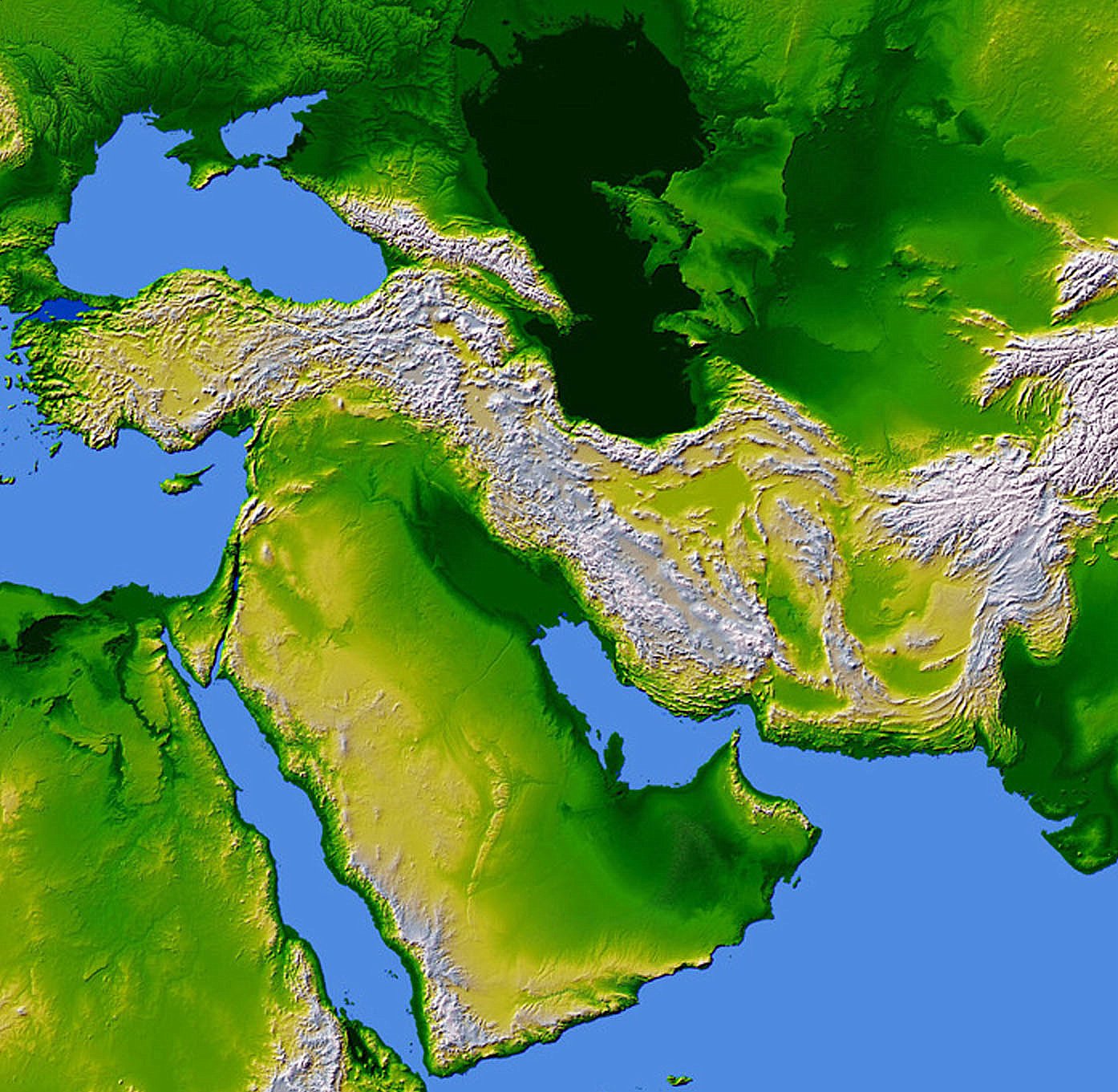
AsiaWMGP-MiddleEast2Large-picasa

1. Iraq

Iran is the key to stabilizing or destabilizing Iraq. The Iranians have close religious and political ties with Iraqi Shiites, who make up a majority of the overall Iraqi population and control most of Iraq’s oil wealth. Iran also has potentially close ties with the Iraqi Kurds, since Iran’s own Kurdish regions are arguably better integrated into Iranian society than the Kurds in Turkey, Iraq, or Syria are within Turkish or Arab society, and since Kurdish is actually a branch of the Iranian language family. Iran has consistently proven that it is not willing to relinquish its influence within Iraq, regardless of any sanctions or threats aimed towards it. This is not surprising, since the Iranians remember too well the hundreds of thousands – or perhaps more than a million – of their citizens who died fighting the Iraqi army between 1982 and 1990, in a war in which chemical weapons, and maybe biological weapons, were repeatedly used. As such, to combat groups like ISIS and Al-Qaeda without sending US soldiers to Iraq and Syria, Iran probably needs to be cooperated with.

2. Syria

Given that Assad has not fallen after four years of intense fighting, it may seem to the US that the best move now is to try and cut a deal with the Syrian government that will bring an end to the conflict in the country as soon as possible. The alternative – a sort of large-scale version of the Lebanese Civil War which lasted from 1975-1990, which killed perhaps five percent of the Lebanese population (far more than the share of Syria’s population that has died thus far) and directly drew in the armies of Syria, Israel, and the United States – is a truly terrifying prospect. Iran, because of its ties to the Assads, to Hezzbolah, to Iraq, and potentially to the Syrian Kurds, must be a negotiating partner within any Syrian ceasefire deal. Moreover, because Assad no longer rules over most of the oil-rich desert of eastern Syria, much of which is now controlled by the Sunni group ISIS instead, and because Assad has been struggling to control all of the urban areas even within the much more populous western half of Syria, cutting a deal now may not even leave the Iranians with the level of influence in Syria they had enjoyed prior to the start of the civil war.

3. Afghanistan

Apart from Pakistan, Iran is the only significant country to share a long and accessible border with Afghanistan. Two of Afghanistan’s three biggest cities, Kandahar and Herat, are quite close to the Iranian border and to Iran’s second largest city, Mashhad. One of Afghanistan’s two lingua franca, Dari, is mutually inteligible with modern Persian. One of Afghanistan’s two major ethnic groups, the Tajiks, speak a language that is mutually intelligible with modern Persian as well. Afghanistan’s other major ethnic group, the Pashtun, speak a language that, while not mutually inteligible with modern Persian as such, is nevertheless a member of the overall Iranian language family. And 10-20 percent of Afghanistan’s population is, like Iran, Shiite. As a result, with the US finally withdrawing most of its armies from Afghanistan, Iran may be necessary to ensure that the country remains relatively stable and does not become a haven for Sunni extremism, a source of conflict between India and Pakistan, or a destablizing force for Pakistan (which, unlike Iran, already has many nuclear weapons) via the Af-Pak border-spanning Pashtun and Baluchi peoples – and specifically, via the most famous Pashtun organization, the Taliban.

4. Russia

The US may want to enlist Iran for the newly remergent American rivalry with Moscow. Iran is the only power outside of China to border Russia’s sphere of influence in ex-Soviet Central Asia. The Central Asian country of Tajikistan actually speaks modern Persian as its main language, while the gas-rich country of Turkmenistan shares direct ethnic ties with the adjacent areas of northeastern Iran. Iran is also the only country outside of the former Soviet Union to border the massive, energy-rich Caspian Sea, across which the West has been hoping to build a roughly 200 km long pipeline that will link Central Asia with Europe by way of Turkey and/or the Black Sea, in order to break the monopoly that Russia (and to a lesser extent, China) has on transporting Central Asian energy. Alternatively, Russia’s monopoly in Central Asia could be undercut via the construction of pipelines running through Iran from Turkmenistan to the Indian Ocean, or through Iran and the Middle East toward the Black or Mediterranean Seas.

Iran is also the only country apart from Russia and Turkey to border the Caucasus, a region that includes the southernmost, seperatist-inclined districts of Russia as well as the ex-Soviet states of Georgia, Armenia, and Azerbaijan; a region in which 15-20 million Muslims, and a similar number of non-Muslims, live. One Caucuses country, Azerbaijan, is energy-rich: it is currently the world’s 17th largest crude oil exporter and 30th largest natural gas producer. Azerbaijan is also intended to be the lynchpin of any attempt to build a pipeline linking Central Asia with the West. Crucially, Iran has potentially close ties with Azerbaijan, as an estimated 20-25 percent of Iran’s own population is ethno-linguistically Azeri, and as Azerbaijan’s population is Shiite rather than Sunni. Azerbaijan’s leading city, Baku, is only 500 km from Tehran, compared to 1900 km from Moscow and 1750 km from Istanbul.

Finally, given that Iran is thought to have by far the world’s largest reserves of easily-accessible natural gas outside of Russia, and given that Iran’s natural gas export capacity has been consistently underdeveloped in the past generation as a result of sanctions and war (Iran is currently only the 20th-25th largest natural gas exporter, in fact), the US may hope to see future growth in Iranian gas exports substantially undercut Russia’s gas revenues. This would be very significant if it were to occur, sincd Russia is far and away the world’s largest exporter of natural gas at the moment, even without counting the enormous amounts of natural gas in Central Asia where the Russians continue to hold most of the cards.

5. Arabia

By far the biggest prizes for Middle Eastern powers to fight over are the small, energy-rich monarchies in the Persian Gulf: Kuwait, Qatar, Oman, tiny Bahrain, and the considerably larger (though still pretty small) United Arab Emirates. Kuwait and the UAE alone possess an estimated 20 percent or so of the world’s “proven oil reserves” that are not located in shale deposits or tar sands, while Qatar accounts for an estimated 12 percent of the world’s proven natural gas reserves. Together, these mini-monarchies account for 5-10 percent of the world’s current oil and gas production.

These states also directly border the most energy-rich areas of Saudi Arabia, Iran, and Iraq, and even reach as close to 380km from an important region of Pakistan. Nearly all of the US military bases in the Middle East are located in these small kingdoms. Their populations are not ethnically or religiously homogenous: rather, they are a complicated mishmash of ordinary citizens, extended royal families, foreign visitors, and so many foreign workers (many of whom are non-Muslim) that non-citizen immigrants now often outnumber the citizens of these countries. Religiously, their citizens and royals are a mix between Sunnis, Shiites, and, in Oman, Ibadi Muslims.

Regardless of a deal with Iran, the US is probably not going to back away from its relationships with these monarchies under any circumstances. It has already proved its commitment to these countries in the past, most notably in 1990 when it liberated Kuwait from Iraqi annexation, and most recently in 2011 when it basically supported a Saudi-led invasion of Bahrain during the Arab Spring, which was aimed at protecting Bahrain’s Sunni monarchy from its protesting Shiite-majority population. Today, virtually all of the American soldiers in the Middle East (not counting Afghanistan) are stationed in Kuwait.

The US and its allies in this region have long relied on Iran to ensure safe passage through the narrow Strait of Hormuz, and for this reason alone a deal with Iran makes sense. While there is admitedly a risk of Iran becoming more influential in the Persian Gulf than the US or its allies would be comfortable with – in particular, because southern Iraq and eastern Saudi Arabia are both Shiite-majority energy-rich areas – the US is probably not going to let Iranian influence grow to too great an extent. Iran’s ability to access the Gulf is further limited, moreover, by the fact that the population of its own Gulf coastlands are home mainly to ethnic Arabs rather than to Persians, while a majority of Iranians live many hundreds of extremely mountainous – and for the most part inaccessible – kilometers away from the Gulf. As such, while the Iranians might conceivably be able to block or disrupt the energy production of the Gulf Arabs, they are unlikely to consider seizing the energy directly like Iraq tried to do when it annexed Kuwait.

6. Turkey

Many people worry that Iran will become the major power in the Middle East. In reality, however, Turkey actually seems to be in a far stronger position than Iran is. The Turks have an economy that is larger than Saudi Arabia’s and more than double the size of Iran’s; an economy which, unlike most other economies in the region, will probably benefit a great deal from the recent fall in oil prices. Turkey has a population that is less internally fractious than those of Iran or Saudi Arabia, and which has significant ties with the Turkic populations of Uzbekistan, Khazakstan, Turkmenistan, and western China, as well as with Turkic Azerbaijan and with the populous Turkic Azeri regions of Iran. Moreover, unlike Shiite Iran or extremist Wahabbi Saudi Arabia, Turkey potentially has ties with the rest of the world’s Sunnis, who account for perhaps 90 percent of all Muslims. Turkey also has a military that has benefited from being an ally of the US – and the only longtime Muslim NATO member – for decades. The Turkish military has dominated Turkey’s domestic politics for most of the past century, securing for itself a generous budget in the process.

Turkey’s economy grew faster than any other major country apart from China during most of the 2000’s; it grew, for example, from about the same size as its arch-nemesis Greece twenty years ago to roughly quadruple the size of the Greek economy today. One of Turkey’s closest allies, Azerbaijan, meanwhile, was virtually the fastest growing economy in the entire world during the past decade: the Azerbaijani GDP is now more than 11 times larger than it was back in 2003. Finally, and most importantly, almost every single one of Turkey’s neighbours – Greece, Syria, Iraq, Ukraine, Georgia, Libya, Egypt, Cyprus, Russia, the European Union, and before them the former Soviet Union, Yugoslavia, and Armenia – have been either seriously weakened or completely torn apart during the recent past. This has created quite a large power vacuum for the Turks to consider filling.

As Turkey’s power has grown, and as Turkey’s relationship with the West and especially Israel has become increasingly strained, a deal with Iran has become much more palatable for the US. Indeed, prior the mid-19th century, Iran was the only significant foil of the Turks in both the Middle East and Caucasus for many hundreds of years. Today, potential Iranian influence with the Kurdish people – the achilles heel of modern Turkey – and with the Alevi religious grouping that makes up arguably one-fifth of Turkey’s own population, may help in containing the vehemently Sunni and allegedly neo-Ottoman tendencies that have been emerging under the stewardship of Turkey’s Islamist Prime Minister-turned-President Recep Tayyip Erdogan since 2003. Iran may also be useful in balancing Turkish influence in both the Caucasus and Central Asia, where Turkey has very ambitious economic and pan-Turkic aspirations. Finally, the Iranians may have some economic leverage over the Turks, since Turkey gets around 40 percent of its oil imports from Iran, 20 percent of its natural gas imports from Iran, and 20 percent or so of its oil imports from Iraq where the Iranians continue to have influence.

7. India

While the Americans and Israelis have been publically spending most of their time worrying about the eventual possibility of an Iranian nuclear bomb, a much more pressing and probable danger may actually be that, should the political stability of South Asia deterioriate, one of Pakistan’s hundred or so nuclear weapons might fall into the wrong hands. Today, with the US leaving Afghanistan, and with India having last year elected a Prime Minister from an anti-Islamic, arguably fascistic organization (a Prime Minister who is not even allowed to travel to the United States except for when he is serving as Prime Minister, because he is seen as having been complicit in a large-scale attack against Muslims while he was governor of the Indian state of Gujarat), the politics of South Asia, which are brittle in the best of times, may be getting worse. This is not good for anybody.

Iran, however, has the potential to serve as a stabilizing force in South Asia. This is not only because of its level of influence in Afghanistan, which is signficant, but also because Iran is the only major country that has potentially close ties to both the Indians and the Pakistanis. Iran already has a very close economic relationship to India; even with sanctions, India gets around 5-10 percent of the oil it imports from Iran, another 15 percent or so from Iraq, where the Iranians have influence, and another 10-15 percent or so from Iran’s main Arab trade partner, the United Arab Emirates. Moreover, the Indians and Iranians have a relatively close political relationship, which has emerged in order to balance against the Sunni Arab-Sunni Pakistani-Sunni Afghan relationship that they both are afraid of. India is also home to tens of millions of Shiite Muslims, hundreds of millions of speakers of Hindi, which is related to modern Persian, and millions of speakers of Urdu, which uses the Persian script and is even more closely related to modern Persian (though admitedly, Urdu is quite a bit closer to Hindi than it is to modern Persian).

Pakistan, meanwhile, shares a long border with Iran, and, jointly with Iran, governs over the large, sparsely populated, resource-rich region of Baluchistan, where many Baluchis would like to gain independence from both Iran and Pakistan (and where Iran and Pakistan have historically cooperated in order to ensure that they are not able to do so). Baluchi languages are part of the Iranian language family, as are the Pashtun languages that are spoken by tens of millions of people in Pakistan along the Afghan border and in megacities like Lahore and Karachi. Anywhere from 15-35 million Shiites live in Pakistan, meanwhile, and nearly all of Pakistan’s population speaks Urdu. Finally, like India, the Pakistanis also have an increasingly voracious appetite for Middle Eastern and/or Central Asian energy, which the Iranians could help to provide them with.

Iran, therefore, could be helpful in keeping South Asia relatively stable. Given the harsh realities and dangers which exist in South Asia, which could in theory spread from South Asia to the rest of the world – and have already done so in the past, most famously on September 11, 2001 – stability in this region could be a huge boon for everyone, the US and its allies included. From a long-term, self-interested US point of view, moreover, an Iranian partner might eventually be useful in helping to contain India geopolitically if India becomes a major power and if the Pakistani or Bangladeshi states implode.

8. Qatar and the UAE

In recent years, the foreign policy of Qatar, the Gulf Arab monarchy with a per capita GDP that is well over double any of the others (it is the highest in the world apart from Norway, in fact), has diverged from those of some of the other Gulf Arab states. Not only has Qatar been trying to gain global prestige and influence via its plan to host the World Cup in 2022, its hosting of the pan-Arab news station Al Jazeera, and its ambitions for its capital city of Doha to outshine even Dubai as a regional hub, but the Qatari government has also been bankrolling groups like the Muslim Brotherhood (and its Palestinian affiliate, Hamas), which the Saudis view as an enemy. The Saudi-Qatari rivalry came to a head in 2013, when Egypt’s Muslim Brotherhood government was overthrown in a coup by the Egyptian military, which has been receiving huge amounts of subsidies from the Saudis, and which had the support of Egypt’s next largest electoral bloc, the Saudi-backed Islamist Salafists.

The Saudis have been looking for a way to curb Qatar’s confident meddling in the region, but this is not easy to do, since the Qataris have powerful friends in the United States (Qatar hosts a critical US air force base), Turkey (which has been the Muslim Brotherhood’s other leading backer in the politics of the Middle East), and Japan (which buys about 40 percent of the world’s LNG, an industry in which the Qataris are by far the dominant players). While the Saudis are certainly not happy about the possibility of American-Iranian reengagement, they may nevertheless see a silver lining in the deal as being that it could reduce the regional clout of Qatar.

The reason this could occur is because the Qataris, unlike the other Gulf Arab states, overwhelmingly produce natural gas rather than oil. With Iran itself having the world’s second largest gas reserves, and needing lots of Western capital in order to build pipelines and LNG facilities in order to transport those reserves to market (since transporting gas is not nearly as simple a process as transporting oil), a US-Iran deal could hurt Qatar’s position in the global natural gas market – and in particular, its dominance in LNG markets, in which Qatar accounted for one-third of the world’s exports as recently as 2013, which was almost quadruple the amount of the world’s next largest LNG exporter, Australia.

Apart from Qatar, Saudi Arabia’s other potential frenemy within the Gulf Cooperation Council fraternity is the United Arab Emirates, a country with a population that is about as large as those of Qatar, Kuwait, Oman, and Bahrain combined – and with a GDP that is actually larger than those of Iran and Israel, and more than half the size of that of Saudi Arabia itself. The Emiratis have historically had relatively close commercial ties to Iran, and they have kept these ties in place throughout the modern sanctions era. The UAE is also home to quite a large Iranian population. Indeed, along with Iraq, the United Arab Emirates are thought to have been by far the leading intermediaries for Iran’s covert, sanctions-beating imports of goods and exports of oil. This has earned the UAE enormous sums of money, but has also bothered the Saudis at times. If the sanctions on Iran end, it might put an end to this situation, which could be another silver lining for the Saudis. (The Economist had a somewhat different take on this point).

9. Israel

There has always been something a little bit ironic about the rheotric Israel has used regarding Iran, given that Israel arguably needs Iran as a balance against the Sunni, Arab, and Sunni Arab worlds far more than any other country does. Indeed, it seems possible that Benjamin Netanyahu was never as worried about Iran as it seemed to be, but was railing against it mainly because doing so helped his party within domestic Israeli politics, and because, prior to Iran’s weakening position in the Middle East as a result of the rise of anti-Assad rebels in Syria, Israel may have been agreeing to play “bad cop” with Iran during the past decade, while the US played “good cop”. (The Saudis – who are truly terrified of Iran – were not willing to publically play bad cop themselves, since they did not want to be seen as stoking inter-Islamic conflict. Moreover, the Saudis, unlike Israel, lacked the ability to seriously scare Iran with military threats much even if they had been willing to issue them). Certainly, the Iranians have a far better historical relationship with Israel and the Jewish people, both in modern and premodern times, than any major Arab state has.

The Iranian-Israeli relationship has also been indirectly improving of late, as a result of the broken ties between Hamas and Iran over Syria, and the fact that Hezzbolah and Assad have been focused entirely on Syria rather than on Israel since the civil war began, and finally because Israeli relations with Turkey have sdeteriorated sharply ever since the Gaza flotilla incident in 2010. The Israeli economy is also likely to be among the major beneficiaries of the lower oil prices that a US-Iran deal could help to solidify. This is of course not to say that Israel is not worried about Iran – far from it. But Israel has a lot of things to worry about. It is not so difficult to imagine that Israel may actually end up being happier about improving relations with Iran than even the Americans will be. And even if the Israelis do keep Iran as their main enemy, a US-Iranian deal may still be appealing, as it will distance the US from Israel a little bit, which some Americans may be pleased with since it could help grant them leverage against Israel with regard to Israeli-Palestinian relations.

10. Iran

Apart from the geopolical argument that a rapprochment with the Iranians will make Iran too strong in the Middle East, or the argument that it will allow Iran to covertly develop nuclear weapons, the most common argument against a US-Iranian deal is that Iran is a terrorist state that is pushing an extremist ideology across the Muslim world. In fact, this argument has never made too much sense, because clearly Saudi Arabia fits this description far better than the Iranians do. Unless the Americans are willing to adopt a new strategy in which both Saudi Arabia and Iran become US rivals, this argument does not seem to have much merit.

Indeed, as has often been pointed out, Iran is in many ways arguably the most promising major country in the region from a cultural perspective. Much of its population is urban (72 percent, the same percentage as Turkey’s population, and not too far from double that of Egypt’s), and it is also much more pro-American than any other major Muslim country in the region (in some ways at least), and less socially conservative than most of the Arab world, or even than large areas of Turkey or a decent-sized share of the Israeli population. Iran’s government, meanwhile, while hardly a true democracy, is a lot more democratic than many other Middle Eastern states. And since Iran is Shiite rather than Sunni, its ability spread its extremist religious ideology around the rest of the Muslim world, which as a whole is thought to be nearly 90 percent Sunni, is relatively limited.

Iran also has one of the largest, and probably the wealthiest and most secular, American diaspora among major Middle Eastern states. This is a result of the historical US and British alliance with the Iranian elite, which fled the religious Iranian Revolution in 1979. The Iranian population in California, where about half of Iranian-Americans live, is sort of like a smaller version of the Cuban-American diaspora that resides in southern Florida. By contrast, there is not much of a Turkish diapsora in the US, and the Arab diaspora in the US tends to be made up of poorer immigrants who arrived just in the past decade or two. Because the Iranian diaspora has been in the US for a longer period of time, and because it is not Arab, its relationship with the US was not complicated by the recent 9-11 and Iraq War era in the same way that America’s Arab diaspora has been. Moreover, its earlier arrival has given it the time to give birth to a generation of bilingual, bicultural children who have now come of age.

Finally, the Iranians have a a uniquely proud identity that stretches back far before the emergence of Islam. This stands in  contrast to some of the other Middle Eastern states, such as Saudi Arabia, where Islam is seen as the fundamental and overwhelming attribute of national identity, or Turkey, which was proudly the seat of the Sunni Caliphate, with formal control over Mecca and Medina, until the early 20th century, and where pre-Islamic history is associated with the original Turkic home of Central Asia rather than with the country’s modern location in Asia Minor.

Europe and Arabia: A Geopolitical Perspective

As different as the Quran is from the New Testament, or the Constitution of France is from the Constitution of Saudi Arabia (which is, in fact, the Quran), these differences are arguably less important than those which seperate the geography of Europe from the geography of the Arab world.

Europe is a region of islands, peninsulas, mountains, rivers, forests, and marshes: natural barriers that have historically hindered the development of a unified European identity. The Arab world, on the other hand, is in effect an enormous coastal desert, stretching for nearly 8000 km from the Atlantic to the Indian Ocean and yet, with the exception of some notable mountain ranges, containing few internal barriers of any sort. This comparatively open landscape of the Arab world has allowed it to achieve a level of linguistic, religious, and cultural unity that Europe has rarely if ever been able to match.

While the Desert and its coastal seas act as unifying force within the Arab world, the fact that significant supplies of freshwater can be found in just a few scattered areas within its gigantic territory (mostly in mountains, as in Morocco, Algeria, and Yemen, or in rivers, as in Egypt, Sudan, and Iraq) has meant that the pan-Arab identity it has fostered must compete with a wide assortment of intra-Arab identities, which in most cases have been far better than pan-Arabism at winning the allegiances of their inhabitants. In addition, the geographic division between the Middle East and North Africa has led to sharp ethno-linguistic and political divisions between Arab and Berber peoples within countries like Morocco and Algeria.

The desert geography has also tended to make the Arab world relatively poor, again in stark contrast to Europe, which has become rich as a result of the commercial navigability provided by its numerous slow-flowing rivers, long coastlines, and sheltered seas and fjords, as well as by its luck in possessing a temperate climate and natural resources like freshwater, farmland, timber, and coal.

These opposing geographies have underlain the great historical contest between the “civilizations” Europe and the Arab world have cultivated for themselves. The advantage was first with Europe, arguably, as Italy, led by Rome, was able to conquer the entire Mediterranean basin as well as Mesopotamia, defeating the Carthaginians (a powerful Semitic empire based out of what is now the Arab state of Tunisia, which had controlled much of North Africa and Spain and were ethnically linked to the Phoenicians in the Eastern Mediterranean) and other African and Middle Eastern groups in the process. Even following the decline of the Christian Roman Empire, most of the inhabitants of the Middle East and North Africa continued to be ruled by Rome’s successor, the Greek-led Byzantine Empire (which was also Christian), for several hundred years.

Eventually the tables turned, however, and around 600 CE the Arabian Peninsula united under Muhammad and then expanded its control outward during the rule of his immediate successors, quickly conquering Spain, most of France (for a very brief period), and a large part of Asia. In turn, the Arabs were invaded and occupied by Central Asian groups like the Mongols and Turks; however, in a sign of Arab influence, most of the conquering Turks ended up adopting the religion of the conquered Arabs, and long outlasted the Mongols.

While the Arabs then lost their beloved Spain after a more than 700 year long struggle with Christian forces to keep hold of it, the Muslim Ottoman Turks made up for the loss by conquering all of southeastern Europe as far as the Austrian capital of Vienna, which they besieged in 1529 and again in 1683. Muslims also continued to spread the faith into Southeast Asia: much of what is now Indonesia, which today has the world’s largest Muslim population by far, adopted Islam during the 1400’s or 1500’s, many centuries after the lifetime of Muhammad.

Of course, the Europeans ultimately regained the advantage over their Muslim neighbours. During the late 1400’s the Portuguese first sailed a route to India which avoided passing through Turkish or Arab-held territory, while, around the same period, the Spanish reached the Americas and the Russians surged into Muslim Turkic Central Asia, conquering territory they mostly continue to hold today. The greatest blow to Islam then fell in the 1700’s and 1800’s, as the Muslim Mughal Empire, which at its height had governed over almost a quarter of the world’s population, lost its hold on the Indian subcontinent to the British. The colonizing Europeans also took over Muslim populations in places like Africa and Southeast Asia.

During the 1800’s and early 1900’s, the Ottoman Turks forfeited southeastern Europe and the Arab world in a series of assaults aimed at them by European powers like the British, French, Russians, and Austrians. The Persian empire was heavily intruded upon by both the British and Russians. Finally, in the 1970s, the last super-sized Islamic state, Pakistan, was divided into two separate countries, Pakistan and Bangladesh, which do not even border one another anymore since India lies between them. Today Pakistan and Bangladesh are the world’s sixth and eighth most populous countries, respectively.

For many people, the battle between Europe and Arabia, or between the West and Islam, continues to this day. After losing its main source of wealth when Europe stole the control of trade with India and China away from it, most of the Middle East seemed likely to become somewhat irrelevant to global politics. Instead, it gained a new source of wealth in the modern era: oil. As recently as 2010, more than 15 percent of world oil production occurred in Saudi Arabia alone, while an additional 15 – 20 percent occurred in other Arab countries and 40-50 percent occurred in the Muslim world as a whole.

The Muslim world also accounts for close to a third of world natural gas production (led by Iran, Qatar, Saudi Arabia, and Algeria), and is estimated to possess over 60 percent of the world’s “conventional” proven reserves of natural gas (not including gas from shale) as well as over 50 percent of non-shale oil reserves and over 75 percent of oil reserves that are neither from shale nor from oil sands.

Today, partly as a result of the energy wealth it has gained during the past century, the Arab world has a population of approximately 380 million (in contrast to a century ago, when its population was significantly smaller than even any of the major European nation-states were at the time, without even counting the Europeans’ overseas empires) and a nominal gross domestic product of just under 3 trillion dollars. This means that, if the Arab world could somehow reunite politically, it would have the third largest population and fifth largest economy in the world. It would, in other words, become a Great Power again.

Needless to say, few of the Arab world’s neighbours want to see any serious pan-Arab union come into being. Arab unification was in fact very briefly attempted in modern times, in a formal sense, with the joining of Egypt and Syria to form the United Arab Republic, which lasted from 1958 to 1961. From a purely geopolitical perspective, the potential of such cooperation between Arab countries is especially worrying to regions like Europe because of the Arab world’s shared religious identity – and to a lesser extent, shared cultural traditions and linguistic affiliations – with other parts of the Middle East and Muslim world.  The “classical” version of the Arab language, which is understood by scholars (and other people too) in every country of the Islamic world because it is the language of the Quran, is one potentially important example of a unifying factor throughout the Middle East.

If combined with non-Arab Middle Eastern neighbours Turkey and Iran, the population of the Arab world would rise to more than 530 million and its GDP would rise to more than 4 trillion dollars. The states that comprise the Organization of Islamic Cooperation, meanwhile, have a combined population of approximately 1.6 billion and a GDP of approximately 7 trillion dollars — and they do not even include the estimated 180 million Muslims living in India, 25 million living in China, 16 million in Russia, or 20 million living in the European Union.

While in the West there is much talk of the Muslim world being stuck in an economic decline, Muslims actually continue to have a higher per capita income than Hindus do, or than Christians in Sub-Saharan Africa do. Many Muslim countries have a higher per capita income than China does, even today following decades of rapid Chinese economic growth. The past decade has in fact been a terrific one for most Muslim economies, with oil and gas prices rising sharply, the developing world as a whole growing solidly, and a number of countries with large Muslim populations, most notably Indonesia, Turkey, India, and Nigeria, growing very quickly.

Apart from economic growth, the Muslim world’s geopolitical trajectory has also been positive in the past generation, mainly as a result of the collapse of the Soviet Union having freed about 60 – 90 million Central Asian Muslims (the exact number depends on whether or not you count Soviet-occupied Afghanistan as part of Central Asia) from Russian rule, along with the gigantic, resource-rich region they inhabit.

Since then, some Muslims have been hoping or pushing for a further Islamic geopolitical revival, which many non-Muslim countries would obviously not be happy to see. Pan-Islamic sentiments have, to varying extents, found their way into local and regional disputes between Muslims and non-Muslims throughout the world, in places like Kashmir, western China, Palestine/Israel, various African countries, various Southeast Asian countries, the Caucuses (both within Russia and without), and the Balkans. Arguably, technologies like the Internet have been strengthening pan-Islamic identities as well.

The West has, of course, generally aimed to gain influence within the Arab world, in part to prevent it from ever becoming too closely united. Europe, Russia, and the US have historically been focused on gaining influence in Egypt, for example, as Egypt has by far the largest population of any Arab country, is more internally stable and united than any other large Arab country, and is strategically located, sitting directly in the centre of the Arab world and encompassing the Suez Canal.

The West has also focused on gaining influence in the Persian Gulf, in particular by allying itself closely with the tiny energy-rich Gulf monarchies (Kuwait, the UAE, Qatar, Oman, and Bahrain), as well as with  the royal family of Saudi Arabia and, not too far away, the Israelis, the Iraqi Kurds, and the royal family of Jordan. Given that the West is in some ways more powerful today than at any time in history (largely as a result of the rise of the US, which was completed with the fall of the Soviet Union), and that the Persian Gulf region is sharply divided between Arabs and Iranians, Sunnis and Shiites, and Iraqis and Saudis, gaining influence there has not been too difficult for the West to achieve.

And so, even leaving aside social values or issues explicitly tied to religious belief, many Arabs believe the West is acting unjustly or aggressively towards them. Most believe that the current political borders of the Middle East are “artificial”, imposed on them a century ago by ignorant or sinister British and French politicians. There is certainly truth to this, though, in defence of the British and French, many of the borders that were drawn actually did accurately reflect existing social and geographic divisions within the Arab world.

With a few possible exceptions, such as Kuwait and Lebanon (which arguably should not have been created as independent states), Israel and Palestine (which arguably should have been created as a single state, perhaps even including neighbouring Jordan as well), and Kurdistan (which arguably should be created out of parts of Turkey, Iran, Iraq, and Syria, though even this is more complicated than it is often portrayed), it is not clear that the borders in the Middle East could actually be all that improved upon. But of course, this is a topic worth debating in much greater detail.

It is also not only the West that has been responsible for messing with the “natural” borders of the Arab world. Iran and Turkey, for instance, both refuse to give up Arab-inhabited regions of the Fertile Crescent they possess; a more consistent geographic or cultural rendering of Middle Eastern borders should perhaps have included Turkey handing over its province of Hatay to Syria (as Syria still officially claims it should) and Iran handing over its province of Khuzestan to Iraq.

Yet most people who complain of Western-imposed artificiality among the borders of the Arab world are not concerned with either of these areas, even though both are significant to the politics of the region (especially Khuzestan). Indeed, while Arab bitterness toward Europe’s past imperialism remains wholly justifiable, complaints of imperialistic European map-drawing in the Arab world nevertheless tend to be somewhat exaggerated. If you want to see truly unfair and dangerously-drawn borders the Europeans were responsible for, you should not even begin to think of the Middle East, but look instead to regions like West Africa.

Why Iraq?

Ten years after the invasion of Iraq, most people are still confused as to why the United States chose to initiate a war against Saddam Hussein. While it is generally understood that the WMD and democracy-building arguments for war peddled by the Bush administration were overly propagandistic, the most popular explanation to replace these arguments, namely that the United States wanted to control Iraq’s oil, does not stand up to the test of logic either. If the United States had wanted access to Iraqi oil, it would have been enormously cheaper simply to buy it. This is of course not to say that oil did not play a big role in the decision to invade. It just did not do so in the simplistic, “I drink your milkshake” sort of way that is often implied or alleged by Bush’s critics.

The real motivation behind the American invasion of Iraq seems to have been the Bush administration’s belief that it would help the United States to bolster the American strategic position in the Middle East and constrain Islamic-oriented militancy.  Saddam Hussein might not have wanted to support Osama bin Laden or planned to acquire nuclear weapons, but Iraq was critical to Bush’s plans anyway because of its position in the heart of the Middle East and its Saddam-era animosity towards Iran and Kuwait.

The United States blamed two countries the most for 9-11: Afghanistan and Saudi Arabia. Afghanistan was blamed because it was where Al Qaeda was based, while Saudi Arabia was blamed because Bin Laden and other high-ranking Al Qaeda members were Saudi, fifteen out of the nineteen airplane hijackers were Saudi, much of the funding of the Taliban, Al Qaeda, and other extremist Islamic organizations was derived directly or indirectly from Saudi oil revenues, and Saudi Arabia itself had an officially radical – or, if you prefer, ultraconservative – ideology (among other things, it is illegal for Saudi women to drive). Saudi Arabia was also allied with the nearby majority Sunni population of Pakistan, a country which was also close to the Taliban, had become the first Muslim state to acquire and keep nuclear weapons in 1998, and had fought a war against India in 1999.

The United States wanted to compel Saudi Arabia to crack down on its religious radicalism, but the Saudis were loath to do so because such radicalism was ingrained deeply in their society and state, and was also used as a tool for the Saudis to project influence abroad. Invading Saudi Arabia was not an option: it is the seventh largest country in the world, is covered almost entirely by desert and mountains, was an integral component of the US-led global economic system because of its oil production (whereas Iraqi production was low because of decades of sanctions and wars), and it would have been extraordinarily difficult to “put back together again” with any new government – more difficult even than Iraq was, perhaps.

Indeed, given the conservatism of the Arabian peninsula, not only in Saudi Arabia but also in neighbouring, overpopulated Yemen, the region would potentially have become even less friendly to the United States under a government other than the Saudi royal family. And of course, it would have been a disaster to put American troops anywhere near the Saudi-controlled sacred cities of Mecca and Medina. Thus, the Bush administration followed through with a different plan: invading Iraq.

Invading Iraq might have been about overthrowing a dangerous totalitarian regime, like Bush claimed, and it might have been about putting Iraqi oil reserves under the influence of the United States, like Bush’s critics claimed. Either way, it was also supposed to put pressure on regional Middle Eastern powers like Saudi Arabia by placing hundreds of thousands of American soldiers on their vulnerable borders, as we will discuss in a moment. Moreover, it was supposed to force the Saudis to become more dependent on the US for regional security, as Saddam Hussein’s Sunni-led regime had been Saudi Arabia’s foremost ally in the region against the Shiite and Persian government of Iran.

Saudi Arabia’s population is deeply divided by both geography and religious sect. Sunnis make up the majority of the Saudi population, with fourteen million Sunnis living in provinces bordering the Red Sea and six million Sunnis living in or around the central, capital city of Riyadh. Saudi Arabia’s Persian Gulf region, however, is predominantly Shiite Muslim. This area, separated from the coast of the Red Sea by a thousand kilometres of desert and mountains, possesses roughly ninety percent of Saudi Arabia’s oil.

Saudi Arabia worries that Iran will lead this part of the country to rebel against Saudi rule. Saudi Arabia has not exactly been kind to its Shiites: it has plundered most of their oil wealth and occasionally banned celebration of their holidays. Saudi Arabia’s 2009 invasion of neighbouring Bahrain, aimed at protecting Bahrain’s Sunni monarchy from its protesting Shiite majority, is a recent illustration of this phenomenon. America’s unseating of Saddam Hussein, who had led a massive war against Shiite Iran during the 1980’s and then brutally repressed Iraq’s very large Shiite population during the 1990’s, was in this way a tremendous blow to Saudi security.

Invading Iraq was also intended to transform the United States into the dominant power of the Middle East over the short- to medium-term. In addition to Saudi Arabia, it put tens of thousands of American troops on the borders of Iran, Syria, Kuwait, Turkey,  and Jordan, and created a direct link-up with the US’s Kurdish allies in the region, some of whom had been protected by the US no-fly zone over Iraq between the First Gulf War and 2003. It also displayed American force and resolve (at least, initially), which is why the invasion strategy was referred to as “shock and awe” in the first place. From Bush’s perspective, this was much more useful than pouring troops into Afghanistan, a vast, landlocked country with some of the most rugged terrain in the world, no significant Arab population, and a decade of experience fighting a guerrilla war against the Soviet Union that at the time had ended only twelve years earlier.

While Bush’s strategy involved strengthening Iran in order to weaken the Sunni Arab world by comparison (and, possibly, to weaken the geopolitical positions of Sunni Pakistan and/or Sunni Turkey as well), it was likely believed that Iranian influence could later be contained fairly easily by other regional powers like Turkey, Israel, and Saudi Arabia. This has now occurred to a certain extent with the undermining of the Assad government in Syria, which has been one of Iran’s most important regional allies.

Indeed, Iranian influence was seen as inherently limited, as Shiite Arabs are only a plurality of Iraq and Lebanon’s populations rather than a majority, Syria’s Iranian-allied ruling Alawite population is greatly outnumbered by Syrian Sunnis and other non-Shiite groups, Iranians are not Arabs, and Iran is itself deeply internally divided between ethnic Persians (who are only about half of the Iranian population, according to some estimates), Azeris (bordering energy-rich Azerbaijan, which became independent when the Soviet Union broke up), Turkmen (bordering energy-rich Turkmenistan, which also became independent after the Soviet Union), Kurds (bordering Turkish Kurdistan, Syrian Kurdistan, and energy-rich Iraqi Kurdistan, which became empowered by Saddam’s removal from power and, more recently, by Assad’s weakening), Shiite Arabs (bordering southern Iraq, who also became empowered by Saddam’s removal), Baluchis (bordering Pakistan’s restive Baluchistan region, which became a bit more empowered when the US-Afghan War led to Pakistan’s relative destabilization), and other groups.

iran-principal-ethnolinguistic-families-courrier-international-2009

While destroying the Iraqi regime obviously strengthened Iran over the medium-term, in the short term it was also supposed to make Iran vulnerable to American influence. Invading Iraq put the American military on the border of Iran’s Khuzestan province, which is unique among Iranian provinces in that much of its population is Arab rather than Persian, its border is flat and exposed rather than mountainous, it is separated from the rest of Iranian territory by hundreds of km of mountains, it is home to most of Iran’s oil deposits (which are thought to be the second largest “conventional” reserves in the world, after Saudi Arabia’s), and it is close to most of Iran’s offshore natural gas reserves (which are also thought to be the second largest in the world, after Russia’s). Khuzestan is in many ways the achilles heel of Iran, and the American military presence along its border in Iraq was therefore supposed to help grant the United States leverage over the Iranian government.

Unknown
Source: Freeworldmaps.net

This was an important aspect of US strategy, as Iran has a religious government and had not been an ally of the US since before 1979, and because Iran’s cooperation was needed in order for the war in neighbouring Afghanistan – which is largely a Persian-speaking country – to go smoothly. In fact, because Khuzestan’s Arab population is Shiite, the American goal of replacing of Saddam Hussein’s anti-Shiite regime with a secular Iraqi government may have also been intended to destabilize Iran in the long term by making Khuzestan Arabs more likely to want to secede from Iran and integrate themselves with Iraq instead. To be sure, when Saddam invaded Khuzestan during the Iran-Iraq War, it is thought that he had expected to be received as a liberator by the Arab inhabitants of the province, but was instead shunned by them as a Sunni tyrant.

It is true, of course, that Saddam Hussein’s regime was a Baathist one, and was therefore technically secular rather than Sunni Islamic. And some of Saddam Hussein’s main victims, such as the Iraqi Kurds or the Kuwaitis, were Sunni. That being said, Iraq’s huge and terrible war against the explicitly Shiite government of Revolutionary Iran in the 1980s, the collapse of Iraq’s secular benefactor the Soviet Union in 1991, the repression of Shiite Iraqis in the early 1990s following the Fist Gulf War with the US, the placing of “God is Great” on the Iraqi flag in 1991, and other events – including, arguably, the giving of some support to known Al Qaeda members – seemed to show that the Iraqi Baathists were becoming more politically religious.

Many Baathists certainly did go on to use religion as a political tool following the US invasion; ex-Baathist officials have frequently been accused of playing a leading role in post-Saddam Sunni groups like Al Qaeda in Iraq, or, more recently, in ISIS. And in general, there has been a post-Cold War trend of once secular Sunni Middle Eastern states, for example that of Turkey, the Palestinian militant resistance, the opposition in Algeria during its civil war throughout the 1990s, post-Gaddaffi Libya, or, briefly, post-Mubarak Egypt, moving in an Islamist direction. Though we will never know how the Iraqi Baathists may have evolved over time had they not been removed from power by the US in 2003, seeing Saddam’s government as a Sunni one is nevertheless not an incorrect viewpoint – even if the full truth of it may be a bit more complex.

Of course, none of this changes the fact that the Iraq War was arguably a strategic mistake for the United States, and possibly a moral failure as well. Still, it may be comforting to know that, contrary to popular belief, the reasons behind the invasion were not entirely incoherent or sinister (or at least, not sinister in the ways that people have assumed they were). And perhaps we should not judge Bush too harshly for concealing his true purposes. After all, Obama cloaked his support for Syria’s rebels in precisely the same anti-tyranny, anti-WMD rhetoric that Bush once employed towards Iraq, consistently avoiding the fact that the rebels’ success benefited the United States by curtailing Iranian influence in places like Syria, Iraq, Lebanon, Jordan, and Palestine. And now Obama finds himself again in the same dilemma as Bush, wanting to move closer to the Shiites and/or Persians in the region in order to counterbalance the dominant Sunnis and/or Arabs, yet also concerned that this will result in increased Sunni militancy, a destabilized Arabia, and an ascendant Turkey or Iran.

Bulgaria’s Uncertain Future

Most North Americans know nothing about the country of Bulgaria, except maybe that it was the birthplace of Quidditch superstar Victor Krum.

This is not surprising. After all, there are a lot of countries in the world, and Bulgaria is a relatively insignificant one. It has a population of only seven and a half million, and an economy that is smaller than all but five of America’s fifty states. Americans tend to learn about other countries only when newsworthy events take place in them, and Bulgaria has not generated many of these in recent history. Lying quietly behind the Iron Curtain between 1945 and 1989, then spectating as its Balkan neighbours descended into violence during the 1990s, Bulgaria has largely managed to avoid any wars or ethnic unrest since the Second World War. In that conflict, however, Bulgaria played an active role, taking part in both a Nazi-led occupation of Greece and Yugoslavia in 1941 and an Allied invasion of Hungary and Austria in 1945.

Bulgaria’s current level of anonymity may disappear in the not-too-distant future. In fact, it can be expected that in the approaching decades Bulgaria will attract a level of attention from the rest of the world that it has not experienced in many decades. This notoriety will not come about as a result of Bulgaria`s own accomplishments (sorry Bulgaria). Rather, it will emerge as the product of Bulgaria`s relationship with its increasingly powerful Turkish neighbours.

The land border between Bulgaria and Turkey currently serves as the southeastern frontier of the European Union, and it also Turkey’s most vulnerable one. Whereas Turkey’s eastern borders are separated from the majority of the Turkish population by over a thousand kilometers of hills and mountains, the distance between Istanbul and the Turkish-Bulgarian border is less than 200 kilometers, and the terrain is flat the whole way. Not incidentally, it was from the area that is today Bulgaria that the Romans conquered Byzantium (today’s Istanbul) in 173 BC, and that European forces conquered Constantinople (also today’s Istanbul) during the Fourth Crusade in 1204 AD. In fact, the Turks themselves conquered Constantinople from this direction, in 1453 AD, though in their case they approached the city from both east and west rather than from the west alone.

https://i0.wp.com/upload.wikimedia.org/wikipedia/commons/f/fd/Topographic_Map_of_Bulgaria_English.png

If Turkey were to dominate even just the southern half of Bulgaria, as its Ottoman predecessors did for nearly five hundred years between 1396 and 1885, the distance between its western border and Istanbul would effectively double. Even more important, Turkey would then be able to anchor itself on the Balkan Mountains instead of on the relatively flat lowlands which today comprise much of the border between the two countries. This would give Turkey a defensible buffer in the north, while also allowing it to outflank any theoretical threat that might emerge on its border with Greece, its long-time rival, which is also located near to Istanbul and the rest of the Turkish heartland. Obviously, the Turks would find such a state of affairs to be quite beneficial, all other things being held equal.

This is important, because there is not much reason to think that Turkey could not dominate Bulgaria if it wanted to. Turkey is a much wealthier and stronger country than Bulgaria is. Its gross domestic product is 20 times larger than Bulgaria`s, and its population is more than 10 times larger than Bulgaria`s. Turkey devotes an amount equal to 2.3% of its GDP to military spending, compared to only 1.5% for Bulgaria and 1.7% for the European Union as a whole. There is also a large Turkish diaspora living within Bulgaria, accounting for more than 10 percent of the country’s total population and more than half of the population within two of its 28 provinces.

A few decades from now, Bulgaria will probably become even weaker relative to Turkey than it is today. Turkey’s economy is expected to perform well, since the country is populous, relatively underdeveloped, and strategically located as a land bridge between Europe and Asia, a naval bridge between the Mediterranean and Black Seas, and a cultural bridge between the West and Islam. Indeed, Turkey was the second fastest growing large economy in the world between 2008 and 2012, trailing only China. Turkish birth rates are at a healthy 2.1, compared to Bulgaria’s 1.5, which is among the lowest in the world. Finally, Bulgaria is highly dependent upon exports for its economic growth, while Turkey is not. As a result, any economic slowdown among Bulgaria’s trade partners in Europe and other areas of the global economy would hurt the Bulgarians far more than the Turks.

Bulgaria is also economically dependent on Turkey. The value of Bulgaria`s exports to Turkey are currently equal to about 10 percent of all Bulgarian exports, making Turkey the country’s third largest export destination, slightly ahead of Romania and slightly behind Germany and Italy. However, Italy and Germany have economies that are 2.5 and 4.3 times larger than Turkey`s. As Turkey`s economy grows, therefore, its appetite for Bulgarian exports seems likely to grow faster than Italy`s or Germany`s would if they were to experience the same level of growth — and they are not expected to grow nearly as fast as Turkey is. As a result, it is quite conceivable that Turkey will become Bulgaria’s leading export destination in the near future, possibly by a large margin. In fact, an amount of Bulgarian trade accounting for approximately 20-25 percent of Bulgaria’s gross domestic product already passes through the Turkish-controlled Bosporus and Dardanelles Straits every year on its way to and from other markets around the world.

For all of these reasons, Turkey`s only real barrier to dominating Bulgaria is that, as a member of both the European Union and NATO, Bulgaria has been guaranteed to be economically, militarily, and politically shielded from external threats by Western Europe and the United States, both of which are much more powerful than Turkey. Russia is another country interested in Bulgaria; both Russia and Bulgaria are Slavic, Orthodox Christian countries, and the Russians sell a lot of energy to Bulgaria in order to make Bulgaria’s next-door neighbours, the Romanians (who are Latin rather than Slavic), feel uneasy, so that the Romanians will not become too pushy within their own next-door neighbour, Ukraine. Indeed, the fact that Bulgaria is not being controlled by Turkey as we speak is probably more a testament to the strength of the United States, Western Europe, and Russia than it is to Turkish timidity or Turkish indifference towards Bulgaria.

Ultimately, however, it is easy to imagine that in the future Bulgaria will become the site of a geopolitical tug-of-war that will involve Turkey, various European countries, and the United States. It is also not so difficult to imagine that the Turks will win this tug-of-war, given that they care much more about Bulgaria than the US or any European powers do, and given that Turkish economic prospects look promising. In that case, the level of independence that Bulgaria has enjoyed for the past 23 years could come to an unexpected, perhaps even violent, end. The only silver lining for Bulgaria is that it might benefit economically from Turkish growth.