After accounting for more than a third of the world’s economic growth since 2003, the BRIC economies – Brazil, Russia, India, and China – are likely to slow in the decade ahead. Here are six reasons why that is:
1. Higher Incomes
According to the World Bank, average incomes have reached $7000 in China, $11,000 in Brazil, and $14,000 in Russia. Unlike a decade ago, when Chinese average incomes were still around $1000 and Russian and Brazilian incomes $3000, today only India, with an average income of less than $1500, remains competitive with most other developing nations in being able to supply cheap labour, goods, and services.
2. Aging Populations
China and Russia have populations that are aging rapidly relative to the majority of developing economies. 12% of Chinese and 18% of Russians are over the age of 60, compared to just 7.5% of people in the Indian Subcontinent, Southeast Asia, Latin America, and the Middle East, and 5% of people in Sub-Saharan Africa. China’s most populous generation is currently 40 – 50 years old, and Russia’s is 50-65 years old. By contrast, in most other developing economies the largest generation is somewhere between 0-35 years old.
3. Dependence on Coal
China, India, and Russia are three of the world’s four largest consumers of coal and emitters of carbon dioxide. China derives 70% of its energy from coal, almost double that of any other country. India derives 40-50% of its energy from coal, a greater share than any country apart from China or South Africa. This makes these countries highly polluted, vulnerable to fluctuations in coal prices, and at risk of angering countries afraid of climate change.
4. Dependence on Exports
Exports account for 30 – 35% of the economic output of China and Russia. This is compared to only 10 – 15% for the US, Japan, the European Union, Brazil, and Pakistan, and between 15 – 30% for most other countries. This means that China and Russia are now relatively vulnerable to economic events that are beyond their ability to control. Russia, for example, experienced a decline in its economic growth rate from 7.5% between 2003 and 2007 to just 1% since 2007, in large part as a result of the languishing European economy that consumes the vast share of its exports.
5. Dependence on Imports or Exports of Natural Resources
India has become dependent on importing foreign oil, mostly from the Middle East. Imports now account for more than 75% of India’s oil consumption and nearly 30% of India’s overall energy consumption. This has led India to develop the world’s largest trade deficit apart from the United States and Britain, in spite of having a massive wage-competitive workforce that produce goods and services for export.
China is not nearly as dependent on importing oil as India is, since so much of its energy comes from coal it produces domestically. However, China does depend heavily on imports for a number of natural resources of which it is the world’s largest consumer. These include copper, lead, nickel, zinc, tin, iron ore, timber, rubber, cotton, wool, and soybeans. In some cases this dependence is extreme: for example, China imports 85% of the copper and nickel it consumes, even as it consumes more than four times as much copper and three times as much nickel as any other country in the world. China also depends on imports for roughly two-third of its oil, though it is only the world’s second largest consumer of oil, still well behind the United States.
Russia’s economy, on the other hand, has become too dependent on exporting natural resources. An estimated 30% of Russian gdp comes from the production and sale of fossil fuels alone, even as Russia is also a leading exporter of a number of other commodities, such as diamonds, timber, and aluminum. If the profit margins of oil, gas, or natural resources in general decline, so too will the Russian economy. To a lesser extent this may also be true of the commodities Brazil produces: iron ore, crude oil, soybeans, and sugar account for an estimated 40% of Brazilian exports. (Brazil’s economy, however, is not very dependent on exports in general, so it could probably withstand low commodity prices better than Russia could).
6. Income Inequality
Brazil has the highest income inequality levels of any large country. Russia, China, and India are not far behind. These inequalities are not limited to class-based or urban-rural divisions, but also include significant provincial and regional disparities. In China, for example, the 27 million inhabitants of Shanghai and Hong Kong have an average income that is 8 and 14 times higher, respectively, than that of the 65 million inhabitants of Guizhou and Gansu. In India, the 112 million inhabitants of Maharashtra have an average income 5 times higher than the 103 million inhabitants of Bihar. By comparison, average incomes in New York City are only 2.3 times higher than they are in Mississippi.
Life after BRICs
With the BRIC economies primed to slow down, a new emerging-market acronym is needed – at least, for the type of people who like such acronyms. Goldman Sachs, who’s chief economist Jim O’Neil coined BRIC over a decade ago, has since introduced MIST – referring to Mexico, Indonesia, South Korea, and Turkey. The Economist magazine and HSBC bank, meanwhile, have been pushing CIVETS, for Columbia, Indonesia, Vietnam, Egypt, Turkey, and South Africa. Investors have responded in both cases, purchasing tailor-made financial instruments that target the MIST and CIVETS countries. Each of these instruments received over a billion dollars of investment in 2013.
Both MIST and CIVETS are flawed, however. The MIST countries have almost nothing in common with one another, apart from the notable fact that they are all among the world’s 14-17th largest economies. Average incomes in Indonesia are three times lower than in Mexico and Turkey, and six times lower than in South Korea. Indonesia`s population is nearly five times larger than South Korea`s. South Korea relies on exports for 57% of its economic output, compared to only 25% for Turkey and Indonesia. Indonesia and Mexico are both leading natural resource exporters, while South Korea and Turkey are leading resource importers. 75% of Mexico’s exports go to the United States, compared to just 4% of Turkey’s. 31% of South Korea’s exports go to China, compared to just 4% of Turkey’s and 2% of Mexico’s. 50% of Turkey’s exports go to Europe, compared to 12% of South Korea’s and Indonesia’s and 6% of Mexico’s.
The CIVETS have even less in common. Indonesia has an economy that is more than six times larger than that of Vietnam, and a population that is four and a half times larger than those of Colombia and South Africa. Turkey’s average income is nine times higher than Vietnam’s. Columbia, South Africa, and Indonesia are all major exporters of natural resources, while Turkey is one of the largest resource importers. Vietnam depends on exports for 80% of its economic output, while Egypt and Colombia depend on exports for only 18% of their economic output, and none of the other CIVETS for more than 28% of their economic output. Over 40% of Colombia`s trade is with the United States, while 50% of Turkey`s is with Europe and 45% of Vietnam`s is with Northeast Asia.
It is true, of course, that all emerging market acronyms will inevitably be over-simplistic. Even in the case of the BRICs there were enormous differences between countries: China`s economy, for example, is thought to be larger than those of India, Brazil, and Russia combined, and the populations of China and India are significantly larger and poorer than those of Brazil and Russia. That being said, the BRICs grouping still makes some sense, perhaps, because the BRICs are the only developing countries to be among the world`s ten largest economies, nine largest populations, and seven largest landmasses. Furthermore, when BRICs was invented back in 2001, China`s economy was not nearly as far ahead of Brazil, India, and Russia as it is now, so the acronym made more sense at the time.
By comparison to BRIC, therefore, MIST and CIVETS seem to make little sense. For this reason, it may be appropriate to try to create a new acronym, one that can be of greater use to investors and other people interested in emerging markets. (Yes, there is no real reason to make such acronyms at all, but since it does not seem that they are going to stop being made and trumpeted by the media anyway, there might as well be a more fitting successor to BRICs than has been given thus far). So, with that in mind, let us now introduce the PIPE economies: the Philippines, Indonesia, Pakistan, and Egypt.
Meet the PIPEs
The PIPEs share a lot of noteworthy qualities. All have average incomes between $1300-3600 – or average incomes of $2600-3600 if Pakistan is excluded. All are among the 15 most populous countries in the world. All are among the six most populous countries in which average incomes are higher than $800 and lower than $6000. All except for Indonesia have GDP’s between $230-260 billion: indeed, Pakistan, Egypt, and the Philippines are the world’s 38th, 39th, and 42nd largest economies.
(Update, a year later: So far so good. In 2014, Pakistan, Indonesia, the Philippines, and Egypt had the four best-performing stock markets in the world outside of India, Argentina, Sri Lanka, and China-sans-Hong Kong)
None of the PIPEs is too dependent on any single part of the world to consume their exports. Rather, they are each relatively well-diversified in their trade patterns between North America, Europe, Northeast Asia, and Southern Asia. None, for example, conduct more than 15% of their trade with any single country. Each conducts between 9-12% of their trade with the United States and 9-15% of their trade with China. None depend on exports for more than 26% of their gdp’s, for an average of just 20%.
All of the PIPEs have young populations, with between 6-9 % of their populations over the age of 60. All have fertility rates between 2-3 children per mother. All except the Philippines are Muslim – and the Philippines has a relatively large Muslim minority, accounting for 5 -10% of its total population.
All the PIPEs except Egypt have external debts equal to between 28-32% of their gross domestic products; they are three of the five economies in the world to be within this range, which is slightly lower than the average for developing countries. Egypt, meanwhile, has an external debt of 14%, one of the lowest in the world.
In terms of income inequality, the Philippines is the only PIPE to score poorly, according to the World Bank’s GINI Index. However, the Philippines still ranked as less unequal than China, Malaysia, or almost any country in Latin America or Sub-Saharan Africa.
The Philippines and Indonesia are both tropical archipelagos in Southeast Asia, and possess the first and second longest non-Arctic coastlines in the world. Egypt and Pakistan are both arid states located in the Greater Middle East, and are the first and second largest countries in the world to be oriented almost completely around a single river system (the Nile in Egypt, the Indus in Pakistan).
All the PIPEs except Indonesia are among the best English-speaking countries in the developing world. The Philippines is the world`s largest English-speaking emerging market (proportional to its population), while Pakistan is tied with Nigeria for second and Egypt is fifth. Indeed, in the Philippines, 57% of the population can speak English, compared to just 1-27% for the other developing countries in East Asia. In Pakistan, an estimated 49% of the population can speak English, compared to only 15-20% for its neighbours India and Bangladesh. In Egypt, 35% can speak English, compared to less than 20% in Turkey and less than 10% in most Arab countries. (Note: these language statistics need to be taken with an especially large grain of salt).
In Indonesia, only an estimated 20% of Indonesians can speak English, which is about the middle of the pack for developing countries; less than Thailand, for example, but well ahead of Vietnam or Cambodia. However, because Indonesia is by far the most linguistically diverse country in the world, it may be that its proficiency in English will increase rapidly, so that English will join or perhaps even replace Bahasa Indonesia as the country’s primary lingua franca. Indeed, less than 10% of Indonesians speak Bahasa as a first language, and an estimated 90 million Indonesians barely speak Bahasa at all.
As a result, with Indonesia’s former colonial language, Dutch, having long disappeared from everyday life, many Indonesian children living in urban areas are now learning English significantly better than they are Bahasa. Indonesia was the world’s fourth-fastest adopter of English in 2013, for example, according to English First. In fact, Indonesia’s move towards English is not only due to its linguistic diversity, but also because it attracts more global tourism than any country in Southeast Asia apart from Thailand, and because it has close economic relationships with its two English-speaking next-door neighbours, Australia and Singapore.
All of the PIPE’s are located in areas that are likely to become the new centers of global trade in the years and decades ahead. As the economies of Asia and Africa emerge, the waterways linking the Indian Ocean to the Pacific and the Mediterranean are likely to become by far the most heavily trafficked trade corridors in the world. Indonesia and Egypt surround the two most important of these waterways: the Suez Canal and the Indonesian Straits. One of the Indonesian Straits, the Strait of Malacca, is in fact already the most heavily trafficked waterway in the world.
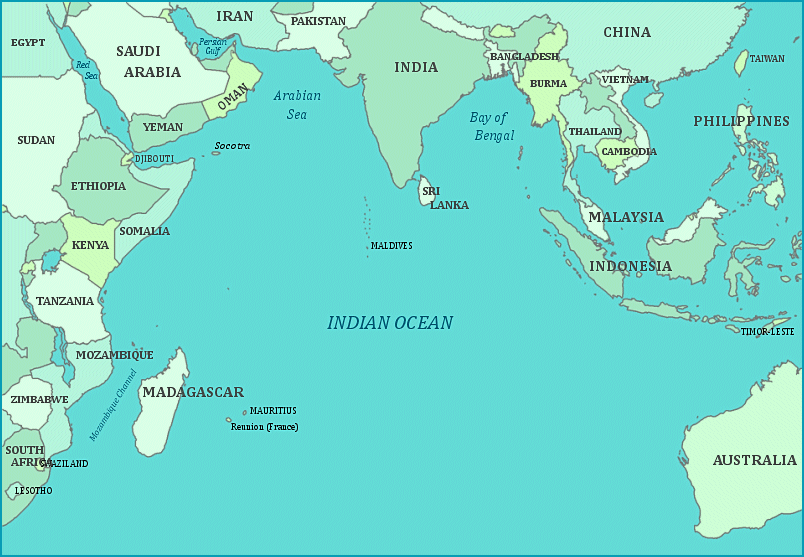
Pakistan, meanwhile, is centrally located in the Indian Ocean, almost exactly halfway between the Mediterranean and the Pacific. Pakistan also directly borders the Strait of Hormuz, the channel through which an estimated 35-40% of the world`s seaborne oil shipments and much of the world’s liquefied natural gas pass through each year. Finally, Pakistan is, along with Iran, the only country to border the oceanic trade routes of the Indian Ocean and the overland trade routes of Central Asia simultaneously.
The Philippines is also favorably located relative to the world’s major trade routes. Along with Indonesia, the Philippines is the only country situated in the part of the Pacific Ocean that connects Northeast Asia to both the Indian Ocean and to Australia and New Zealand. In addition, the Philippines is, to a greater extent than any other Southeast Asian naion with the exception of Indonesia and Malaysia, located amidst the main crossroads of trade between Asia and the Americas.

None of the PIPEs are dependent on coal for more than 22% of their energy usage, for an average of just 14%. Only Indonesia derives a significant share of its wealth from exporting commodities — and even Indonesia is not dependent on commodity exports when compared to many of the world’s other resource-rich developing economies. Exports are only equivalent to 24% of Indonesian gdp, compared, for example, to between 55% and 95% of the gdp’s of leading energy exporters like Saudi Arabia, Kuwait, the United Arab Emirates, Libya, Angola, and Azerbaijan.
Also unlike many other commodity exporting economies, Indonesia is not overly dependent on the price of oil and natural gas. Rather, in addition to being the world’s 7th largest net exporter of natural gas and 20th largest of oil, Indonesia is also the world’s largest exporter of coal, rubber, tin, nickel, coconut oil, palm oil, and aluminum ore.
Of course, the PIPEs are not risk-free environments. Like many other developing nations, the flip-side to their economic growth potential is their vulnerability to natural disasters and political upheaval, both of which may intensify as a result of factors like population growth or climate change. In addition, developing countries also tend to have a lot of exposure to the Chinese economy, the growth of which may be likely to slow or even crash at some point in the years ahead.
Indonesia and the Philippines could be particularly vulnerable to dangers such as these. While their direct trade exposure to China is relatively low, it is still high compared to most countries outside of East Asia. Plus, Indonesia and the Philippines trade a fair amount with other East Asian states, some of which have enormous trade relationships with China.
Finally, even though the fact that the Philippines and Indonesia have the world’s longest tropical coastlines may lead to great opportunities for their tourism and trade, it could also present serious storm and flooding threats. They are also at risk from earthquakes and, in some cases, volcanoes. The Indian Ocean tsunami of 2003, in which an estimated 200,000 people were killed in Indonesia alone, is of course the most tragic manifestation of such dangers to have yet occurred in the twenty-first century.

 Future Economics