A Pan-Canadian NFL Team

Canada does not have a single stadium that would be suitable for an NFL franchise.

Canada does, however, have four stadiums that are not too unsuitable: Montreal’s Olympic Stadium, Edmonton’s Commonwealth Stadium, Vancouver’s BC Place, and Toronto’s Rogers Centre.

Instead of a city like Toronto spending $1 billion or so on a new stadium in order to get an NFL team of its own, Canada should aim for an NFL team that splits its eight home games per season between four existing stadiums in Toronto, Montreal, Vancouver, and Edmonton. The team – the Canada Moose? – would play in Montreal and Edmonton during September and October, then in Toronto and Vancouver during November and December.

Montreal’s stadium can seat 66,000 people, but cannot be used in the winter. Edmonton’s can sit 56,000 people, but cannot easily be used in the winter either. Vancouver’s can sit 54,500 people, plus it has a retractable roof (and a much warmer climate) that allows for winter use. Toronto’s can only sit 49,000 people, but also has a retractable roof. No other stadiums in Canada are close to as big as these. The next largest, in Calgary, seats 36,000 people.

By way of comparison, the average NFL stadium can sit 69,500 people. Unlike in Montreal, Toronto, or Vancouver, most NFL stadiums were purpose-built for football. Still, this should not necessarily be a deal-breaker for Canada, because the NFL does not actually derive a large share of its revenues from ticket sales. Rather, revenues come from TV (and increasingly, Internet) deals and merchandising — which could make a Canadian franchise profitable, as it might have one of the biggest markets in the entire league.

What about playoff home games, where would they be played? Well, to begin with, no team ever plays more than 2 home playoff games per year, so the lack of a good-quality playoff stadium is probably not as big a problem as one might think. (Canada’s current favourite team, the Bills, have not played a single home playoff game in the past 24 years). When a home playoff game does need to be played, some or all of the following options could work:

  • Get Montreal to shell out the estimated $200 million needed to repair its retractable roof, thus allowing it to host some playoff games. There are already plans for such repairs to take place in advance of the FIFA World Cup in 2026
  • Make the venue conditional on the opponent. If playing a home game against Seattle, for example, play in Vancouver. If playing against Buffalo or Detroit, play in Toronto. If playing against New England, play in Montreal (if Montreal has fixed its roof).
  • Play a Superbowl-style Conference Final: if Canada’s team makes it to the semi-finals with home field advantage, play the game in a massive college football venue like Ben Hill Griffin Stadium (home of the Florida Gators; capacity 88,500), to which Canadian snowbirds could flock in January. Give all Canadian citizens first dibs on tickets.

Of course, the idea of a pan-Canadian team is not without risk. Such a team might have difficulty attracting good players. Canadian patriotism might not be sufficient to win new fans to the sport. It might just be too weird to have American cities competing against an entire country (although that has not limited the Raptors’ or Blue Jays’ aggressively national marketing strategies). Combined with the lack of a good stadium, these risks are not insignificant.

On the other hand, look at the possible rewards. You get a huge market in Canada, no wasting taxpayer dollars on a new football stadium, and no direct competition with the CFL or other pro sports franchises. The NFL also gains a lot of flexibility in scheduling, since it can have west coast matchups played in Vancouver or Edmonton and east coast matchups in Toronto or Montreal.

It would also create great local matchups. Canadian games against Seattle, Buffalo, Detroit, Cleveland, and New England would be especially fun. So would Canadian games in snowbird states like Florida, Arizona, Nevada, or California around Christmas-time. Even isolated cities like Green Bay, Minneapolis, Denver, and Kansas City would be able to pull in some tailgaters from the Prairie provinces.

I think the rewards outweigh the risks. For Canada to get an NFL team, without having to build any huge new football stadiums, would be as good as Thanksgiving coming twice a year.
 

A New Baseline for the NBA: Staying In Bounds Behind the Net

The NBA has to decide if it wants to put its baseline courtside seats and cameramen as close to the net as they used to be before Covid. Having more open space this season may be allowing players to drive at the net with more speed and less risk of injury. But, of course, keeping that space open next year would mean that some high-paying fans will be further from the action.

I’d like to propose a compromise of sorts: not only should the NBA keep the baseline space open, it should also push the baseline out-of-bounds line back by about 3 feet. In other words, players should be able to stand behind the net without being out of bounds, sort of like how they do in hockey.

Consider the potential consequences of doing this:

  • there would be even more room for players to drive at the net
  • baseline courtside seats would still be close to the action, despite being further from the net than they were pre-covid
  • there would be fewer baseline out of bounds plays, and therefore fewer stoppages of play and end-of-game out-of-bounds video reviews
  • there could be more passing opportunities for ball handlers: just imagine what Steve Nash could have done with this space…or what a Jokic or Lebron or Doncic could do
  • there could be more opportunities for inside scoring, perhaps helping to combat the league’s 3-point-shooting frenzy a little bit
  • there could be defensive opportunities: deflecting or rejecting a ball and then grabbing it before it goes out of bounds..
  • there would be the occasional awesome high-arching shot over the backboard, presumably taken at the end of a shot-clock in most cases (at least, until Curry masters it and reinvents basketball again)

Back-of-the-Envelope World City


1000 square feet per person, for an apartment with a large balcony, or for a home, is very comfortable.

For 10 billion people to have 1000 square feet is 10 trillion square feet.

With 10-story buildings, 10 trillion square feet would require 1 trillion square feet of land.

1 trillion square feet is 92,900 square km…let’s round that up and say 100,000 square km.

Throw in an additional 100,000 square km of land for roads, parks, etc. – also a very comfortable amount, especially if you don’t waste most of it on cars –  and you get 200,000 sq. km.

200,000 square km is a square with sides of roughly 450 km. It is about the size of Nebraska, or Belarus. In North America alone, there is already an estimated 230,000 km of urban land.

If you don’t like living in a spacious apartment 10 stories high, but prefer instead that your city have 5-story buildings, you would need 2 trillion square feet of land for apartments. That’s 186,000 square km of land. Double that number to add in public space and you get 372,000 square km. That’s a square with sides of just under 610 km. That’s smaller than Montana or Japan. China alone already has an estimated 520,000 square km of urban land, at least.

Whatever else we may lack, space is not it.

Earthquakes

This article is about earthquakes and other disasters. I hope it’s informative, rather than just morbid or ill-timed or pointless..

With an estimated 144,000 deaths so far as a direct result of the Covid-19 virus, this is the first disaster in the past decade to have killed at least 50,000 people. However, it is the seventh to have done so in the past 15 years. There was the Indian Ocean tsunami in December 2004, which caused an estimated 230,000 deaths, the 2005 Kashmir earthquake (~87,000 deaths), the 2008 Burma cyclone (~138,000), the 2008 Sichuan earthquake (~88,000), the 2010 Haiti earthquake (~220,000-316,000) and the 2010 Russian heat wave (~56,000). Covid-19 may prove to be by far the worst of these disasters, but for now at least it has not been the deadliest.

One obvious lesson here is the destructiveness of earthquakes and earthquake-triggered tsunamis. They  caused 4 out of these 7 disasters, including the two deadliest to have occurred so far.

Financially speaking too, earthquakes have usually been the most devastating disasters. According to Wikipedia, the most expensive disaster was the Japan earthquake and tsunami in 2011, which caused approximately 16,000 deaths (2,203 of which were related to the Fukushima nuclear disaster it caused) and an estimated 411 billion inflation-adjusted dollars worth of damage. That same year, the Christchurch earthquake in New Zealand cost an estimated $44 billion, itself one of the most expensive modern disasters. Second costliest was another Japanese earthquake, in 1995 in Kobe (6,400 deaths; $330 billion). Third place was the 2008 Sichuan earthquake (88,000 deaths; $176 billion). The next five were hurricanes in America, all since 2005 (Katrina); three in 2017 alone (Harvey, Maria, Irma). Yet even the 2017 hurricane season as a whole cost less than either of Japan’s big earthquakes.

Of course, these do not come near the figures of the deadliest epidemics, such as the 1957-1958 Asian flu (~2 million), the 1968-1969 Hong Kong flu (1 million), or the AIDS epidemic (~32 million in its 60 years, for an average of 530,000 per year, with a peak of 1.7 million deaths in 2004). Nor (as we have often been told lately) do they approach the number of deaths from other horrible problems, such as car accidents (~1.3 million per year). They also don’t come near the death tolls from the very worst natural disasters, like the floods that occurred in in northern China in 1887 (~900,000-2 million, perhaps half of whom died because of a resulting pandemic and famine) or in 1931 (~400,000-4 million).

These Wikipedia statistics obviously need to be taken with a huge grain of salt. They often range widely: the death toll estimates even for the recent 2010 Haiti earthquake, for example, go from 46,000-85,000 (according to a report made by the US Agency for International Development) to 160,000 (according to a University of Michigan study) to 316,000 (based on numbers from the Haitian government). The death toll from the 1976 North China earthquake, perhaps the deadliest post-WW2 natural disaster, ranges from 240,000-650,000.

All of these estimates may also overlook indirect causes of death and destruction, and certainly they do not include the significant non-fatal consequences disasters usually cause. The 2015 Nepal earthquakes, for example,  led to around 8,000 deaths, but 3.5 million people were made at least temporarily homeless by them.

Nevertheless, these numbers do show that the deadliest disasters in recent years have tended to be earthquakes. Searching online right now, I see that I am hardly the only catastrophist to wonder what would happen if  “the big one”  were to occur in an earthquake-prone area like Tokyo or the US Pacific Northwest in the immediate future, while the current pandemic is still going on. The probability of this happening is small, but not zero. I recommend reading this New Yorker article, which was awarded a Pulitzer Prize, about this subject.

One of the regions impacted most by the virus thus far, the Mediterranean, is also among the most seismically active, ranging from countries with a medium risk of earthquakes, such as Italy (its deadliest modern disaster was the Messina earthquake in 1908, with an estimated 75,000-123,000 fatalities), to those with a high risk of earthquakes, like Turkey. Iran too, which has suffered the most deaths from Covid-19 of any country outside of the US or Europe, is a high-risk country where earthquakes are concerned. It experienced a deadly earthquake in 1990 (50,000). 

China’s Hubei province, of which Wuhan is the capital, is itself used to earthquakes. The province experienced an earthquake this past Boxing Day, just five days before Chinese authorities first told the World Health Organization that there was an unusual pneumonia in Wuhan, less than a month before much of the province went into quarantine.

Historically speaking, northern and central China have suffered some of the deadliest earthquakes, in large part because of how populous they are. Before the terrible ones in Sichuan in 2008 and Hebei in 1976, there was the Gansu-Ningxia earthquake in 1920 (273,000). [Three years after that, the 1923 Great Kanto earthquake in Japan (100,000-143,000) destroyed large parts of Tokyo and was, at the time, probably the most destructive disaster experienced by a modern industrial city]. According to Wikipedia, possibly the deadliest ever earthquake occurred in Shaanxi, in 1556, killing more than 800,000 people.

Before the horrific Indian Ocean tsunami of December 2004, other recent big, deadly disasters include the 2003 European heat wave (70,000), the 1991 Bangladesh cyclone (140,000), the 1976 North China earthquake (240,000-650,000), the 1975 typhoon and resulting Philippine dam failure (230,000) and the 1970 East Pakistan (Bangladesh) cyclone (500,000+).

There have also been a number of disasters with death tolls in the 10,000-50,000 range: earthquakes in Gujarat in 2001 (20,000), Turkey in 1999 (17,000),  Iran in 1990 (50,000), and Armenia in 1988 (28,000). The only non-earthquake disasters in this range during the past few decades were a volcanic eruption in Colombia in 1985 (23,000), and cyclones in Central America and Mexico in 1998 (11,000) and Bangladesh and India in 2007 (15,000).

Certain places have been struck repeatedly by large earthquakes. The most notable of these may be Valdivia, in Chile. It experienced the most powerful earthquake on record, in 1960, an earthquake so powerful that by itself it accounted for roughly 25 percent of the world’s seismic energy released in the 20th century. (The next two biggest in the century, in Alaska and Sumatra, together accounted for roughly another 25 percent). The first really big earthquake recorded was also in Valdivia, in 1575, according to Wikipedia.

The next three big ones after that, all in the 1600s, were in Chile as well, including one in the capital, Santiago. Valparaiso (in central Chile, near Santiago) was then hit with big ones in 1730 and 1822, and Conception (on the coast between Valdivia and Valparaiso) in 1751 and 1835.

The other area to flag in this regard is the island of Sumatra, in Indonesia. It has been hit with one of the only two recent earthquakes with a magnitude of at least 9; namely, the deadly Indian Ocean earthquake and tsunami in 2004. (The other magnitude 9+ magnitude quake was the costly Japan earthquake in 2011; until then most experts had not believed that an earthquake above 8.4 was even possible in Japan). Before that, no 9+ magnitude earthquakes occurred since Alaska in 1964 or Chile in 1960. A magnitude 9 is about 33 times more seismically powerful than a magnitude 8, and over 1000 times more powerful than a magnitude 7. Sumatra was also hit by two of the three only recent earthquakes in the magnitude 8 range (in 2012 and 2005). The other was just off the coast of Conception in Chile, in 2010. Before 2004, there was no magnitude 8+ since Alaska in 1965.

Solar-Based Space Power

Hello! I hope you are all doing as well as possible right now. Since many of us are stuck inside for the time being, I’m going to try to revive this blog a bit.

For this first post, let’s talk about space-based solar power. The idea is a popular one; it is exciting (outer space!) and has some logic to it (there are no clouds, nights, seasons, or land-use-constraints in space!). Sadly, though, if you look into the topic – for example, if you read this very well-thought-out piece from Do The Math –  you see that even with extremely optimistic assumptions, it seems unlikely that sending energy from solar panels located in space to earth will become economically worthwhile any time soon, if ever.

And yet, perhaps these analyses are missing something. From what I can see — with the huge, twin caveats that I haven’t looked too deeply into the subject, and that I understand almost nothing about the physics involved in it — recent discussions about space-based wireless power transmission have been limited almost entirely to the idea of generating power in space and sending it to earth in order to provide civilians with clean, reliable energy. There might, however, be alternative uses and methods for wirelessly-transmitting energy via space. For example:

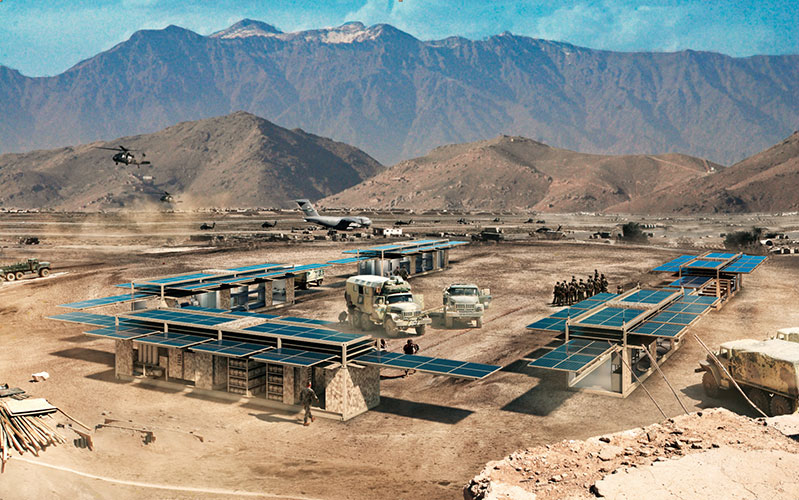
  •  sending space-based solar power to military outposts, in order to provide soldiers with power that is not reliant on vulnerable supply lines, is not bulky to haul around from place to place, and is not intermittent. This is how I first heard about the topic of space-based solar power: George Friedman discusses it in his book The Next 100 Years.
  • the same purpose as above, except that instead of the military outpost receiving power that is generated from space-based solar panels, it would instead receive power that is generated conventionally on earth, then ‘triangulated’: sent up to space, then back down to a different location on earth. Such a system could perhaps also work in tandem with space-based solar panels. Over time, for example, more panels could be launched, so that as the years go by the system would use more power generated in space and less power generated on earth.
  • If the system was located as an array of satellites in Low Earth Orbit (500-2000 km),  rather than much further away in Geosynchronous orbit (40,000 km), having the system use power generated by earth-based sources might allow it to provide power 24/7, as would otherwise not be possible for a Low Earth Orbit system because Low Earth Orbit satellites’ ability to receive sunlight is often blocked by the earth
  • Because wars are themselves intermittent, a space-energy system built for military purposes might be able to double as a civilian system during times when military demand is low. It might be able to help provide power to remote areas in the wake of a natural disaster, for example, which might useful if the disaster (forest fires, perhaps?) is also limiting the remote area’s ability to receive power from other sources, such as from sunlight or  airdrops of fuel or batteries.
  • If the system was built as an array of satellites in Low Earth Orbit, rather than in Geosynchronous orbit, then each satellite in the array would only pass over a given military outpost or region on earth for a very short amount of time.  Most of each satellite’s orbit in such a system might be freed up for non-military uses as result.
  • There is also the question of how to provide satellites with energy, so that satellites themselves can be powered, both for military and non-military reasons. Militarily, for example, if satellites were to be physically attacked, it might perhaps be the case that their ability to protect themselves from any incoming projectiles or debris (the debris perhaps deliberately created by a rival military) would depend on whether or not they have more energy available to them than do the projectiles or debris, which they could then outmaneuver. Thus it might be useful for satellites to receive power wirelessly, either from earth or from other satellites. And again, once such a system is built, it might also be able to find non-military uses.  And perhaps it could also be used to power locations on earth
  • A satellite could perhaps use power generated from its solar panels to create high-energy lasers, in order to destroy any incoming projectiles or debris. A ground-based laser might similarly be used to destroy incoming projectiles or debris threatening a low-earth-orbit satellite. The same lasers might then also be used offensively, to attack rival satellites, or to attack rival targets on earth. They might also be used to provide power from earth to a satellite, or from one satellite to another. This could perhaps be useful if the satellites that are receiving the power are following orbits that spend little to no time in sunlight. It might also be useful if the satellites receiving power are intended to be as small in size as possible (perhaps in order to provide a smaller target for debris or projectiles to hit) and so cannot have big solar panels or batteries or fuel tanks.

Obviously, I have absolutely no idea what I’m talking about here. So I’m asking, is there anything to these ideas? Are there other similar ideas that I’ve left out? How might these factors change the math when it comes to thinking about the future economics of energy in space?

Finally, if the civilians-piggybacking-on-the-military-surplus-capacity-of-triangulating-energy-from-earth-to-space-back-to-earth idea is anything other than totally ridiculous, which power sources would be best suited for it? Would solar panel companies in the Australian Outback benefit, for example, by being able to wirelessly send their otherwise-remote, Southern Hemisphere-summer energy to military and/or civilian locations in space, or and perhaps then on to other places back on earth?

2019 Year in Review: GDP Growth

An in-depth version of this article was originally published on Rosa and Roubini Associates

GDP can often be a misleading measurement, and a year can sometimes be a misleadingly short period of time to measure. A review of a past year’s GDP growth trends may nevertheless serve as a useful starting point for understanding the world’s markets. Carrying out such an exercise in economic hindsight for 2019, we might settle upon the following list of approximate growth trends:

  1. Slowing growth occurred in all major regions and countries

    Global growth in 2019 was estimated to have been 3%, down from approximately 3.5% in recent years. This trend also held at both the regional and national levels. Regionally, North America, Europe, and Northeast Asia all faced slowing growth. Euro Area growth slowed from 1.8% during 2018 to 1.2% in 2019; US growth slowed from 2.8% to 2.2%; China’s growth slowed from an estimated 6.6% to 6.2%. (Elsewhere in Northeast Asia, Japan’s growth remained low at around 1% and South Korea’s slowed from 2.6 to 1.8%). No major country saw an increase in its growth rate, except perhaps a slight increase in Japan’s.


  1. America, China, and South Asia provided most of global growth

    With European and Japanese growth little greater than 1%, and with many commodity-exporting economies struggling too, global growth was carried mainly by the United States, China, and to a lesser extent India and other countries in southern Asia. US growth was estimated at 2.2 percent, which given its size (roughly 25% of global GDP), and the slow growth of global economy, is still a substantial portion of the world’s total growth this year. China’s 6.2% growth (assuming this figure is accurate) is even more substantial. India, meanwhile, which is only around 3% of global GDP in nominal terms (7.5% in purchasing power parity-adjusted terms), experienced 4.9% growth this year. Other smaller South Asian economies grew even more quickly, such as Bangladesh (7.7%), Vietnam (6.5%), Indonesia (5.1%) and the Philippines (5.7%). Thailand, however, which is by far the largest economy in Southeast Asia apart from Indonesia, grew only 2.4%.  
  1. Europe continued to struggle – and not just in the European Union

    The EU’s growth in 2019 is estimated to have been below 1.5%. The Euro Area’s growth was even lower than that, because unlike the European Union it does not include the faster-growing East European economies, notably Poland and Romania with 4% growth and Hungary 4.6% growth. Even outside the EU growth was slow, however. Russia’s growth this year was only an estimated 1.1%, down from 2.3% in 2018. Norway’s was 1%; Switzerland’s 0.8%. Britain’s was 1.2% (that is, assuming you consider Britain as outside the EU). And Turkey’s GDP, after growing at 2.5% in 2018, did not grow at all in 2019.
  2. Central Europe in particular experienced slow growth 

    Perhaps the most notable regional trend in Europe was the slow growth within Central Europe, most notably in the Germany-Switzerland-Italy corridor of nations. Germany and Italy had by far the slowest growth among G7 economies: Germany grew at 0.5% (down from 1.4% in 2018), Italy grew at 0.2% (down from 0.8% in 2018). Most countries around them also had slow growth: France 1.3%, Belgium 1.3%, Sweden 1.3%, Austria 1.5%, the Netherlands 1.7%, Switzerland 0.8%. Even the Czech and Slovak economies slowed, to around 2.5%, down from the 3-4% range they had grown at in previous years. The Central European slowdown was probably the dominant trend in the EU in 2019. The previous dominant trend, namely Southern Europe’s slow growth, did not disappear (Italy, after all, still struggled) but it was eclipsed. Spain’s economy grew at 2.1%, Greece 1.9%.


  1. Europe’s North-South dynamic has become more complicated

    There is no longer any clear divide between a sluggish South and nimble North, either within the EU, the Euro Area, or Europe more broadly defined. At all three levels, the fastest and slowest major economies in 2019 were both Southern states: Spain was the fastest, Italy the slowest. Northern Europe was divided too: major economies such as Germany, Britain, Russia, and Scandinavia (ex-Denmark) grew slowly, while others like Poland, Ireland, and to a lesser extent the Dutch and Danes grew quickly. In the ex-EU Mediterranean region there were divides too: Turkey did not grow, but the Levant grew quickly (Israel 3.2%, Egypt 5.6% for e.g.). In the Maghreb, Morocco grew at 2.5%, Algeria 2.6%.

  2. Latin America had a rough year…

    Venezuela remained in crisis, and Argentina experienced a recession in which its GDP shrank by an estimated 3.3% in 2019. The two largest economies, Brazil and Mexico, grew at just 0.8% and 0.1%, respectively. The Pacific economies that had previously been strong, such as Chile and Peru (both significant commodity exporters), slowed as well. Chile grew by 1.8%, Peru 2.6%. Colombia’s growth did rise however, from 2.6% to 3.1%.

  3. so did the Anglosphere

    The Anglosphere is a tricky group to define. Arguably it is does not even warrant being considered as a group to begin with. Even for those who do think the concept is useful, it is difficult to know which countries it should include. Certainly, it includes countries like Britain, Canada, Australia, and New Zealand. More broadly, it could perhaps also be used to include economies such as Singapore, Hong Kong, South Africa and/or Nigeria. Wherever you do decide to draw the Anglosphere’s lines, the group had a year of slow growth. Britain grew at 1.2%; Canada and Australia at 1.6%. Singapore grew at just 0.8%; Hong Kong actually shrank by 0.3%. South Africa grew by 0.6% and Nigeria (starting at a lower income base) grew by 2.2%. Jamaica grew at 1%. Only New Zealand and Ireland had strong growth, at 2.5% and 4.2%. Ireland’s growth slowed too though, from 6.7% in 2018.

  4. East Africa grew quickly, but Africa in general did not 

    Rwanda may have led all countries in 2019, with 7.8% growth. Ethiopia may have led among all large developing countries, with 7.4% growth. Uganda, Kenya, and Egypt all grew between 5-6%. There were high growth numbers in some other parts of Africa too, but in the largest regional economies, such as South Africa, Nigeria, Angola, and Algeria, growth was slow. Nearby in the Middle East, the Gulf Arab states’ GDP stalled and Iran’s shrank.

  1. In North America, the US kept ahead of Canada and Mexico

    US growth was 2.2% in 2019, compared to an estimated 1.6% in Canada and 0.1% in Mexico. This is the second year in a row that the US grew the fastest of the three. Before then, not since the 2009 recession did the US do so. And before then, not since 1999 was US growth the fastest. (The US grew at 4.7% in 1999, more than double its current pace). In contrast, as recently as 2014 the US grew slower than both Canada and Mexico. 


  1. In America and China both, heartlands outgrew coastlands

    Unlike in the previous two years, US growth in 2019 seems to have occurred at a faster pace in the centre of the country – in the Rockies, the Greater Midwest, or in certain areas along the Gulf of Mexico – than it did along the eastern or western coasts. In China, somewhat similarly, the interior states in the south-west, centre-west, or central China, such as Yunnan, Jiangxi, Hubei, and Sichuan, grew faster than most of the country’s coastal states. The slowest-growing Chinese region of all was, as it has often been in recent years, the northeast: states like Heilongjiang, Jilin, Liaoning, and Inner Mongolia.


The Mezzanine  

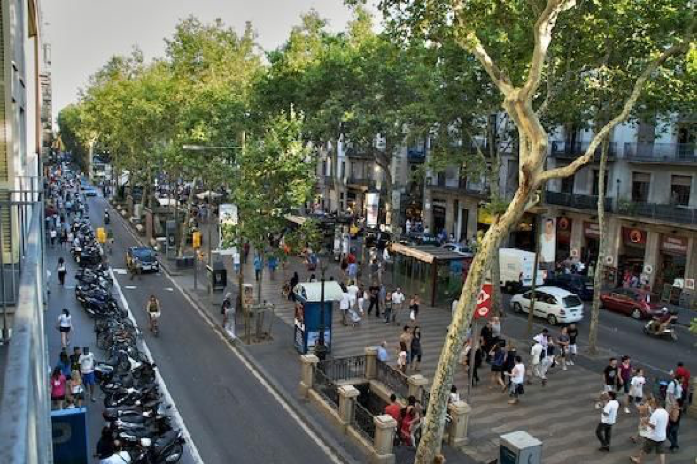
What if, instead of building subway mezzanines underground, we put them at surface level, creating the space to do so by preventing automobiles from passing directly above each subway station?

La Rambla, in Barcelona

  • Eliminating underground mezzanines may become more viable as passengers pay for their subway tickets digitally rather than via fare booths or turnstiles
  • If each car-free street-level mezzanine was, say, 100-200 metres long, it would free up space for bus stops, bikes, wheelchairs, and pedestrians, making it easier to get to and from the subway
  • Putting the mezzanine at street level would allow the underground portion of subway stations to be made much smaller, reducing the cost of station construction
  • A street-level mezzanine could have a social and aesthetic value. By making the space above a subway station free of cars, it could become a nice place to wait for anyone you are planning to meet up with at the station
  • There would also be much more space available for stairwells, escalators, and elevators, making it easier to get in and out of stations quickly and comfortably and reducing platform crowding at busy stations. For deep underground stations especially, this would allow passengers to reach subway platforms from street level without having to fight through busy underground crowds to get from one set of escalators, elevators, or staircases to another
  • For subway stations that have central platforms rather than side platforms, the ability to put station entrances in the middle of a car-free street might allow the subway platforms to be located less deep underground than they would otherwise need to be. It would also allow the platform to be accessible via a single elevator shaft, rather than force passengers with wheelchairs or baby-strollers to ride one elevator to reach the mezzanine and then a second elevator to reach the subway platform
  • In certain cases, by making it easier to access central platforms, and by freeing up space for station entrances and exits generally, street-level mezzanines might allow for the Spanish Solution, to speed up and simplify passenger boarding and alighting
  • Maglev elevators? Having more room for elevator shafts, and also having the ability to access central subway platforms from surface level via one rather than two separate elevator rides, would be especially significant if technological advancements make elevators more efficient. In theory, elevators could be far more space-efficient than escalators, since they travel vertically whereas subway escalators tend to be angled at only around 30 degrees, which is actually quite a bit more horizontal than vertical. In practice, though, elevators are inefficient, since they tend to have only one elevator per shaft, leaving the majority of each shaft empty. If a technological solution can be found to this problem, then a car-free street-level mezzanine with elevators taking passengers directly from surface level to the subway platform could be a great thing
  • Staircase Diversity. The Mezzanine would leave more room for stairwells, which could allow each station to usefully have a number of different types of staircases. The staircases could differ in terms of steepness; steeper staircases are more space-efficient than less steep ones, but are also less easy to use going downstairs, less easy for seniors to use, etc. With more stairwells, some of the staircases could perhaps even be spiral staircases, which could be extremely space-efficient, but not attractive for anyone to use except when the normal staircases are overcrowded during rush hour. Some staircases could be bicycle-friendly

We probably shouldn’t need excuses to limit cars’ space or speed in urban areas, but all the same, a subway station could be an excellent excuse for doing so. Better yet, why not make the street above the entire subway line car-free? That way it would become even easier to get to and from stations, and the area around the entire subway line could become much nicer to spend time in, or to walk or roll through. I’m looking at you, Yonge Street.

The Double Double

Picture1a

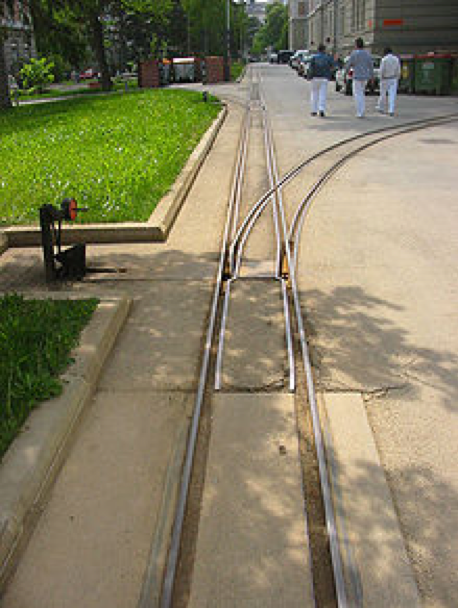
Imagine there existed a Narrow Tram: a streetcar or light rail train that is only about half as wide as the streetcars and LRTs most cities use today.

Narrow trams could fit more easily on narrow streets where there is not otherwise room for a transit-only lane. They might also squeeze into unused edges of existing railway or expressway corridors, where they could avoid red lights. On wider streets, narrow trams could have room for double sets of tracks in each direction: one lane to provide local transit service, the other for express.

Picture1bPicture1c

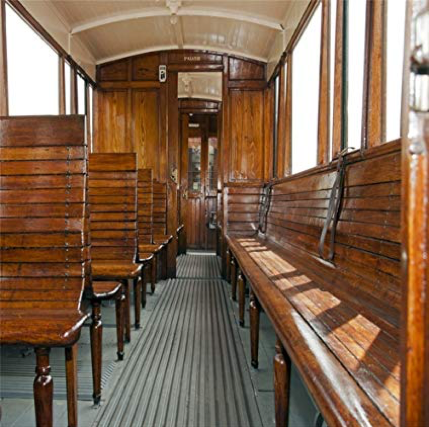
For passengers to comfortably navigate such narrow vehicles, each narrow tram could have an unprecedentedly large number of doors – the more doors the better. Each door would open only if passengers indicate they are getting on or off at that precise section of the vehicle. Platforms would tell passengers in advance which sections of each approaching narrow tram are crowded. Fold-up chairs would be located along one side of the vehicle, only one chair per row. Some chairs could be sideways-facing to let people to sit together, others would be front-facing.

Picture1d
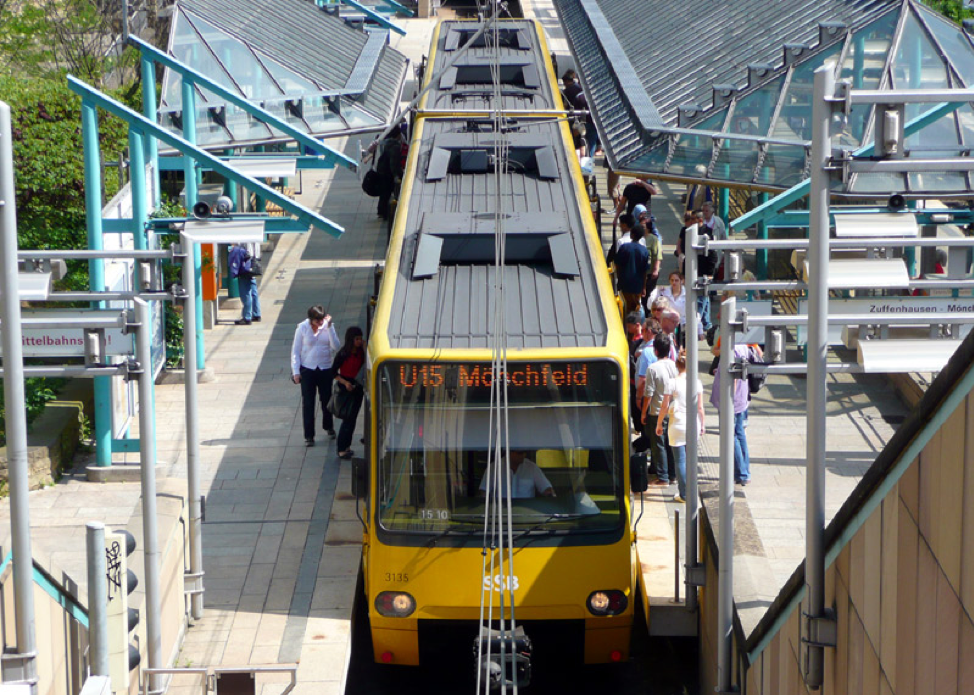
Spanish Solution in Stuttgart

In certain cases, narrow trams could perhaps free up enough room for platforms on both their sides – the Spanish Solution – in order to simplify boarding and alighting and allow passengers to transfer very easily between local and express vehicles. Spanish Solution narrow trams might have to have even fewer seats, but this might be manageable, since express trams would be able to travel further in less time than conventional transit, so passengers might be more willing to stand. Plus, with multi-multi-door vehicles and smart-platform systems, you might be able to put chairs close to doors without creating passenger blockages, so the number of chairs might not have to be reduced too much even with the Spanish Solution’s addition of doors along both walls.

Picture1e
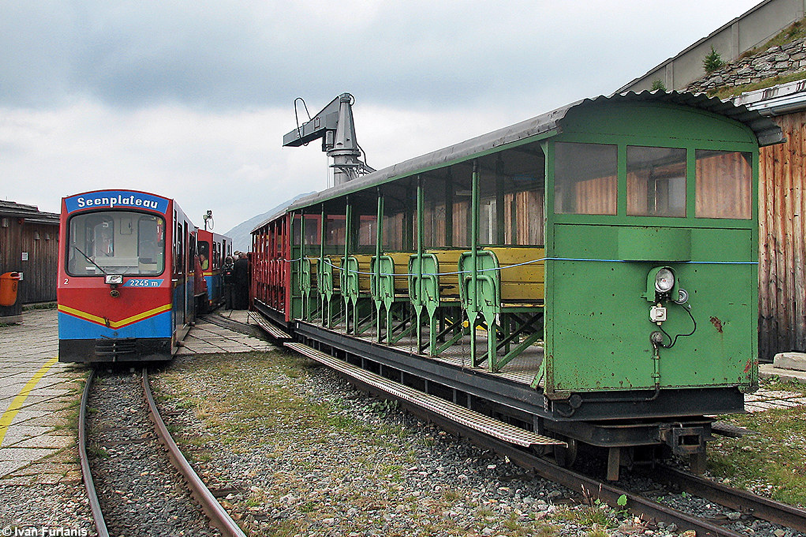
Vienna Feldbahn

Picture1f

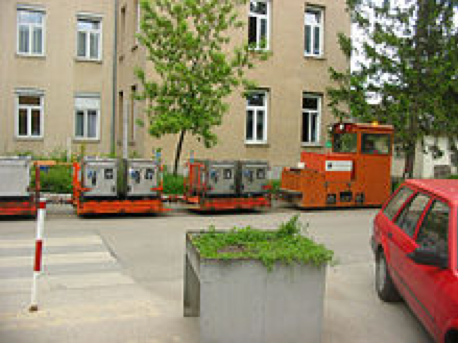
Narrow tram systems that have separate local and express tracks might also eventually help to facilitate the use of freight trams, at least during times of day when there is not a high demand for passenger transit. With two tracks per direction, a narrow freight tram could linger in one spot to be loaded or unloaded without blocking other trams behind them. If, for example, the process of loading and unloading goods from trucks and trains becomes automated, leading to an increase in multi-modal freight transport or nighttime freight delivery, freight trams might become useful in urban areas because of how quiet, clean, and battery-free they are. Narrow trams might also serve well as freight trams by being able to squeeze into the edges of certain railway or expressway corridors where industrial and freight-transport infrastructure already exists.

Narrow trams might also allow for longer vehicles, at least on their express lines or on grade-separated sections. They could have more room to carve out the wide turns needed by longer vehicles, since their narrow size might allow them to make diagonal cuts to avoid intersections without taking up too much valuable street-corner real estate. Such diagonal cuts would also them to have useful indoor stations. Their longer length could help compensate for narrow trams’ smaller number of passengers per row. Eventually, perhaps, driverless vehicles (at least, in grade-separated corridors) might also allow for viable narrow trams that do not have long lengths.

Picture1g
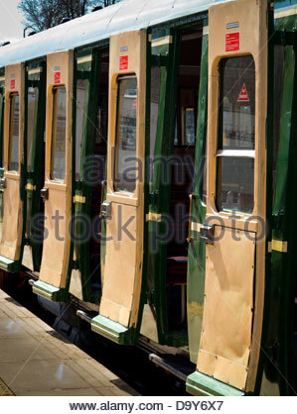
Glasgow Subway

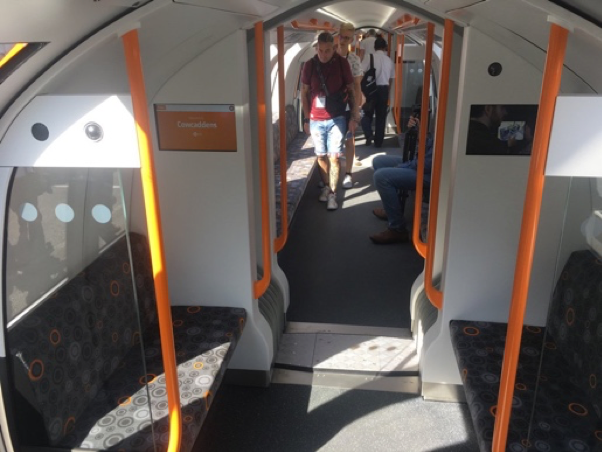
In some cases, it would not just be the width of the vehicle that would be narrow, but also the diameter of the vehicle. A Narrow-Diameter tram would have both a narrow width and a low ceiling. A ceiling height of seven or eight feet, for instance, would be relatively low, yet would not be so low as to make passengers too uncomfortable, particularly given that the plentiful doors and smart-platform system would help prevent passengers from having to fight their way through a crowded vehicle. The benefits of having a lower ceiling and smaller diameter could be significant. Lower ceilings can make it easier to use underpasses or get in and out of tunnels. Smaller diameters also reduce the required size of tunnels. A tunnel with a 7-foot diameter, for example, would have a volume that is only a quarter as great as that of a tunnel with a 14-foot diameter.

Hypothetically – very, very hypothetically a city could even take an existing subway tunnel and repurpose it to run local and express narrow subway trains in each direction, with the express narrow trains being so narrow that they could able to bypass the local trains at certain points. Even more unrealistically, a city could build a futuristically tubular train with a diameter of only, say, 4.5 feet, in which most passengers would have to sit in order to fit on board, like in a car. A 4.5-foot-diameter tunnel would have a volume only around one-tenth that of a 14-foot one.

Of course, such extreme steps are not needed. There might be benefits to be gained from making vehicles even just a little bit narrower than they are today. Technologies such as digital payment systems that make it easy to board any door on a vehicle, transit apps that make it easy to choose between local or express vehicles, the possibility of smart-platforms that can indicate which sections of approaching vehicles are crowded, and perhaps eventually also the possibility of automation, might all make narrower trams more viable than they have been until now.

Picture1h


Two Half-Baked Montreal Expos Stadium Ideas

The Washington ex-Pos won the World Series earlier this week, at the end of a very exciting playoff run. It would be nice if Montreal could get a team again: hopefully they will take Tampa Bay’s, and so join their neighbours Toronto, Boston, New York, and Baltimore inside the American League East.

If Montreal decides to build a new stadium, what should it be like? Here are two half-baked ideas:

  1. Pitched Outfield Walls

Baseball, arguably, needs more running and fielding plays, more extra-base hits and fewer shallow home runs. There may be a great way to achieve this: have part of the outfield wall be slanted. For instance, put a pitched roof over the outfield bullpens, with the roof serving as an angled extension of the outfield wall rather than part of home run territory. Very long fly balls and line drives would then bounce off the slanted roof and back up into the outfield into play, creating doubles and triples, attempts at triples, first-to-home scoring attempts, maybe even the odd inside-the-park homer.

If you really want to go big, you could even create a sort of angled version of Fenway’s Green Monster. This Monstre Bleu would produce exciting running and fielding plays and extra base hits, rather than the singles and shallow homers that Fenway’s Monster creates. What’s the ideal size and angle for a slanted portion of an outfield wall? I don’t know: maybe ten feet long, forming a 45-degree angle with the normal outfield wall from which the slanted section extends?

  1. Seasonally Enclosed Stadium

Half a dozen MLB teams have stadiums with retractable roofs, and one team, Tampa Bay, has a permanently closed roof. Retractable roofs are useful obviously, but they are also expensive and far from aesthetically ideal. Montreal has arguably the best summer baseball weather of any MLB city, but also the coldest weather in spring and fall. Maybe, then, instead of building a stadium with a conventionally retractable roof, it could pioneer a seasonally enclosed stadium of some sort, to be open in the summer but enclosed in spring, fall, and winter.

Ideally, such a stadium would overcome some of the financial and aesthetic limitations of conventional roofs. Perhaps, depending on how much time and effort would be needed to open and close the roof, the stadium could also be enclosed ahead of summer weeks when the forecast calls for lots of rain.


Wall Ball

Wall Ballor WalBall, if Walmart ponies up the cash to buy the rights — is baseball with one tiny, gigantic quirk: if a fielder catches a ball directly off of a wall, the batter who hit that ball is out.

This change will serve multiple purposes:

  • it could allow for much smaller field sizes* without leading to a correspondingly large increase in home runs, so long as the outfield walls are built very tall. This can allow for much cheaper ballparks (whether at the recreational, amateur, or professional level), both for outdoor fields in urban areas where land is expensive, or for retractable-roof stadiums where reductions in field size can result in disproportionately large roof-cost savings
  • it could make fielding and base-running much more of a coequal part of the game with hitting and pitching, rather than a distant third and fourth in terms of importance. One result of this will be far more highlight-of-the-night plays. Another may be more athletic players
  • it could make game durations much shorter, as there will be more fly ball outs and, depending on the placement and height of any walls in foul territory, more foul outs too
  • In city parks, it can prevent long fly balls or line drives from hitting pedestrians, parked cars, or cars in motion, thereby freeing up valuable park space or parking space in urban areas
  • It could serve as a practice facility for amateur baseball players, and, particularly in very small parks, could allow recreational or practice games without needing nine players a side
  • it could make for interesting variations from one ballpark to another. If there are also seats above the wall (assuming Wall Ball takes off enough to become more than just a recreational endeavor) it could make for cool outfield seats, much closer to the infield
  • the high outfield walls could double as gigantic projector screen surfaces (the Dallas Cowboys’ jumbotron, by way of comparison, is 72 feet high), to be used for movies, concerts, etc. And the side of the wall facing away from the field could be a climbing wall!

*If, say, the outfield walls were made to be 37 feet tall (the same as Fenway’s Green Monster), and placed 310 feet from home plate (same as the Green Monster) in left field and right field, and 350 feet in center field, the overall field would be roughly 10-20 percent smaller than a typical MLB field. If the walls were 75 feet tall (a double Monster), at 290 feet in left and right field and 340 at center, the field would be maybe 20-30 percent smaller. If the walls were 150 feet high…well, you get the idea. Granted, such extreme reductions in field sizes would leave much less open space for balls to drop into the outfield for a hit. This would increase the importance of outfielders’ defensive ability (and especially their ability to catch balls off of the wall) and infielders’ ability to prevent singles

Pitching to Walmart:

The World Series may not be about actual world supremacy, but Walmart’s fight with Amazon might be. Walmart has one huge challenge – it must attract customers to its stores – and one huge asset: vast real estate holdings (mostly, its mega-parking lots) located close to Americans’ homes.

One big question is, in a future with online shopping, space-efficient autonomous-valet parking lots, mobility apps, and the like, what will Walmart do with parts of its gigantic parking lots, in order to prevent its customers from abandoning it for online retailers? One possible answer is recreation and entertainment. A small baseball field could fit easily into just a small fraction of a Walmart parking lot. (In fact, entire MLB stadiums could fit in Walmart parking lots, that’s how crazy North American parking lots really are). The outer-facing side of the outfield walls could act as drive-in movie theatres for the parking lot, and the field itself could double as a (wall-shaded) park or outdoor market.

If you build it, Walmart…