Seniors Discount? Oil Prices and Old Rulers

Today’s low oil prices are probably not the result, even in part, of elderly men ruling over the world’s major energy-exporting nations. Still, it may be worth noting that the sons of Saudi Arabia’s modern founder, Abdulaziz bin Saud, are finally nearing the end of their long royal lifespans, while the leaders of energy-endowed countries like Iran, Algeria, Angola, Oman, Kazakhstan, and Uzbekistan have now reached old age too, after multiple decades in office. Even Vladimir Putin is 63 years old, long past his judo prime. He was just 47 when he first came to power.

As Egypt’s Hosni Mubarak and Libya’s Moammar Gaddafi arguably showed in 2011, longtime aging rulers can sometimes give way to political upheaval that causes domestic oil and gas production to fall. Uncertainty over the vigour of some of the following leaders might indeed cause global energy exports to fall, and thus, perhaps, prices to rise:

Kuwait – Sabah al-Ahmad al-Jaber al-Sabah – 86 years old – In power since 2006  

Sabah’s presumed successor, Nawaf Al-Ahmad Al-Jaber Al-Sabah, is 78 years old. As recently as 2012 Kuwait was the world’s largest oil exporter outside of Russia and Saudi Arabia.

Saudi Arabia – Salman bin Abdulaziz bin Saud – 80  years old – In  power since 2015 

Salman will probably be the last king to be chosen from among the 45 or so sons of the founder of modern Saudi Arabia, Abdulaziz bin Saud. Salman’s youngest living sibling, his half-brother Muqrin, is turning 71 this year and, as of last year, is no longer the designated  Crown Prince. The Saudi Crown Prince has since become Muhammad bin Nayef, Salman’s nephew, while the Deputy Crown Prince has become Salman’s own son Mohammad bin Salman

Algeria – Abdulaziz Bouteflika – 79 years old – In power since 1999 

Bouteflika came to power during and after the Algerian Civil War of the 1990s. Today his health is in question. Algeria is estimated to be the world’s 16th largest energy producer and its fourth largest natural gas exporter.

Uzbekistan – Islam Karimov – 77 years old – In power since 1991  

Karimov first came to power at the end of 1980s, when he became President of the Uzbek Soviet Socialist Republic

Iran – Ali Khameni – 76 years old – In power since 1989 

Kazakhstan – Nursultan Nazerbayev – 75 years old – In power since 1991 

Oman –  Qaboos bin Said al Said – 74 years old – In power since 1970

Qaboos first became ruler  after overthrowing his father in a palace coup in 1970. He has no children or clear successor

South Africa – Jacob Zuma – 74 years old – In power since 2009 

Zuma was Deputy President of South Africa from 1999-2005. South Africa is a major producer of energy, and a net exporter of energy, because of its coal reserves, though it is a net importer of oil

Nigeria – Mohammadu Buhari – 73 years old – In power since 2015 

Buhari was previously Nigeria’s head of state during the 1980s

Angola – Jose Eduardo dos Santos – 73 years old – In power since 1979 

Angola, one of the fastest-growing economies of the past decade, is now the world’s third or fourth largest oil exporter outside of the Middle East

Equatorial Guinea – Teodoro Obiang Nguema Mbasongo – 73 years old – In power since 1979 

Equatorial Guinea is the 30th-40th largest oil producing country, but may have the world’s third highest per capita oil production, the highest outside the Middle East.  Both the age of its leader and the number of years he has been in power are exactly the same as in Equatorial Guinea’s relatively nearby neighbour Angola

Sudan – Omar al Bashir – 72 years old – In power since 1993

Brunei – Hassanal Bolkiah Muiz’zaddin Wad’daulah — 69 years old – In power since 1967

Brunei is the world’s 40th-50th largest oil producing country, but may have the 6th highest per capita oil production

Brazil – Dilma Roussef – 68 years old – In power since 2010

Her predecessor, Louis Inacio Lula da Silva, who literally as of today was selected to  become Roussef’s new chief of staffwas 65 years old when he left office in 2011 at the end of an eight-year term. Roussef has been facing an impeachment attempt, while Lula has been under investigation in a corruption scandal. 

United Arab Emirates – Khalifa Al Nayhan — 68 years old  – In power since 2004

The Emir of Dubai is 66 years old, meanwhile

Colombia – Juan Manuel Santos – 64 years old – In power since 2010 

South Sudan – Salva Kiir Mayardit – 64 years old – In power since 2011

Iraq – Haider al Abadi – 63 years old – In power since 2014 

Masoud Barzani, meanwhile, who has been president of oil-rich Iraqi Kurdistan since 2005 and leader of the Kurdistan Democratic Party since 1979, is 69 years old. Foud Massoum, a Kurdish politician who is Iraq’s president (a more ceremonial role than prime minister), is 78 years old and has been in office since 2014. Nouri al Maliki, who was Iraq’s prime minister from 2006-2014 and is now Iraq’s vice president, will turn 66 this June. Saddam Hussein was 42 years old during his purge of 1979 and 66 years old when the US invaded in 2003.

Russia – Vladimir Putin – 63 years old – In power since 1999

Malaysia – Najib Razak — 62 years old – In power since 2009

Mahatir Mohammad, meanwhile, is 90 years old. Malaysia is thought to be the world’s 25th largest oil producing country

Turkey – Recep Tayyip Erdogan – 62 years old – In power since 2003

While Turkey is a significant net importer rather than exporter of energy, it is nevertheless capable of impacting the rest of the Middle East, and it has hopes to become a major energy nexus at the centre of the Middle East, North Africa, and Caspian Sea region. (Similarly, Israel’s Benjamin Netanyahu, who has been prime minister since 2009 and was previously prime minister from 1996-1999, is 66 years old)

Australia – Malcolm Turnbull – 61 years old – In power since 2015

Egypt – Abdel Fathah al-Sisi — 60 years old –  In power since 2014 

Sisi was also highly influential for at least a few years before 2014, following Hosni Mubarak’s departure from office in 2011

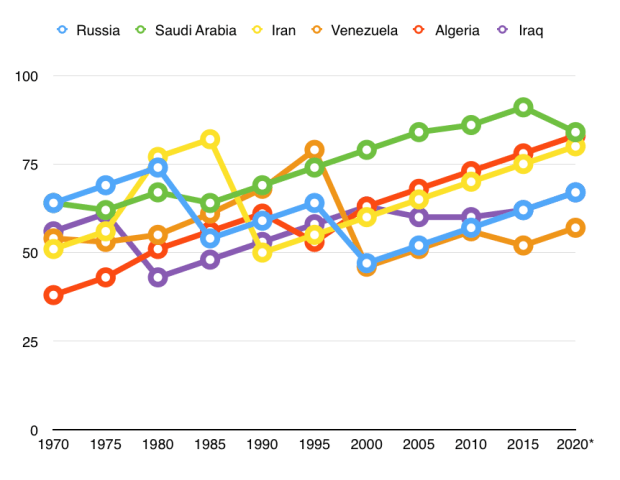
The following graph shows how old these countries’ rulers were in any given year between 1970 and 2015, and how old they will be in 2020 if today’s rulers remain in power for the remainder of the decade:

Age oil leaders

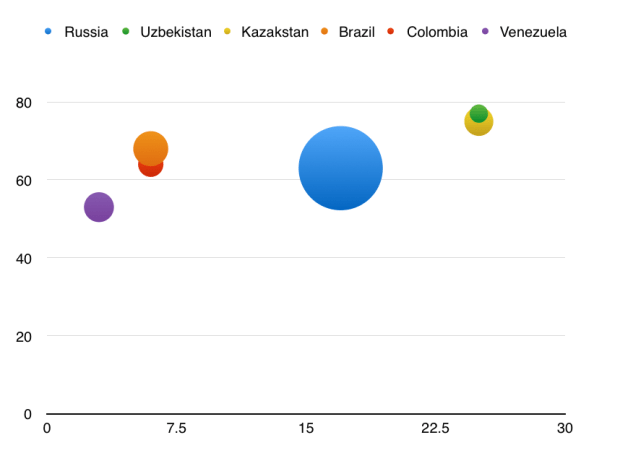
In the graphs below, the y-axis indicates the age of today’s rulers, the x-axis indicates the number of years they have been in power, and the size of the circles indicates the relative amount of energy that is produced by their country.

oil3

oil5

oil4

oil leaders

US Legal Immigration — Image of the Day

most-common-country-immigrants

most-common-country-immigrants-no-mexico

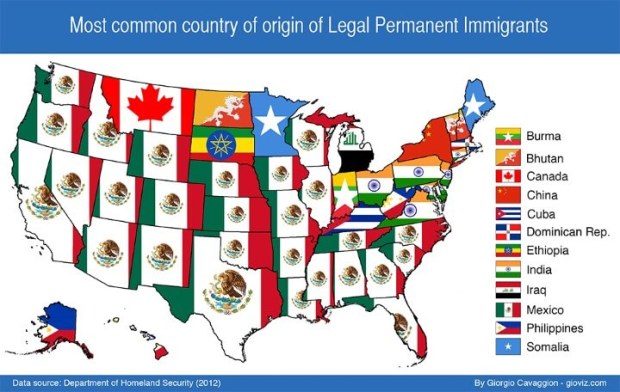
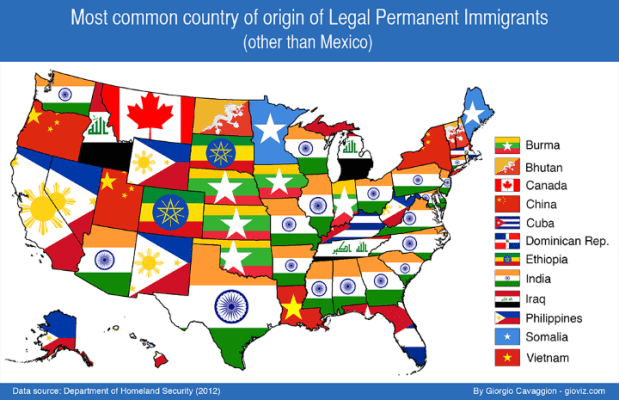
With all the disgusting Trump talk on the issue of illegal immigration that has been going on, the other main source of American newcomers – legal immigrants – is sometimes overlooked. The maps above were made by Giorgio Cavaggion, using data from the Department of Homeland Security of immigrants who “became legal permanent residents during the fiscal year of 2012.” That year over one million people in the US became Legal Permanent Residents. Here are 10 thoughts on the maps above:

1. Mexico Still Dominates

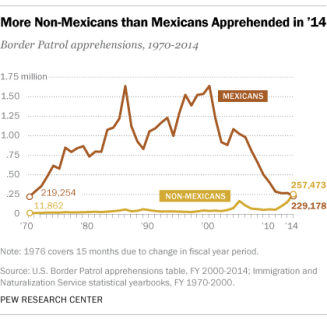
Even in spite of the big drop-off in immigration from Mexico to the United States (see graphs below), Mexico still ranks first in half of the states in the country. Only in the northeastern and north-central regions of the US, from Montana to Maine, is Mexico not #1.

2012-phc-mexican-migration-08aFT_14.12.26_BorderApprehensions

2. India a Strong Second 

India finished first in six states (Ohio, Pennsylvania, New Jersey, Connecticut, Delaware, and Virginia) and second to Mexico in twelve states (Washington state, Arizona, Texas, Wisconsin, Illinois, Missouri, Arkansas, Mississippi, Alabama, Georgia, South Carolina, and North Carolina). This is a big increase from previous generations (see graph below).

Still, nearly a third of all Indian immigrants in the US live either in California or New Jersey. More than 25% live in San Jose, Chicago, or Greater New York City. Also notable is that India’s many regions are not represented proportionally in America. Rather, Indian states like Gujarat and Punjab are highly over-represented. Gujaratis, for example, account for more than 20% of Indians in the US, though they are only 6% or so of the population within India itself.

pyramid5-2011
Population pyramid of Indian Immigrants in the US
sp-chart-aug13.jpg
Foreign-born Americans By Country of Origin. India still ranks far behind Mexico, and just barely ahead of various Pacific and Caribbean countries

3. Burmese in Fly-Over Country 

Burma (aka Myanmar) was first in Indiana and second to Mexico in Kansas, Oklahoma, Nebraska, and Iowa. This could be significant going forward, given that Myanmar may have finally begun to liberalize its political system and renew ties with the United States in recent years. Indeed, Myanmar has often been seen as one of Hillary Clinton’s primary achievements during her time as Secretary of State, so if she becomes president it could perhaps further impact the US-Burmese relationship. Since the mid-2000’s, though, most Burmese immigrants in the US have been from non-Burmese ethnic minority groups, like the Karen people.

4. Bhutan Surprises

I would never have guessed that Bhutan, a far-away Himalayan country of just 750,000 people, would finish first on this list in three separate states (Vermont, New Hampshire, and North Dakota). No other country, apart from Mexico, India, and the Philippines, was first in three or more states. And even the Philippines was first in just one of the Lower 48 states.

5. The French Connection 

Vietnam finished first in just one state, Louisiana, and the fact that it did reflects two different ways in which history continues to inform the present-day United States. First is the French connection: Louisiana and Vietnam were both part of the globe-spanning French Empire, a fact that seems to resonate today even though neither Louisiana nor Vietnam even speak much French anymore. Or maybe Vietnamese just enjoy New Orleans jazz.

Second is the American military: wherever it goes, people from that country tend to end up in the United States. The Vietnamese have now become one of the biggest non-Hispanic groups in the US apart from Chinese and Indians, as have immigrants from Korea and the Philippines where the US also fought significant wars during the 20th century.  Iraq too has seen its share of immigrants to the US grow over the past decade: on the maps above, Iraqis finished first in Michigan and second to Mexico in Tennessee and Idaho.

6. Cubans in Kentucky, Dominicans in Massachusetts 

One might have expected Cuba to finish first in Florida, but in fact Mexico took that honour, leaving Cuba in second. But while Florida was the only state where Cuba finished second to Mexico, Kentucky, surprisingly, was the only state where Cuba finished first overall. Massachusetts and Rhode Island, meanwhile, were taken by the Dominican Republic, which did not finish second to Mexico in any states.

Though Cuba and the Dominican were the only two Spanish-speaking countries apart from Mexico on either of the maps above, the United States of course also has a very large population from other Latin American countries. These did not finish first – or second to Mexico – in any states, however, because many live in Washington D.C. (Salvadorans in particular) or in major immigrant-rich states like California, New York, and Florida, or come from Puerto Rico which is not considered to be a foreign country, or have not yet become Legal Permanent Residents.

7. East Asia in the West 

This is an obvious one: immigrants from East Asian countries often continue to cling to the Pacific Ocean even once they reach the United States. Though Mexico still finished first throughout the entire US West Coast, the Philippines finished first in Hawaii and Alaska and second to Mexico in California, Nevada, New Mexico, and Wyoming. Oregon and Utah, meanwhile, were the only two states in which China was second to Mexico. India, though not a Pacific country, was second to Mexico in Arizona and in Washington state.

8. East Africa in the North

Of the ten states in the Lower 48 which directly border Canada, Mexico finished first in just two (Washington state and Idaho), Canada finished first in just one (Montana), Bhutan finished first in three, Somalia in two (Maine and Minnesota), and Iraq in one (Michigan). Another East African state, Ethiopia, finished first in nearby South Dakota. Ethiopia also finished second to Mexico in Colorado.

9. Filipinos in Coal Country

Outside of the offshore states of Hawaii and Alaska, the only state the Philippines finished first in was West Virginia. Outside of California, Nevada, and New Mexico, the only state the Philippines finished second to Mexico in was Wyoming. Today Wyoming accounts for approximately 40% of US coal production and West Virginia accounts for about 10% of US coal production. Both states produce considerably more coal than any other state; only Kentucky even comes close to  their level of coal production. Wyoming, West Virginia, and Alaska also have the highest per capita energy production of any states in the country.

10. China “Seemingly” Underrepresented

China, in spite of its huge population, only finished first in one state, and only finished second to Mexico in two states. This could be a bit misleading, though, since the state that China finished first in was New York. New York was the only one of the “Big 4” states (California, Texas, Florida, and New York) not to be finished by first in by Mexico, and, with the exception of Michigan, it was the only one of the fourteen most populous states in America not to be finished first in by either Mexico or India.


Capital Idea — Image of the Day

Capital_City_Plaza_Hotel

Countries have different way of ordering their own provinces and capital cities, and how they choose to do so may sometimes say a lot about what sort of politics they have. Where countries’ capital cities are concerned, there is usually something akin to one of the following four set-ups:

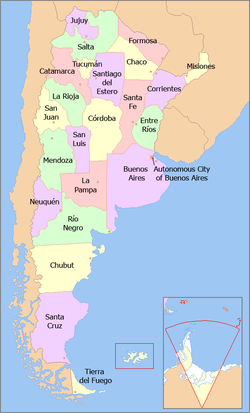
  1. The Argentine model: the country’s capital city serves as its own unique administrative district and is surrounded on all sides by a single province that it influences to a large degree.
  2. The American model: the capital city serves as its own unique administrative district but is not surrounded by a single province (or state, etc.), but rather by two or more provinces.
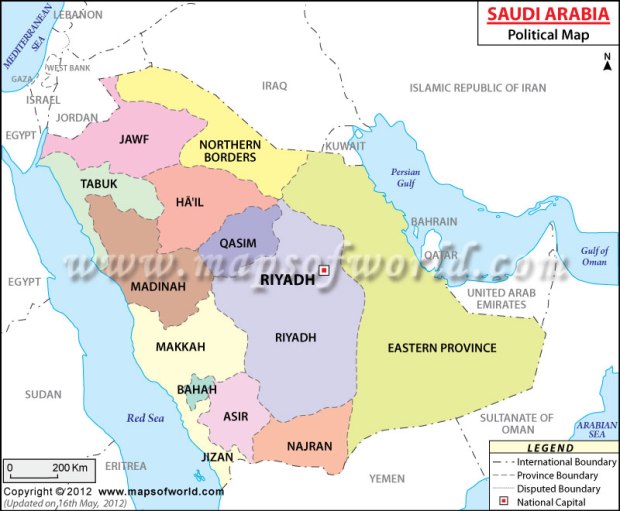
  3. The Saudi model: the capital city is not its own unique administrative district, but is part of an important province that is named after itself.
  4. The Canadian model: the capital city is sometimes annoyingly full of bureaucrats, but is otherwise more or less a normal place. It is not its own administrative district.

The Argentine Model 

250px-Map_of_Argentina_with_provinces_names_en

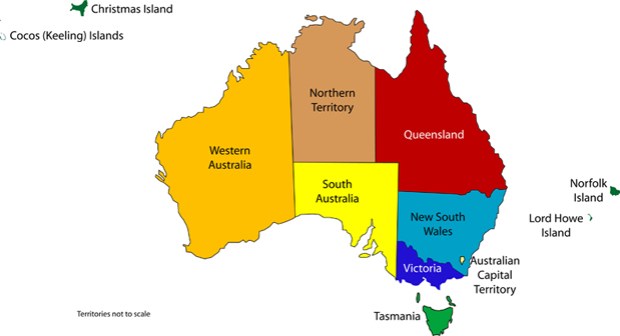
Examples of the Argentine model include, of course, Buenos Aires, which is surrounded by the province of Buenos Aires (Argentina’s recent presidential election, in fact, was between the mayor of Buenos Aires and the governor of Buenos Aires province); Berlin, which is surrounded by Brandenburg (see map below); Moscow, which is surrounded by the Moscow oblast; the Australian Capital Area, which is surrounded by New South Wales (see map below), Vienna, which is surrounded by Lower Austria; Brussels, which is surrounded by Brabant (though Brussels does not directly border Walloon Brabant, which is several km to the south of Brussels); Prague, which is surrounded by the Central Bohemian Region; and Addis Ababba, which is surrounded by Oromia.

Australian-States

Germany-Map.jpg

oesterreich_karte_en


Beijing probably also belongs in this category: it is surrounded mostly by the province of Hebei but in two spots also by the city of Tianjin, which like Beijing is one of China’s four “direct-controlled municipalities” (the other two are Shanghai and Chongqing). Tianjin was temporarily made part of  Hebei province in the 1960s, and in recent years there has been much talk of increasing integration and cooperation between Beijing, Hebei, and Tianjin in order to form a sort of capital city macro-region, which is often referred to by the acronym Jingjinji.

20150530_CNM939

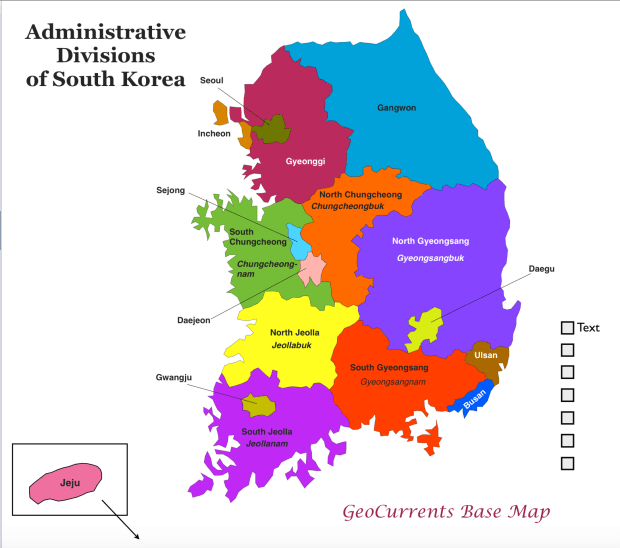
Seoul in South Korea has a similar set-up to Beijing. It is surrounded almost entirely by the province of Gyeonggi, but also touches the coastal city-province of Incheon, in the same way that Beijing does the city-province of Tianjin:

South-Korea-Divisions-Map.png

Note by the way that South Korea has a number of city-provinces. Of these, only Gwangju, in the southwest, conforms fully to the “Argentine model”.

Paris too may be included in this list; Paris is not itself a province, but it is surrounded on all sides by Ile de France, one of France’s 13 regions. (Prior to the beginning of this year Ile de France was one of France’s 22 regions, but these have since been reordered and reduced).


The American Model 

md-map

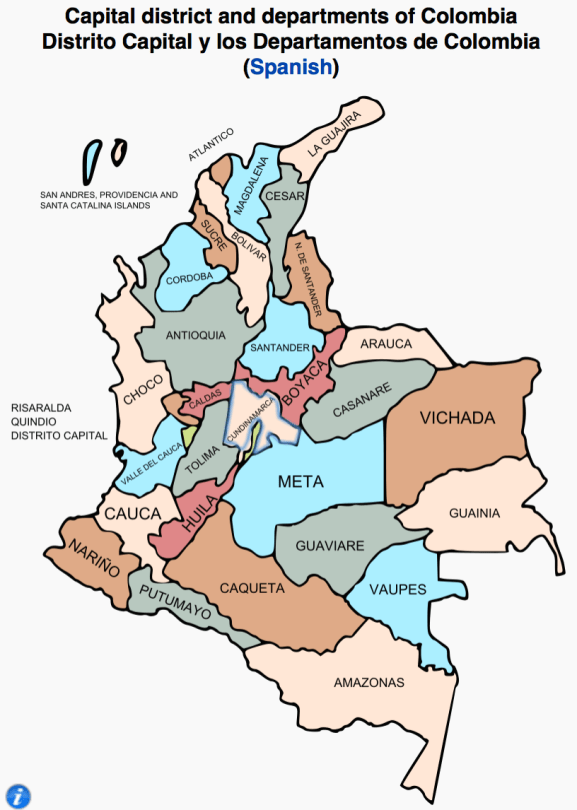
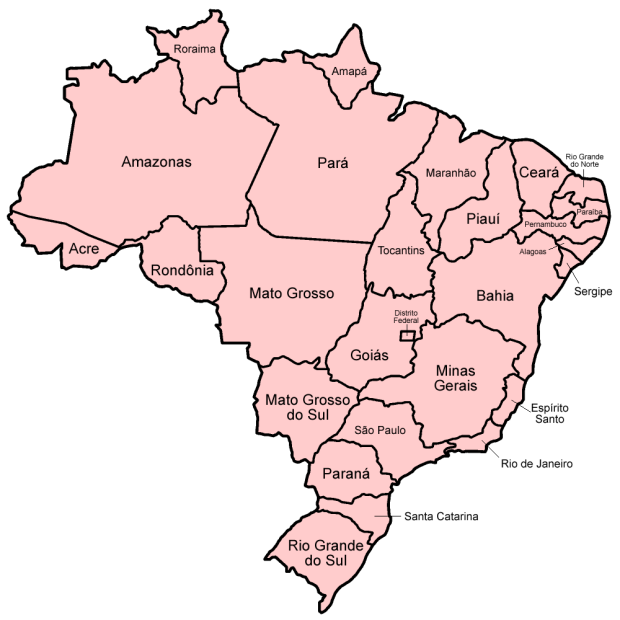
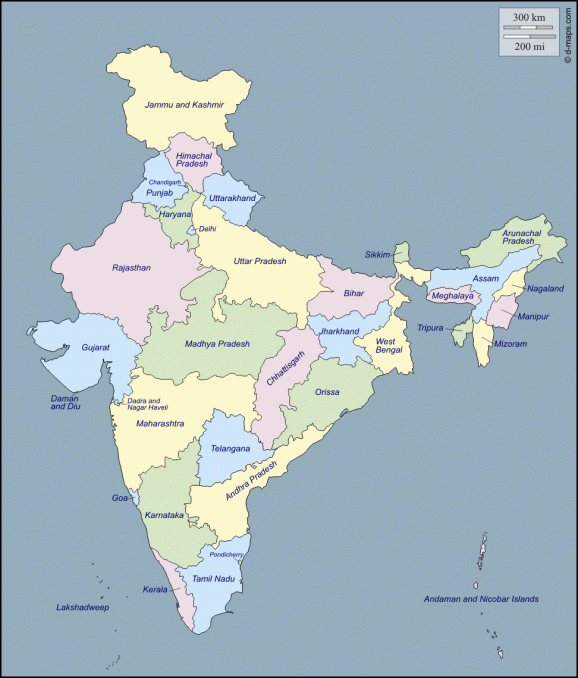
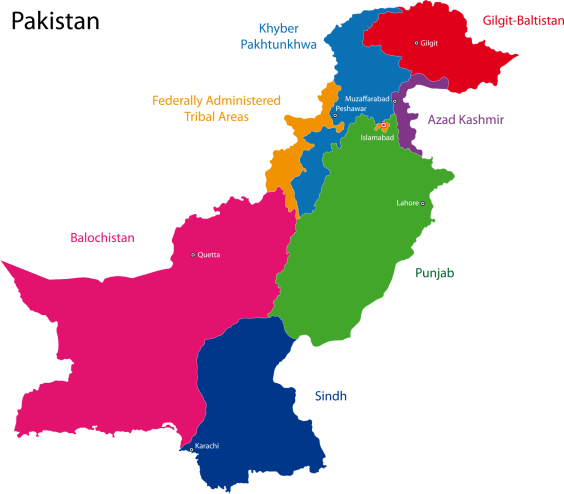
Capitals which are their own unique administrative districts but lack their own single encircling province include Washington D.C. (which is surrounded by both Virginia and Maryland), Tokyo, London, Delhi; Mexico City, Bangkok, Tehran; Hanoi, Abuja (though Nigeria’s largest city by far, Lagos, which was the capital until 1991, is an example of  the Argentine model), Baghdad (which is surrounded by four other provinces), Manila, Jakarta, Madrid, Islamabad, Brasilia (though just barely …and the capital of Brazil prior to 1960 was Rio de Janeiro), Kinshasa, and Bogota (though in a relatively weird way; see map below, Bogota is the sliver between the departments of Cundinamarca – which Bogota is also the capital of – and Meta).


colombia

One feature that a number of these have in common is that, while the capital city’s administrative district often borders two other provinces, it is usually surrounded much more by the less populous of the two other provinces. Notable examples of this include Washington D.C., which is surrounded much more by Maryland (population 5.9 million) than by Virginia (population 8.3 million); Delhi, which is surrounded much more by Haryana (25 million) than by Uttar Pradesh (205 million); and Brasilia, which is surrounded much more by Goias (6.5 million) than by Minas Gerais 21 million.

Brazil_states_namedinde49

Capitals which do not fit this pattern, however, are Mexico City, where the federal capital district is surrounded much more by  the state of Mexico (population 16 million) than by the state of Morelos (population 1.9 million); and Islamabad, which is surrounded much more by Punjab (population 91 million) than by Khyber Pakhtunkhwa (population 27 million).

mapmexicobasic

PakistanProvincesMap


A number of non-capital cities, meanwhile, such as Hamburg, which is the most populous city in Germany apart from Berlin, fit into this category as well.


The Saudi Model 

saudi-arabia-political-map

A capital city which is not its own unique province, but rather is part of an important province named after itself. Examples may include Riyadh, Stockholm, Dhaka, Santiago, and Ankara. Bern also could probably be on this list, but Bern is only the de facto capital of Switzerland; Switzerland has no de jure capital city.

Map-of-Turkey-and-81-provinces.jpg


The Canadian Model 

Examples of countries in which the capital city is not its own unique independent unit may include Ottawa, Amsterdam, Rome, and Warsaw.

According to Wikipedia “two national capitals in federal countries are neither federal units [like provinces, states, etc.], special capital districts, nor capitals of federal units: Ottawa, the capital of Canada [because Toronto is the capital of Ontario, the province in which Ottawa is located], and Palikir, the capital of the Federated States of Micronesia“. Ottawa is situated entirely within the province of Ontario, but also directly borders French-speaking Quebec.

maxresdefault
Ottawa
93f88daab2d2ff195b57f9c71ee3db76
Palikir


Please let me know if I’ve made a mistake on any of these; administrative divisions can be a bit complicated – and I can be a bit lazy.


Texas: The Real Swing State 

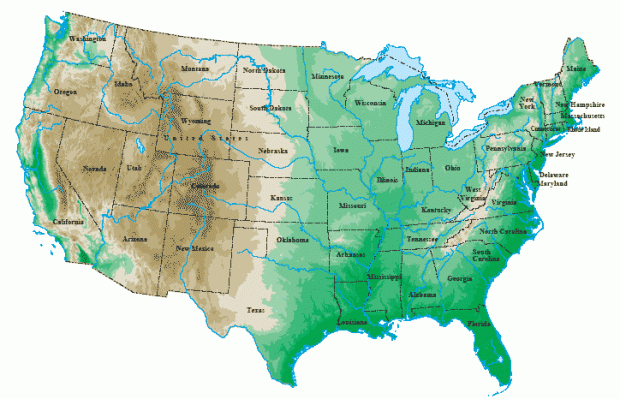
There are, in a certain sense, three big political regions in the United States: the Northeast, the Southeast, and the Southwest.

The Northeast has a temperate climate, excellent natural harbours along the Atlantic Ocean and Great Lakes, and a long border with Canada. The Southeast has a sub-tropical climate, less-than-excellent natural harbours (excepting New Orleans), and no international borders. The Southwest has a semi-desert climate, an abundance of energy and mineral resources, and an extremely long border with Mexico.

us

For the purposes of this article, the Northeast has five “core” states: New York, New Jersey, Pennsylvania, Massachusetts, and Connecticut. These states are geographically contiguous, and they have voted for the same party as one another in all six of the presidential elections since 1988 and in 23 out of the 30 elections since 1892. At least four of them have voted in unison in 27 of the past 30 elections.

If you subtract the smallest of these states, Connecticut, then at least 3 of the remaining 4 of these states have voted in unison in 29 of the past 30 elections. The sole exception to this was 1988, when New Jersey and Pennsylvania voted for George H W Bush while New York and Massachusetts were two of only ten states to vote for Michael Dukakis, who had been governor of Massachusetts.

Before that you have to go back 31 elections to see the Northeast vote split, when in 1892 Grover Cleveland won New York and New Jersey while Benjamin Harrison took Pennsylvania and Massachusstetes. While in those days the Democrats had been more popular in the south than in the north, the Democratic candidate Grover Cleveland had already been governor of New York, mayor of Buffalo, and President of the United States, and he was born and raised in New Jersey.

Today the five Northeastern core states account for 15% of US electoral college seats. New York and Pennsylvania, the most populous of the five, account for 9% of US electoral college seats.

The Southeast arguably has five core states as well: Louisiana, Mississippi, Alabama, Georgia, and South Carolina. These too are geogaphically contiguous, and they have voted in unison during all four of the most recent presidential elections, 9 out of the past 13 elections, and 27 out of the past 34 elections — including, incredibly, a run of 17 elections in a row from 1880 to 1948. Other states like Arkansas could probably be included in this group as well, but for simplicity’s sake we’ll leave them out for now.

Today the Southeastern core states account for 8% of US electoral college seats, led by Georgia which is by far the largest of the five. As the population of the Southeast core is roughly half as large as that of the Northeast core, it often requires support from adjacent populous states, most notably Texas and Florida but also North Carolina and Tennesse (both of which are larger than any of the Southeastern core states with the exception of Georgia) in order to be electorally competitive with other regions.

The Southwest, in contrast, has just two core states, which are not geographically contiguous: Texas and California. These have not voted in unison since 1988, and have voted in unison in just 5 of the past 13 elections — twice for Reagan, who had been governor of California, twice for Richard Nixon, who had been born in California and served as both a Senator and a Congressman representing California, and once for George H W Bush, who had been Reagan’s Vice President.

This division has, perhaps more than anything else, defined modern American politics, as California and Texas are the most populous states in the country, accounting for 17% of the electoral college seats in a presidential election. By comparison, Arizona, New Mexico, Colorado, Utah, and Nevada combined only account for 7% of electoral college seats.

During the past six elections, starting with the very first post-Cold War election of 1992, which also happened to be the dawn of the (ongoing) Clinton era, the Northeast core and California have voted for the Democrats while the Southeast core and Texas have voted Republican. This has occasionally left the presidency in the hands of populous areas  located on the fringe of the three political regions, such as Florida, Ohio, Illinois, Indiana, Colorado, Virginia, Michigan, and upstate Pennsylvania. Not incidentally, this year’s Democratic National Convention will be held in Pennsylvania, while the Republican National Convention will be held in Ohio.

Ohio, currently the seventh most populous state in America, has voted for the winning president in every election since it voted for Nixon (who was beaten by Kennedy) in 1960, Hewey (who was beaten by FDR) in 1944, and Harrison (who was beaten by Grover Cleveland) in 1892. Ohio’s president-picking has been even better of late than that of Missouri, the “bellwether state”, which voted for all but one victorious president between 1904 and 2004 before failing to pick Obama in 2008 and 2012.

Florida has almost exactly the same successful record as Ohio since 1928, except that unlike Ohio it voted for Bush Sr., who was beaten by Clinton, in 1992, and for FDR to have a fourth term as president during the Second World War election of 1944. While today Florida has a population much larger than any state apart from California and Texas, it was only the 18th most populous state in 1950, and at the begining of the 20th century had a population barely larger than that of Rhode Island.

Illinois, in spite of being America’s fifth most populous state, has been less successful in getting its preferred candidates into the Oval Office. It did not vote for George W Bush in either of his elections, and voted for Gerald Ford rather than for a victorious Jimmy Carter in 1976. Many people, however, believe that Illinois was the decisive state in the election of 1960, the closest election of the 20th century. It has been alleged that Illinois’ vote was rigged in Kennedy’s favour that year.

Michigan has been nearly identical to Illinois in its voting patterns, with the exception of 1968 (Michigan voted for Hubert Humphrey rather than Nixon), 1948 (Michigan voted for Dewey rather than for Truman), 1940 (Michigan was the largest of just 10 states to vote for Indiana-born Wendell Wilkie instead of Franklin D. Roosevelt), and 1912 (Michigan was one of just seven states to vote for Progessive Party candidate Theodore Roosevelt instead of for Woodrow Wilson). Today Michigan, Illinois, Ohio, and Florida account for 15% of electoral college seats.

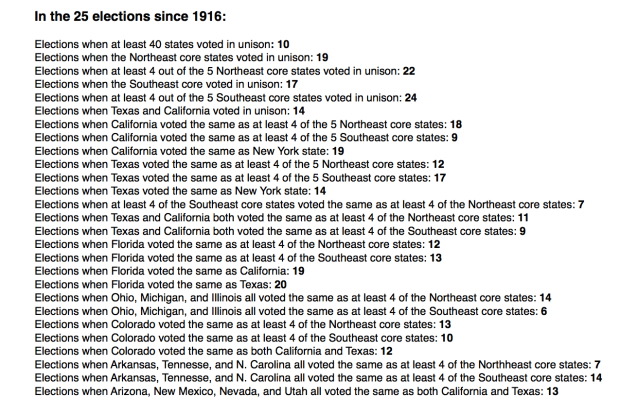
elections
Source: Future Economics

The Break-Up 

The most significant modern shift in American politics has probably been in the Southwest. Whereas California voted for the Republicans nine out of ten times between 1952 and 1988, it has voted for the Democrats in all six elections since. Whereas Texas voted for the Democrats four out of ten times between 1952 and 1988, it has voted for the Republicans in all six elections since. And whereas Texas and California voted in unison seven out of ten times between 1952 and 1988 and fourteen out of nineteen times between 1916 and 1988, they have not voted in unison since. It is certainly more difficult now to imagine a Republican president hailing from California, as both Reagan and Nixon did, or a Democratic president hailing from Texas, as Lyndon Johnson did.

California’s shift has occured probably as a result of a demographic influx from Latin America, the Pacific rim, and other parts of the US. Texas’ political shift has been less distinctive than California’s, meanwhile; it went from red-violet to red whereas California went from nearly red to blue.

Texas’ solidification as Republican state may be partly due to economics and environmental politics. Whereas oil and gas production across much of the rest of the US plummeted during the 1980s and 90’s (including in California, where oil production has halved since 1985), oil in the Gulf of Mexico rose from under 15% of total US oil production in 1985 to nearly 45% of total US oil production by 2000. This left Texas, which also produces prodigious amounts of natural gas and coal, with an even larger role in American energy production, just as many Americans were becoming increasingly concerned with the ozone layer and global warming. As states were forced to choose a side in the environmental war, Texas’ allegience was an obvious one: it is with the Republicans.

The Bush and Clinton families may perhaps have played a role in the political shift in Texas as well. The Bush’s, historically a northeastern family, shrewdly put down roots in Texas during the 1950’s. George H W Bush became a Texas congressman and George W Bush would later become its governor from 1995-2000. Bill Clinton, meanwhile, was born in neighbouring Arkansas, and served as governor of Arkansas from 1983-1992 (remember when Hillary Clinton had a southern accent?) before beating George H W Bush in the 1992 presidential election. In that year Texas voted for a second Bush term, while Arkansas, Louisiana, Georgia, and Tennessee all voted Clinton.

The Clinton-Bush rivalry has continued in intensity since then, first because of the contested election between Bush Jr. and Clinton’s Vice President Al Gore (which occurred in the wake of Bill Clinton’s perjury scandal, which the Republicans at times tried to tarnish Gore as having been involved with), then because of Hillary’s 2008 anti-Bush primary campaign (before it became clear that Hillary’s true opponent was Obama, rather than just the legacy of George W.), and finally during 2015 when many thought that this year’s election would be Hillary vs. Jeb. Perhaps this Clinton-Bush, Arkansas-Texas dynamic has helped to sour the Texans on the modern-day Democratic Party to some degree.

Looking Ahead

The question now is whether or not the post-1980’s predictable electoral system will begin to change. Will the Republicans continue to dominate the Southeast, or will the Democrats make inroads there, solidifying their position in Florida and even moving into the Southeast core? The Southeast has certainly been changing in recent years; among the ten fastest-growing Hispanic populations in the US during the 2000s, eight were in the Southeast. The Southeast may also have seen growth among its white liberal population, as metropolitan areas like Raleigh, Atlanta, Nashville, Austin, Houston, and Dallas have all been among the fastest-growing American cities in the past decade.

Similarly, could the Republicans look to take back some Northeast (and Midwest) states that have been reliably Democratic-leaning since 1992? The Northeast too has seen some big changes; Pennsylvania, for example, is in the midst of a gargantuan natural gas boom that could perhaps help tilt the state towards the Republicans, assuming environmentalist voters finally tire of the Democrats’ somewhat cynical embrace of burning natural gas as a “transitional” substitute for coal and begin to pressure the Democrats to abandon their alliance with the gas industry. New York may have similar gas resources, but fracking there is prohibited for now.

Finally, could California and Texas reconcile?  Texas, now effectively serving as the Republican heartland, and California, now the Democratic heartland, actually have some commonalities. Both have large Mexican populations. Both are arid and sunny. Both have a lot of oil (especially if the Southern Monterey shale formation is viable, though even without it California remains the fourth biggest oil producer in the US). Both have substantial ties to Asia: California because of its Pacific frontage and sizeable Asian population; Texas because the port nexus of Houston-New Orelans handles by far the most bulk goods of any shipping region in America, making it an integral component of US-Asian trade. (Houston, in fact, has suprisingly become one of the top Chinese tourist destination in the US, a legacy of Yao Ming and later Jeremy Lin having played for the Rockets).

Texas and California are also the two most populous states, and so would benefit from electoral reforms that would stop the US Senate and US presidential election rules from continuing to over-represent small states like Rhode Island and Hawaii in favour of big ones like California, Texas, and Florida. Florida, to be sure, has commonalities with California and Texas as well: it is populous, sunny, and home to a large number of Spanish-speakers.

Texas and California, when combined with Arizona, New Mexico, Nevada, Utah, and Colorado, have 24% of the electoral college seats in the US. Between 1928 and 1964 Texas and California voted for the same candidate in 9 out of 10 elections: 3 Republicans, 6 Democrats. Could it happen again? It seems extremely unlikely to this year, but the longer-term future is less certain. Indeed Texas, with its enormous population, its  20th century history as a purple state, and its position straddling both the Southwest and the Southeast, is in some ways arguably America’s truest swing state. It has simply forgotten how to fly.

East Asian Trade – Image of the Day

From Finally Passing Gas: 10 Winners and Losers of the Panama Canal Expansion:

trade asia

A typical assumption has been that China and Japan will be the primary beneficiaries of the canal. China, after all, leads the world in importing commodities and exporting bulk goods, and Japan has accounted for 40% of the world’s LNG imports – far more than any other country – in recent years.

Yet while China and Japan lead the pack in terms of the value of their absolute trade, they lag far behind both South Korea and Taiwan in the more relevant category of relative trade; that is, the value of their trade relative to the overall size of their economies. As can be seen in the chart above, the economies of China and Japan are generally not as trade-oriented as those of South Korea and Taiwan. As such, they might not benefit as much from the canal, which is intended to ease trade — in particular LNG trade, which the pre-expansion canal could not facilitate.

Of course, none of this means that South Korea and Taiwan are risk-free investments. They are not. Both, for example, have significantly more exposure to China’s economy, which has been struggling of late, than Japan does. All else being held equal, though, South Korea and Taiwan appear likely to be two of the greatest beneficiaries of the new canal.


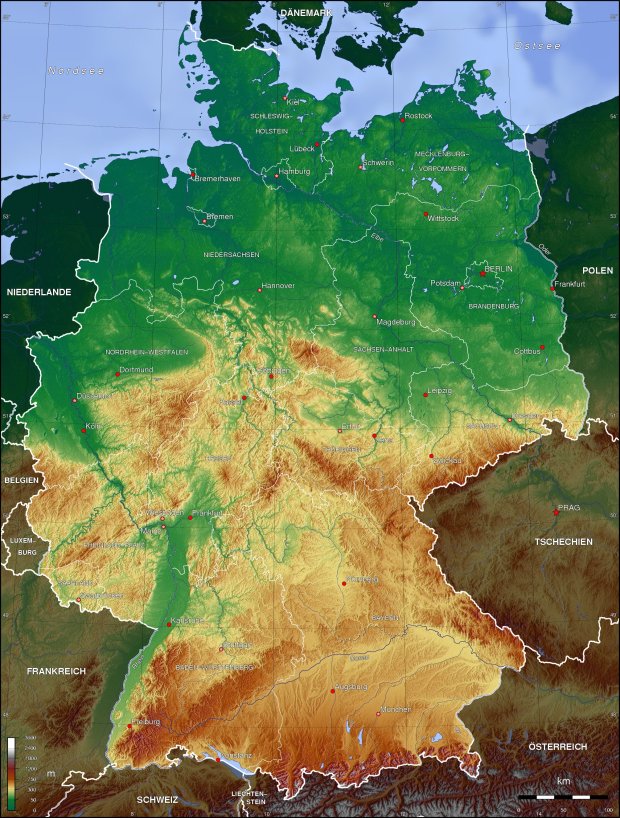
Image of the Day – Germany at a Crossroads

Deutschland_topo

Germany, which accounts for an estimated 21% of the European Union’s GDP and has an unemployment rate that is less than half as high as the EU average, is now facing five big economic challenges:

1. Germany has one of the oldest populations in the world: it’s old age dependency ratio is as high as Greece’s and higher than any other country apart from Italy and Japan; the share of its population aged 80 or older is higher than in any European country apart from France or the “PIGS” (Portugal, Italy, Greece, and Spain). The largest portion of Germany’s population is between 45-60 years old. Old age is beckoning.

2. Whereas Britain, France, Italy, Russia, India, China, and Turkey depend on exports of goods and services to account for an estimated 20-30 percent of their GDPs, and the United States, Japan, and Brazil for just 10-20 percent, Germany gets approximately 46 percent of its GDP from exports. As economies throughout Europe and the developing world are simultaneously growing slowly right now, such a dependence on exports may not be a good thing to have.

3. Low energy prices are not likely to benefit Germany as much as many think, nor will they benefit Germany’s neighbours in northern Europe, central Europe, or especially the former Soviet Union too much (see links for more: herehere, or here). According to the Wall Street Journal, oil imports account for just an estimated 2.4% percent of Germany’s GDP, compared to 3-6% in Spain, Greece, Turkey, Poland, Japan, South Korea, Taiwan, and India, while, according to the World Bank, imports of energy in general account for approximately 62% percent of Germany’s overall energy use, compared to 70-95% in Spain, Portugal, Italy, Turkey, South Korea, and Japan.

4. Germany is facing economic and political diminishing returns in its eastward economic integration. In the past generation it has looked to East Germany and Eastern Europe, but Eastern European countries are no longer so cheap. Czech Republic and Slovakia now have nominal per capita GDP’s of around $19,000, for instance, up from just $5700 in the year 2000; Russia has reached $14,000, up from $1800 in 2000. Increasingly there are also political limitations of various sorts to German involvement to its east. Many Eastern European countries, for example, would rather not see the Germans and Russians become too close with one another economically, and also do not want to become German economic satellites themselves. Things may be becoming more politically fraught than they were a decade or two ago.

5. A similar dynamic is true of Germany’s domestic politics. In the 1990s Germans could unite over the goal of German reunification, while in the 2000s they could unite over European expansion into Eastern Europe, a region located for the most part directly on the borders of Germany or German-speaking Austria. Now, though, with both those goals having been realized to a large extent, there could be room for inter-German regionalism to become more prominent.

It has still been just 145 years since German unification, and 25 since reunification; the three-way divide between eastern Germany, western Germany, and southern Germany, aka Bavaria, may still be somewhat in play. This was seen recently, when Merkel’s longstanding political coalition finally came under pressure as a result of internal opposition from Bavaria over the refugee issue. Germany is under no threat of dissolution, obviously, but regionalism could nevertheless threaten the ability of its central government to continue forming majorities, and it could threaten the ability of any majority governments it does form to take decisive political action.

Germany’s parliament is already regionally split to a slight degree: the Christian Social Union in Bavaria, the regional sister-party of Angela Merkel’s national Christian Democratic Union, holds 7 percent of the seats in Germany’s parliament. Southern German states, moreover, in particular Bavaria but also neighbouring Baden-Wurttemberg, tend to be more right-wing in their voting patterns, whereas eastern German ones tend to be the most left-wing. (Here’s an article describing some of the geographical patterns in Germany’s 2013 election). Bavaria and Baden-Wurttemberg are the second and third most populous of Germany’s 16 states, and have the closest ties to Austria.

There may be other triggers as well for  regionalist challenges within Germany. If, for example, Europe’s banking and political system, which is currently under pressure from struggling economies like Italy, Greece, and France, ends up being badly damaged, it may hurt western or southern Germany more than eastern Germany. This is because Frankfurt (in central-western Germany) is Europe’s banking and transportation hub, and because southern Germany has relatively close connections with nearby northern Italy while western Germany is relatively close with France,  Belgium, and the Netherlands (the latter two being Europe’s political and shipping hubs). Of course, this is all extremely speculative; I am not actually saying that  political regionalism will reemerge within Germany, only that it cannot be ruled out.

The Crossroads

There are, perhaps, two basic roads Germany can now go down. One is to become a more nationalist, more insular country. German nationalism could be used as a tool to attempt to bring about cooperation in parliament. Germany could restrict immigration flows as most other countries (and Bavaria) have wanted to do. Germany could try to use technology rather than immigration to solve its looming old-age crisis. And Germany could attempt to overcome its dependence on exports by reorienting its economy: either by having the government buy up the surplus goods that Germany now exports to other countries, or else by producing fewer goods and attempting the difficult task of making money in other ways instead.

On the other extreme, Germany could become even less nationalist and even less insular than it is now — and it is already quite a bit less nationalist or insular than most other countries, as a result of its 20th century history and export-intensive economy. It could continue to welcome immigrants from places like Africa, Arabia, and Asia, which could help it to address its old-age problem and, along with the population of Turks and many other groups already living in Germany, would make Germany a globally diverse country, somewhat like Canada, Britain, and the United States are. Germany could continue to happily use the English language without being worried that this will threaten the German language, rather than move towards a linguistic protectionist model as countries like France often have. And Germany could continue to integrate economically with Eastern Europe, Russia, and Turkey, but become so non-nationalist in its identity that this expansion will not be as likely to create a political backlash.

Which direction will Germany choose? I suspect, regretfully, that it will be the former. Nationalism may simply be too difficult for a nation to overcome.


For more, read Germany’s Trade Empire


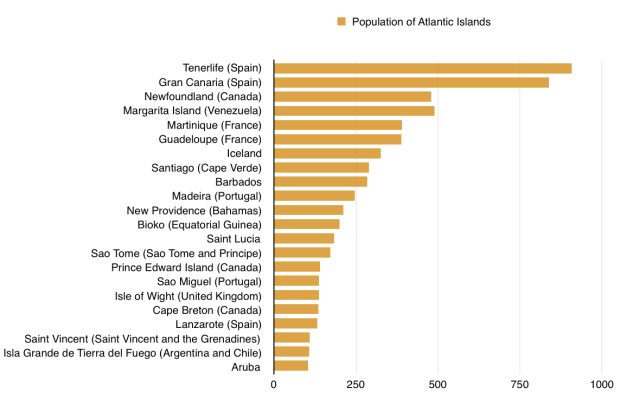
Image of the Day – Islands of the Atlantic

As a follow up to the post about Pacific islands from last month, I decided to make another chart showing islands in the Atlantic. This chart is not as extensive as the previous one, though; it only shows islands that have populations between 100,000 and 1 million. Also, it may be missing a couple of islands, or have population statistics that are already a bit outdated, so if you spot a missing island or a population mistake please post a comment about it below. And if you have a favourite Atlantic island, I would like to hear about that as well!

atlantic islands

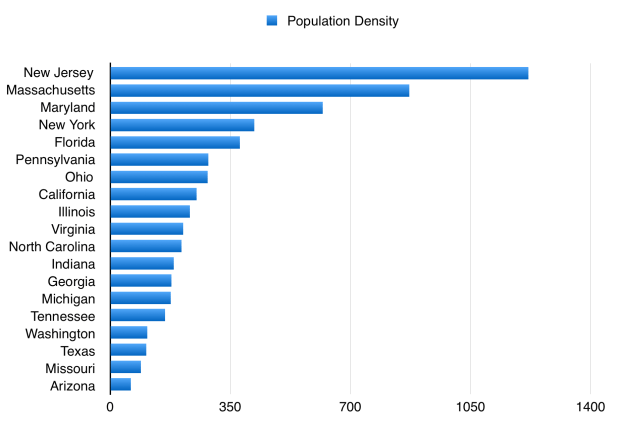
Image of the Day – US States

pop dens

The graph above shows the population densities of the 19 states in America that have at least 6 million people living in them. (Of the other 31 American states, 20 have fewer than 3 million inhabitants, 14 have fewer than 2 million inhabitants, and 6 have fewer than 1 million inhabitants). The graph below also shows the populations of these states. As you can see, New Jersey stands out for its high population density and high population size, while Texas and Arizona stand out for their low population densities and high population sizes.

pop dens 2

On the other extreme, Alaska and Wyoming stand out for their low population densities and low population sizes, while Rhode Island stands out for its high population density and low population size. Even Rhode Island, however, which is the most densely populated state in the country apart from New Jersey (not counting Puerto Rico or Washington D.C.), is about 17 percent less densely populated than is New Jersey. Massachusetts is the third most densely populated, followed by Connecticut (not shown above) and Maryland.


Exceptional New Jersey…now that’s something you don’t hear every day.

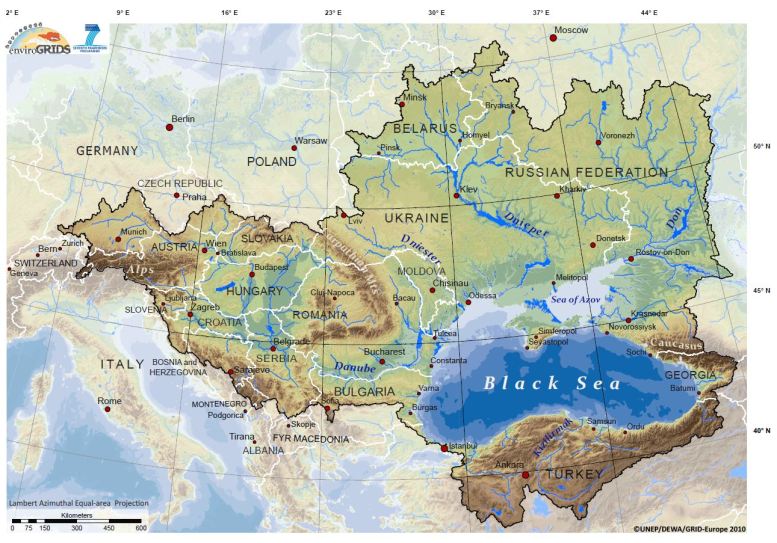
Image of the Day – Now that’s a basin!

black-sea-map

Assuming this map is accurate, the areas it highlights are those in which rivers flow into the Black Sea. A number of things about this may perhaps be geopolitically noteworthy:

– some countries, most notably Ukraine, lie almost completely within the Black Sea basin, whereas others, most notably Poland, lie just beyond the borders of the basin. Others still, like Bulgaria, are neatly bisected by it.

– a number of important cities, such as Istanbul, Lviv (the largest city in western Ukraine,  with the exception of Odessa), and the capital cities of Bulgaria (Sofia), Belarus (Minsk), and Bosnia-Herzegovina (Sarajevo), are situated precisely at the outer edge of the basin. Ankara, the capital of Turkey, is almost at the outer edge of the basin, meanwhile.

– the easternmost areas of Ukraine have rivers that flow into Russia’s Don River, and a coastline located along the Russian-controlled Sea of Azov rather than along the open Black Sea. Given that eastern Ukraine is relatively hilly (which this map does not show well) and is a leading producer of bulk goods like coal which are expensive to transport via truck, this Russian-oriented riverine and maritime access of eastern Ukraine is especially notable.

– The two most important rivers within this basin, namely the Danube and the Dnieper, empty into the Black Sea only about 200 km apart from one another, as a result of the fact that the Danube turns sharply north just before it reaches the sea, while the Dnieper turns southwest.


The Geopolitics of Cheap Energy

Oil prices have fallen again: they are now at $29 a barrel for West Texas Intermediate crude and a similar price for Brent, their lowest since 2003. Natural gas, coal, and other commodity prices have also been dropping of late, in most cases. So: what will be the geopolitical consequences of cheap energy in general and of cheap oil in particular, all other things being theoretically held equal?

One consequence of cheap energy is the weakening, possibly, of four potential great powers: Russia, Brazil, China, and Mexico. While the media has understood the Russian and Brazilian half of this list – their economies are both estimated to have shrunk by 1-3 percent druring 2015, after all, which is difficult to miss – it has largely failed to register the Chinese and Mexican half. This is because it views China as being a leading oil, energy, and natural resource importer rather than as a resource exporter like Russia or Brazil, and because it views Mexico as merely a source of drugs, migrants, resorts, and cheap goods rather than as a potential great power.

China

China may be the world’s largest energy importer, but it is has also become its second largest energy producer, and as such only relies on energy imports for an estimated 15% of its total energy consumption, in contrast to 94% in Japan, 83% in South Korea, 33% in India, 40% in Thailand, and 43% in the Philippines. In 2014 imports of oil were equal in value to just around 2.4 % of China’s GDP, according to the Wall Street Journal, compared to 3.6% in Japan, 6.9% in Korea, 5.3% in India, 5.4% in Thailand, 4% in the Philippines, and 3.3% in Indonesia.

South Korea and Japan also imported more than two and four times more liquified natural gas, respectively – the prices of which tend to track oil prices more closely than conventional natural gas prices do – than China did. China’s LNG imports barely even surpassed India’s or Taiwan’s. China’s imports of natural gas in general, meanwhile, were less than half as large as Japan’s and only around 20% percent greater than South Korea’s.

China, furthermore, tends to import energy from the most commercially uncompetitive, politically fragile, or American-hated oil-exporting states, such as Venezuela, Iran, Russia, Iraq, Angola, and other African states like Congo and South Sudan. In contrast, Japan and South Korea get their crude from places that will, perhaps, be better at weathering today’s low prices, namely from Kuwait, Qatar, the UAE, and Saudi Arabia. Similarly, China gets much of its natural gas from Turkmenistan, Uzbekistan, and Myanmar, whereas Japan imports gas from Australia and Qatar and South Korea imports gas from Qatar and Indonesia.

China’s top source for imports of high-grade anthracite coal, and its third largest source for imports of coal in general, is North Korea. China has, in addition, invested capital all over the world in areas hurt by falling energy and other commodity prices, including in South America, Africa, Central Asia, Canada, and the South Pacific.

Another mistake the media makes is looking at China as if it were a country, rather than what it really is: both a country and a continent. Continents have internal, deeply-rooted regional divisions, and China is no exception. Its main divide is between areas south of the Yangtze River, which tend to be mountainous, sub-tropical, and dependent upon importing fossil fuels, and areas north of the Yangtze, which tend to be flat, more temperate, and rich in fossil fuels.
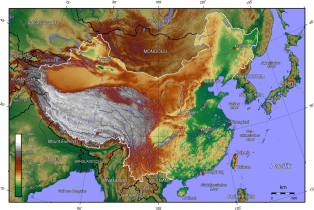
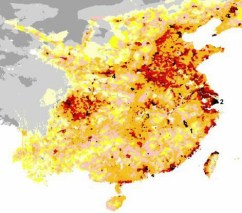
Northern China, stretching over 1000 km from Beijing southward to Shanghai on the Yangtze, is the country’s political heartland. It is densely populated and home to most of China’s natively Mandarin-speaking, ethnically-Han citizens. When compared to southern China, the north has historically been somewhat insulated from foreigners like the Europeans, Americans, and even Japanese. Beijing’s nearest port is roughly 5000 km away from Singapore and the Strait of Malacca; Hong Kong, in contrast, is only around 2500 km from Singapore and Malacca. Beijing is rougly 2600 km from Tokyo by ship, whereas Shanghai is just 1900 km from Tokyo and Taipei is just 2100 km from Tokyo.

Japan’s Ryukyu island chain and the Kuroshio ocean currents historically allowed for easy transport from Japan to Taiwan and the rest of China’s southeastern coast; the Japanese controlled Taiwan for more than three and a half decades before they first ventured into other areas of China in a serious way during the 1930s. Even today, Japan accounts for a larger share of Taiwan’s imports of goods than do either China or the United States.

Southern China has often depended on foreign trade, since much of its population lives in areas that are sandwiched narrowly between Pacific harbours on one side and coastal subtropical mountain ranges on the other. In northern and central China, in contrast, most people live in interior areas rather than directly the along the Pacific coast. These people in the interior generally did not engage in as much foreign trade, as in the past moving goods between the interior and coast was often limited by the fact that northern China’s chief river, the Huang-he, was generally unnavigable and prone to flooding northern China’s flat river plains, destroying or damaging roads and bridges in the process.

In southern and central China, by comparison, even people living far inland could engage with the coast by way of the commercially navigable Yangtze and Pearl Rivers, which meet the Pacific at the points where Shanghai and Hong Kong are located.

Northern China, however, was most directly exposed to the land-based Mongol and Manchu invaders who ruled over the Chinese for most of the past half-millenium or so prior to the overthrow of the Manchu Qing Emperor in 1912. Today the north continues to retain the political capital, Beijing, and a disproportionally large majority of Chinese leaders were born in north China — including Beijing-born Xi Jinping and Shandong-born Wang Qishan (a former mayor of Beijing) — in spite of the fact that most Chinese political revolutionaries, including Mao Zedong, Deng Xiaoping, Chang Kai-Shek, Sun Yat Sen, Zhu De, Ye Jianying, Hong Xiuquan, and famed writer Lu Xun, hailed from southern or south-central China.

Today, out of China’s seven Standing Comittee top leaders, only seventh-ranked Zhang Gaoli was born in southern China, whereas five of the seven were born in northern China and one, Premier Li Keqiang, was born in central China. Zhang Gaoli may in fact be the first person born outside of northern or central China in thirty years to have made it to the Standing Committee. He is also the only person currently in the 25-member Politburo born outside of northern or central China. Among the 11-man Central Military Commission, meanwhile, seven were born in northern China, while two were born in north-central China and two in south-central China. Out of the 205 active members of the Party Central Committee, fewer than 15 were born south of central China.

Indeed, the southern half of China, stetching from islands in Taiwan, Hainan, Hong Kong,  Xiamen, and Macau in the east to the plateaus of Yunnan, Sichuan, and Tibet in the west, is politically peripheral. It is home to a majority of China’s 120 million or so non-Han citizens (most of whom are not Tibetan or Uyghur, though those two groups recieve almost all of the West’s attention), China’s 200-400 million speakers of languages other than Mandarin, China’s tens of millions of speakers of dialects of Mandarin that are relatively dissimilar to the Beijing-based standardized version of Mandarin, most of China’s 50-100 million recent adopters of Christianity, and most of China’s millions of family members of the enormous worldwide Chinese diaspora.

Southern China is physically closer to Southeast Asia (a region with a huge Chinese minority population) and most of the populous areas of Japan, and further away from sparsely populated Mongolia or Siberia, than northern China is. The south’s Fujian province, in particular, is linguistically and economically close to Taiwan, while the south’s Guangdong province is close to Hong Kong. A large share of China’s GDP comes from the coastal areas of China from around Shanghai south to Guangdong, particularly if you include Taiwan as part of the country. Guangdong alone accounts for an estimated 10% of mainland China’s GDP and over 25% of its exports. This creates a somewhat unbalanced dynamic: China’s political periphery is also its economic centre.

As it happens, northern China produces almost all of China’s fossil fuels (particulary in and around Shanxi province, 300 km or so inland from Beijing, where a large share of China’s coal is mined and which has seen the biggest political shakeup of any province from Xi Jinping’s anti-corruption campaign thus far), whereas southern and central China, especially if you include the neighbouring economy of Taiwan as being part of China, account for most of China’s imports of energy. Taiwan, in fact, may be more dependent on oil imports than any other significant economy in the world. Falling energy prices may weaken the Chinese political heartland relative to its periphery, in that case. Whether or not this will generate any political instability going forward remains to be seen.

If (a big if) energy prices remain low for a sustained period, then the question of China’s future dependence on imported energy also becomes relevant, as does the question of the future dependence on imported energy of China’s most important neighbours. In that case, how dependent on energy imports will countries like China, Japan, and India be in a decade or two from now?

While it is impossible to know what the future will be like, it is not difficult to imagine that China will remain less dependent on energy imports than India and/or Japan during the years or decades ahead, as a result of India’s still-emerging economy and Japan’s still-roboticizing economy.

China is not likely to be a major adopter of energy-intensive robots, in per capita terms, because China has a far larger cheap labour force than any country in the world apart from India. Japan, in contrast, will likely help lead the robot revolution, as its labour force is expensive and aging rapidly. This could make Japan even more dependent on importing energy, as machines that are both highly mobile and capable of sophisticated computation require an enormous amount of energy to run — and indeed, one of their main advantages over human labour is that they can and frequently will be tasked to run 24-7,  without even taking any time off for holidays or sick days.

China is not certain to increase its energy imports nearly as much as less-developed economies like India, meanwhile, as the Chinese inudstrial sector is facing challenges as a result of its past generation of energy-intensive growth. China faces rising labour costs in its cities, a pollution problem, crowded transportation infrastructure, a US that is concerned with Chinese industrial power, and countries throughout the world afraid of China’s world-leading carbon emissions. In addition, China is located much further away from the Persian Gulf and Caspian Sea oil and gas fields than the Indians and other South Asians are, and so might have difficulty accessing them in a pinch.

China may also have to face industrial competition from resource-rich or capital-rich economies such as Australia, Norway, Canada, Qatar, Texas, and maybe even Hong Kong, which will perhaps be able to use energy-intensive robots of various kinds to build up their manufacturing sectors in spite of their small labour forces. This could make China’s industrial growth rate slip, which in turn might reduce China’s resource imports and thus prevent China from becoming the leading beneficiary of low energy and commodity prices.

Such a shift will be especially likely if the United States or European economies decide to enact tariffs on goods coming from places that generate power by using coal in inefficient ways, a prospect that has become increasingly likely as a result of America’s triple-alliance between environmentalists opposed to coal consumption, shale gas producers competing with coal, and energy companies trying to pioneer more expensive but cleaner ways of consuming coal. China may then have to focus on growing its service sectors instead of its energy-intensive industrial sectors.

Japan, lastly, might benefit from Russia’s energy-related woes more than China will. This is not only because the Chinese have to a certain extent often looked to Russia as an ally against the West, but also because the areas of Russia that China is close to are mostly irrelevant to China: they are landlocked, Siberian, and for the most part located far from China’s population centres. Pacific Russia, in contrast, located next to the Sea of Japan on the East Asian side of Russia’s Pacific mountain ranges, has a far more liveable climate than the continental Siberian interior, is home to a number of useful medium-sized port cities, and accounts for much of the oil and nearly all of the Russian natural gas exports to Asia — led by energy-rich Sakhalin Island, which is just 40 km away from Japan and was partly owned and inhabited by the Japanese prior to the Second World War.

Russia may, in fact, be somewhat better prepared to fight another border war with China like it did in 1969, which might not be too different than the many other wars Russia has fought around its own borders both prior to and since then, than it would be to face off against Japan again within its far-eastern, mountainous, archipelagic and peninsular Pacific region, as it did in 1905 and then during World War Two. Of course this does not mean Japan will attack Russia — though it has certainly toyed with the idea of making more forceful moves in the Southern Kuril Islands, which both countries claim as their own. Even the unspoken possibility of conflict, however, may help grant the Japanese leverage over Russia in negotiations relating to commercial or political issues.

Mexico 

Mexico is much more than just America’s messy basement. It has the world’s 11th largest population,14th largest GDP, and, because it is in the New World, its population is in many ways much more internally unified than those of most other large countries are. It also has important ties to the rest of the Spanish-speaking world, to the Latin-based world in general, and to the 35 million or so Mexicans in the United States in particular, most of whom live in states adjacent to the Mexican border. Mexico is the clear potential leader in the Spanish-speaking world: its population is bigger than those of Colombia, Argentina, and Venezuela combined, and its economy is about to surpass Spain’s. If you include illegal transactions, Mexico already has the largest economy in the Spanish world by far. Along with (or perhaps instead of) Portuguese-speaking Brazil, Mexico could potentially help Latin America to become one of the most prominent regions in the world during the decades ahead.

Mexico may not be a major beneficiary of low energy prices, for three general reasons. First, it is a net oil-exporting economy: oil exports accounted for an estimated 2.7% of Mexico’s GDP in 2014, and Mexico had been hoping to increase its oil and gas production since its president enacted widely-touted reforms in the country’s energy sector that year. Mexico is also often a relatively high-cost oil producer, and so may be forced to cede market share to more price-competitive producers in other countries.

Second, Mexico has ties – both existing ties and potential future ties – to other countries in Latin America, a region that is highly economically dependent on exports of energy and other natural resources. Most of the South American economy is already in or flirting closely with recession as a result of the commodity crash, which on the whole is probably not a good thing for Mexico.

Third, Mexico has ties to the southwestern United States, in the areas of America that were part of Mexico prior to the 1830s-1850s, most notably California and Texas where around 25 million Hispanic-Americans live today. Like Mexico itself, this part of the US is dependent on energy exports, led by Texas (a major producer of oil, gas, coal, wind power, solar power, and refined petroleum products: Texas produces approximately one-fifth of US energy and one-third of US crude oil) but also including the surrounding energy-producing states of Oklahoma, Colorado, New Mexico, Utah, Louisiana, Arkansas and the federally-administered oil-and-gas producing waters in the Gulf of Mexico.

Nearly all of the states with a high share of Mexican-Americans are either energy-exporting states or else, in the case of California, New York, Florida, and Arizona, have the lowest per capita energy consumption of any states apart from tiny  Rhode Island, Hawaii, and Connecticut.

Even California’s energy imports do not balance out Texas’s energy exports, because California is itself the US’s third largest oil-producing state, tenth largest energy-producing state, and has the fourth lowest per capita energy consumption; its energy imports are not as large as one might expect given the enormous size of the Californian economy. They might even shrink in the future, if the Monterrey basin shale resources are developed. California is also the largest agricultural producer in the United States (Texas is fourth), a big sector that can be hit by falling commodity prices as well.

Mexico has admittedly been benefiting from cheap gas prices brought on by Texas’s shale boom.  Mexican imports of US gas have nearly tripled since 2009, which has benefited the industrial sector in northern and north-central Mexico. This gas import growth might slow going forward, however, as America’s LNG export facilities may soon be coming online, LNG import facilities in both Europe and China are expected to be opened soon, and the Panama Canal expansion which will be finised this year may allow LNG ships to traverse the canal from Texas to Asia for the first time. As LNG allows US gas to be sold worldwide, Mexico’s import growth of US gas might slow down. In any event, Mexico is the 19th largest natural gas producer in the world, so even with increasing imports from the US it will not soon become a significant net importer of natural gas.

In the future, meanwhile, somewhat similar to China, Mexico’s industrial growth may not be as strong as most people expect, which could cause it to become less dependent on energy and other commodity imports relative to other countries. Mexico is currently a major industrial economy, the result of its large and cheap labour force and proximity to US consumers. As labour and other prices in northern and to a lesser extent central Mexico are becoming more expensive due to economic growth in these areas, however, Mexico’s industrial growth rate may slow. This is because central and especially southern Mexico are separated from the US by vast areas of mountainous deserts or jungles, making the north-south roads and pipelines through Mexico expensive to build, use, and maintain, as well as potentially vulnerable to groups like the drug cartels, indigenous peoples, or local governments. Southern Mexico resembles Central America more than it resembles northern Mexico.

Mexico may increasingly also have to face industrial competition from Cuba, which is the only other sizeable Hispanic country close to the United States; from Venezuela, if it too can finally mend fences with America and leverage its energy resources to industrialize; or from Canada and the US, if they try to use robots and other technologies to re-industrialize. If, finally, domestic politics lead the US to try to make the Mexican border more of a barrier, Mexico might have to industrialize less and stick more to the many other sectors of the diverse Mexican economy, which are less resource-intensive.

Europe 

There is a fourfold division in Europe, where energy and commodity imports are concerned. First is between mainland Europe, which is a major importer of energy and oil, and the regions surrounding mainland Europe (namely Scandinavia, the North Sea, the former Soviet Union, the Middle East, North Africa, western Africa, and the Americas), which are energy and commodity producers. Even the United States has now become such a big energy producer that its energy imports account for only around 15% of its overall energy consumption, a very low share in comparison to an estimated 62% in Germany, 71% in Spain, 77% in Italy, 46% in France, and 43% in Britain.

Second is between countries which use the Euro as their currency – Germany, Spain, France, Italy, Greece, Slovakia, etc. – which tend to be significant importers of oil or other commodites, and countries that do not use the Euro – Norway, Sweden, Switzerland, Britain, Denmark, Poland, Romania, Czech Republic, Ukraine, Belarus, Russia, etc. – which tend to produce a decent amount of oil, energy, or other commodities — or else, like Switzerland, have economies that are not energy-intensive and so may not benefit as much from cheap energy. (Switzerland, the 20th largest economy in the world, also relies on imports for just 52% of its energy, according to the World Bank, which is a lower share than in all but four of the 19 countries within the Eurozone). Admitedly there are a few exceptions to this rule: most notably Turkey, which imports a lot of energy but does not use the Euro, and Estonia and to a lesser extent the Netherlands, which produce a decent amount of energy domestically yet do use the Euro. Still, even the Netherlands is a major net importer of crude oil.

The third division is between countries that are in the European Union and European countries that are not in the European Union. This division is similar to the Eurozone one, except that states like Britain, Denmark, Poland, Romania, and Sweden — all of which are mid-sized energy or commodity producers – are in the European Union but do not use the Euro, which leave the continent’s major commodity and enegy producers of Norway, Russia, and Ukraine as more prominent outsiders. Turkey, meanwhile, is, unlike Russia, Switzerland, Norway, or Ukraine, a member of the quite important European Customs Union, though like them it is not part of the EU.

Finally, and in some ways most pertinently, there is a division between northern Europe and southern Europe. The further north you go, the less dependent the Europeans are on energy imports. Scandinavia and Russia are the furthest north: they are major energy and commodity producers. (Even the three Baltic states, which are generally assumed to be among the smaller countries in Europe, actually own far more land per capita – and especially forested land, which is crucial for feeding Europe’s sizeable wood-fuel industry – than any European countries to the south of them do).

These are followed by countries like Britain, the Netherlands, Romania, Ireland, the German economies, Poland, the Czech Republic, Slovakia, Hungary, Belgium, and northern France, which have economies that are also not too dependent on energy imports. (Like Switzerland, both Ireland and northern France have economies that are not at all energy-intensive, when compared to others).

In southern Europe, finally, there are the economies of Spain, Portugal, Greece, Italy, France-sans-Paris, Turkey, Cyprus, and Malta, which are highly dependent on imports of oil, natural gas, and energy in general. (While nearby Algeria remains a large energy-exporting state and Libya has energy-export potential, Morocco, Israel, Lebanon, and Jordan are highly dependent on energy imports and Egypt and Tunisia are both more or less energy neutral). Perhaps not incidentally, most of southern Europe has experienced an economic depression during the past eight years.

The biggest exception within southern Europe, meanwhile, is Italy, which produces more oil than France, Greece, Turkey, and Spain combined, slightly more oil than even Germany produces. This may in fact partly help to explain why Italy has been suffering a great deal of late, whereas the Spanish, Portuguese, and possibly even Greek economies might finally be on the mend. Even Italy is the world’s third largest gas importer, however, so as with Spain, Portugal, Turkey, and Greece, the Italians depend on imports from abroad to supply more than 70% of the energy they consume.

Turkey

Turkey is in the most interesting position of all when it comes to energy and geopolitics. It, along with its nearest European neighbour Greece, is a significant net energy importer; Turkey has a relatively energy-intensive economy and energy imports account for three-quarters of its energy consumption, while in Greece energy imports account for 60% of energy consumption. Oil imports in Turkey and Greece were estimated to be equal in value to 3.2% and 4.5% percent of GDP in 2014, respectively, both figures quite a bit higher than in most other countries within Europe.

Surrounding Turkey and Greece, however, is a ring of leading energy-producing regions: the Middle East, Russia, Ukraine, the Caspian Sea-Central Asia region, and North Africa. Even Turkey’s closest Western neighbours of note, namely Italy, Romania, and Austria, are not necessarily going to benefit much from cheap oil or cheap energy. Italy produces nearly three times as much oil as Turkey does, Romania produces nearly twice as much oil as Turkey and depends on energy imports for just 22% of its energy consumption, and Austria has the lowest oil-imports-as-a-percent-of-GDP of any country in the Eurozone. Even Israel, Cyprus, and Egypt have made major new energy discoveries of late, of natural gas within the Eastern Mediterranean.

In past years, Turkey has already seen many of its neighbours fall to shambles to one extent or another — first the Soviet Union, Yugoslavia, Lebanon, Algeria, and the Caucuses in the 1990s, now Iraq, Syria, Ukraine, Greece, Georgia, and Libya, among others. Further troubles in the regions surrounding Turkey, then, perhaps brought on by the falling price of energy, could create a serious power vaccum for the Turks to consider filling.

Turkey’s close-to-home rivals the Kurds, meanwhile, are also potential losers in a cheap energy environment. They produce a lot of oil in Iraqi Kurdistan, abut a number of hydropower facilities located within Turkey’s mountainous Kurdish regions where the headwaters of the Tigris and Euphrates rivers form, and possess ties in some cases to energy-rich Iran (as a result of the Kurdish population in Iran as well as the fact that Persians tend to be ethno-linguistically closer to most Kurdish groups than most Kurds are to either Turks or Arabs) or to energy-rich Iraq (as a result of the sizeable Kurdish population that lives in Iraq).

India 

India, like China, is both a major energy producer, the seventh largest in the world, and a major energy consumer, the third largest in the world. In India, however, oil imports were equal to 5.3% of GDP in 2014, compared to just 2.4% in China, while energy imports accounted for 33% of Indian energy consumption, compared to just 15% for China. And whereas in China the areas that benefit the most from cheap energy are located outside of the Chinese political heartland, in India the country’s political core territories — which are centred around India’s largest state by far, namely Uttar Pradesh (population 200 million), as well as parts of its neighbouring states like Bihar (India’s third largest state), Madhya Pradesh (5th largest), Rajasthan (7th largest), and Delhi (India’s capital city, population 17 million) — may benefit among the most in India from falling oil and energy prices.

Some of the other areas within India, on the other hand, such as parts of both Western India (which produces 75% of the oil from onshore fields in India, and which has close economic ties to the nearby energy-rich Persian Gulf) and Eastern India (which is where most of India’s coal and other commodities are produced or exported), might not benefit in the same way*.

[*when I say “benefit”, I mean it in the geopolitical sense of the term, not in the ethical sense. From an ethical point view, for example, the fall in energy and commodity prices is arguably great news for many of the people in Eastern India who were being exploited because of their coal and mineral wealth. Obviously, things like this are usually far more complicated in reality than can be captured in any single essay].

India’s geopolitical dream is of a prosperous, peaceful Indian Ocean basin in which it, by virtue of its size, diversity, and central location, would be far and away the most prominent and powerful country. In order to accomplish this India must have better relations with Pakistan, a country that has been backed by the United States as well as by fellow Muslim states like Saudi Arabia. With the Saudis and other Sunni Muslim countries hurt by cheap oil and energy prices, and with India’s traditional allies against Pakistan, namely the Russians and Iranians, hurt by cheap energy too, both India and Pakistan might perhaps be forced to rely more heavily on the Americans. If, then, the Americans decide to prioritize India-Pakistan peace-making as a way to maintain stability in South Asia and help to contain forces like China, Russia, and pan-Islamism, there may be some cause to be hopeful. Don’t be too sure though: there are plenty of reasons why India, Pakistan, and the United States might each find it difficult to pursue Indian-Pakistani or Hindu-Muslim reconciliation.

Within the wider Indian Ocean region, stretching 6000 km from Madagascar to Indonesia and 6000 km from Sri Lanka to Kerguelen, there is also some scope for careful optimism. In East Africa, from around Ethiopia south through the Great Lakes, most economies are not dependent on energy exports in the way that western African countries like Angola, Nigeria, Algeria, Congo, Gabon, and Equatorial Guinea are. Even South Africa, the world’s sixth largest coal exporter, is not nearly as dependent on energy exports as Nigeria, Angola, or Algeria are, and is a net importer of crude oil. Oman and Yemen, similarly, the two Arab countries with coastlines directly along the Indian Ocean, are not nearly as dependent on energy exports as other Arab countries like Saudi Arabia, the UAE, Qatar, and Kuwait are. They, especially Yemen, may also be leading importers of food.

In the eastern Indian Ocean, the Indonesian islands of Sumatra and especially Java (combined population: 195 million) tend to be energy-importing areas, in contrast to Indonesia’s Pacific islands like Kalimantan and, 3500 km to the east of the Indian Ocean, West Papua, which account for most of Indonesia’s energy production as Sumatra’s aging oil fields are declining. In Indonesia’s neighbour Malaysia, similarly, most oil production comes from around the Pacific island of Borneo, an island Malaysia shares with Indonesia and Brunei, rather than from the Malay Peninsula on the edge of the Indian Ocean where most of Malaysia’s population lives. Singapore, moreover, which is located roughly in between western Malaysia and western Indonesia, is the world’s 13th or 14th largest oil importer (it is roughly tied with Thailand, which is also located along the outer edge of the Indian Ocean); in spite of its small size Singapore now imports nearly twice as much crude oil as Indonesia and Malaysia combined export to the world.